Catholic Charities in the Diocese of Youngstown looks toward its next chapter
The Diocese of Youngstown was still new enough to feel unfinished in 1943.
Across Northeast Ohio, the steel mills thundered day and night for the war effort. Factory whistles cut through the darkness before sunrise. Freight trains rumbled past rows of modest homes clustered around Catholic parishes that anchored the immigrant neighborhoods of Youngstown, Warren, Canton and the surrounding communities. Ethnic identity, family life and faith were deeply intertwined in those neighborhoods, where churches stood at the center of daily life and families worried constantly about sons overseas, rationing at home and the uncertainty of a world at war.
The diocese itself had only recently been established, and into that uncertainty stepped a 22-year-old social worker named Martha Whelan Murphy.
Educated in sociology at Seton Hill University and trained in social work through graduate study at The Ohio State University, Murphy was asked to establish a Catholic Charities office in Portage County for the new Diocese of Youngstown. There was no blueprint waiting for her, no expansive staff and no elaborate nonprofit structure—just need.
The work itself was often simple and deeply human: helping struggling families, assisting newcomers, responding to poverty and trying to ensure vulnerable people did not disappear into isolation.
Much of the ministry operated through relationships long before the language of “case management” or “social systems” became common in nonprofit work. Priests, religious sisters and lay Catholics responded directly to what they encountered in neighborhoods, parish halls and family homes.
“We see from the very beginning of the diocese people organized to care for others—for children and the aged especially and for newcomers to the United States, people displaced by poverty or war,” said Joan Lawson, chancellor and archivist of the Diocese of Youngstown.
“There were Catholic Service Leagues, Catholic Community Leagues and Catholic Social Service Bureaus—agencies in Ashtabula, Canton, Massillon, Ravenna, Salem, Warren and Youngstown … dedicated to charity and social well-being,” Lawson said. “It’s such a hallmark of our people to live the works of mercy.”
There were few formal processes in those early years. Much of the work depended on improvisation, trust and the simple conviction that the Church had a responsibility to remain close to suffering.
The mission did not begin with an organizational chart—it began with presence.
That spirit would guide Catholic Charities through decades of change across the Diocese of Youngstown—from wartime relief and postwar growth to economic decline, demographic shifts and the increasingly complex realities of modern poverty. Over time, the structures surrounding Catholic Charities would evolve dramatically. Agencies merged. Administrative systems expanded. Professional standards became more rigorous.
Ministries adapted to new social realities.
But the core mission remained remarkably consistent: to encounter Christ in those who suffer and respond with compassion, dignity and practical care.
Today, as Catholic Charities Diocese of Youngstown and its agencies prepare to complete a long-planned unification process, expected to be finalized in January 2027, diocesan leaders say the changes are not about abandoning that mission, but strengthening it for the future.
“This is not about closing agencies or responding to a crisis,” said Rachel Hrbolich, director of Catholic Charities Diocese of Youngstown. “This is really the next logical step for us.”
In many ways, the history of Catholic Charities in the Diocese of Youngstown is a story about continuity through change—about how a ministry rooted in the works of mercy adapted to new forms of hardship while trying to preserve something deeply human at its center.
Before There Were Systems
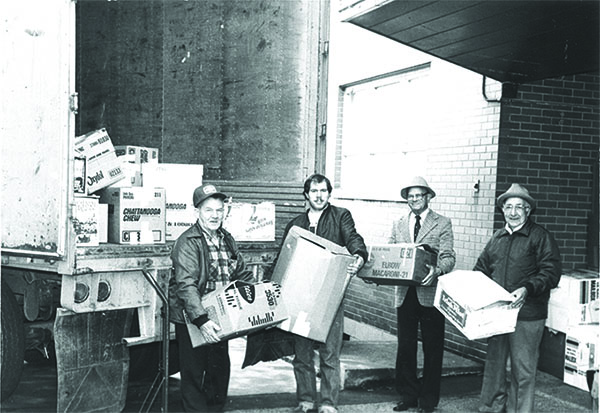
Long before Catholic Charities became a unified diocesan structure, Catholic social ministry throughout Northeast Ohio existed in local and often informal forms.
The roots of that ministry stretched deep into the immigrant and industrial history of the region itself. Throughout the late 19th and early 20th centuries, Catholic parishes became centers not only of worship but of survival and belonging for immigrant families arriving from Ireland, Italy, Poland, Germany, Slovakia and Eastern Europe. Churches anchored neighborhoods built around mills, railroads and manufacturing plants. Religious sisters staffed schools and hospitals. Parish communities organized meals, mutual aid and outreach long before modern nonprofit systems existed.
The expectation was simple: the Church would remain close to suffering rather than distant from it. Murphy belonged to that tradition.
Beginning her professional work with the Catholic Service League in Youngstown in 1942, Murphy helped establish one of the earliest Catholic Charities offices in the diocese while still in her early 20s. During World War II, she built the Portage County office largely from scratch, helping coordinate services for struggling families and vulnerable residents during a period of enormous uncertainty.
Her career would later expand far beyond Catholic Charities itself. After returning to Youngstown and raising five children with her husband, Robert Murphy, she returned to diocesan social ministry in 1969 at the request of Bishop James Malone, focusing much of her work on aging services.
That work eventually led her into regional and statewide leadership in elderly programming, including helping establish Area Agency on Aging District 11. Colleagues reportedly nicknamed her “Margaret Thatcher” for her decisiveness and leadership style during the 1980s.
But even as Catholic social services became more professionalized over the decades, the underlying mission remained familiar. The work was still rooted in accompaniment and presence.
Building Structure
By the 1980s and 1990s, Catholic Charities faced a different challenge: how to preserve that mission while developing stronger systems capable of supporting increasingly complex ministries.
The diocese began moving toward clearer governance structures and stronger coordination among agencies. Reorganizations in 1989 and again in 1999 helped formalize relationships between Catholic Charities agencies and diocesan leadership while strengthening accountability, administrative consistency and Catholic identity.
That evolution reflected broader changes happening throughout Catholic Charities nationally. Founded in 1910, Catholic Charities USA developed into a nationwide network supporting diocesan agencies through professional training, advocacy and organizational development.
According to Brian Corbin, executive vice president of member services of Catholic Charities USA, who previously served for more than 27 years at Catholic Charities in the Diocese of Youngstown, “CCUSA’s purpose since its inception is to support local diocesan Catholic Charities agencies, professionalize social work through evidence-based practices and be an advocate for the poor.”
Youngstown played a significant role within that national network over the years, with diocesan leaders serving on national boards, committees and planning groups. “Youngstown Catholic Charities, though average in size compared to other diocesan entities, has and continues to play a tremendous leadership role,” Corbin said.
At the local level, collaboration between agencies slowly expanded. When Hrbolich first joined Catholic Charities more than 30 years ago, there were seven separate agencies operating throughout the diocese, along with a housing corporation. Over time, agencies began merging and sharing administrative resources.
Stark East and Stark West merged in 1995, and around the same time, Trumbull and Mahoning counties consolidated into a single agency. In 2010, the Portage and Stark agencies merged. Each step reflected a growing recognition that collaboration strengthened sustainability. “There’s been a movement all along toward working together, sharing resources and solving administrative issues as a system versus each agency trying to do everything on their own,” Hrbolich said.
But the path toward greater unity was not always smooth.
“Back when I first started with Catholic Charities, the agencies were not collaborative at all,” Hrbolich said. “There was a lot of mistrust with regard to the diocese.”
Over time, however, relationships evolved. “We’ve come a long way from that sense of isolationism and mistrust to where we are now,” she said.
The Needs Changed
If the early decades of Catholic Charities were defined by building structures capable of lasting, the decades that followed were defined by adaptation.
The communities Catholic Charities served were changing rapidly. Northeast Ohio experienced economic decline, industrial contraction and demographic shifts that reshaped entire neighborhoods. Manufacturing jobs that once sustained generations of families disappeared. Housing instability became more common. Mental health needs became more visible. Substance use crises deepened. An aging population required new forms of care and outreach.
In many ways, the work facing Catholic Charities today reflects a broader shift in American poverty itself—one that is often less visible, more emotionally isolating and far more common among working families than many people realize.
“The reality of poverty has not changed much here in our diocese,” Hrbolich said. “We’re still continuing to see families and individuals who need us come to us for help.”
What has changed, she said, is the complexity surrounding those struggles.
“There was a time when people could come to Catholic Charities, and maybe they had an overdue utility bill or needed help with rent because they had faced a temporary setback during a particular month,” Hrbolich said. “But now, it seems like people just have so many problems.”
A request for help with an electric bill may uncover food insecurity. Rent assistance may reveal unemployment, untreated medical concerns or transportation problems. What appears initially to be one crisis often exposes several others underneath it.
Increasingly, Catholic Charities workers say the people seeking assistance are employed, raising children and trying desperately to remain financially stable in an economy where a single setback can destabilize an entire household.
“Most of the people who come to Catholic Charities are people who are working,” Hrbolich said. “I think people have an idea in their minds of what people living in poverty look like, and it’s probably not that.”
That reality has reshaped the ministry itself.
Over the decades, Catholic Charities evolved from primarily emergency assistance into a broader system of case management, referrals and relationship-based support. Staff members increasingly spend more time listening to clients, identifying underlying problems and helping families navigate multiple forms of hardship at once.
“A lot of it is about relationship building,” Hrbolich said. “It’s more than just handing them a voucher for food or paying the utility bill. It’s really developing a relationship with them, so they know Catholic Charities is there for them.”
The shift altered the pace of ministry itself. “We may not be serving the same volume we once did,” Hrbolich said, “but we’re spending more time with people because the issues are more complex.”
In that sense, Catholic Charities evolved from emergency response alone into something broader and more relational—a ministry of accompaniment in a time when many people feel economically and socially fragile.
And yet, despite the growing complexity of the work, Hrbolich emphasized that most people who seek help are not looking for permanent support. “We found that most of the people we serve need us once,” she said. “They need a hand up, and then they’re able to move forward.”
That distinction remains central to Catholic Charities’ understanding of human dignity. The goal is not dependency—it is stability, trust and the belief that difficult moments do not define an entire life.
Toward One Catholic Charities
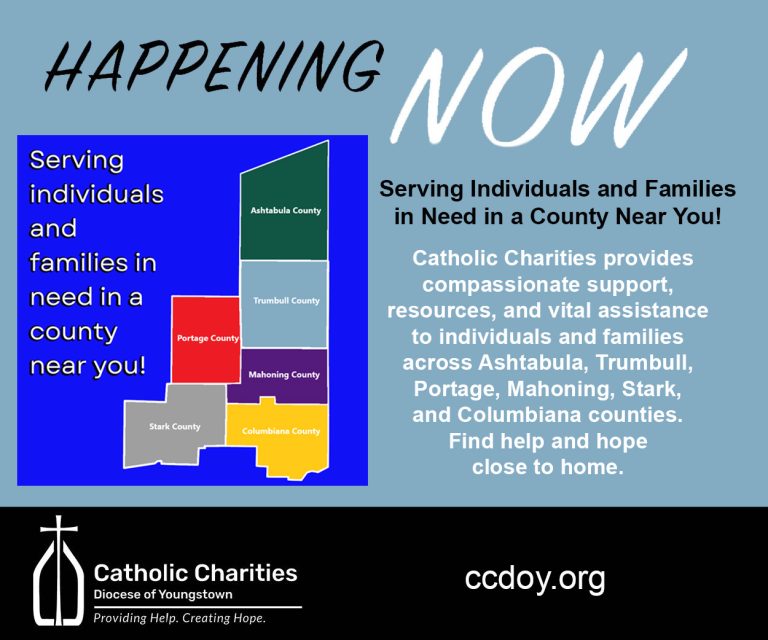
The upcoming unification process did not emerge suddenly. In many ways, leaders say, it represents the continuation of a decades-long movement toward greater collaboration and shared identity across Catholic Charities ministries throughout the six-county diocese.
Under the current plan, Catholic Charities agencies will formally unify into one corporate structure by January 2027. Leaders emphasize the move is not about eliminating services or downsizing ministries but strengthening long-term sustainability and administrative efficiency.
“What we’re really working on now is the operations side,” Hrbolich said. “We’re not eliminating service sites. We’re not eliminating programs.”
Instead, the unification is intended to strengthen shared systems, such as development, personnel management and administrative support—areas where many agencies currently operate with extremely lean staffing. By sharing administrative responsibilities across a unified structure, leaders hope to free staff members to focus more directly on ministry and service while also preparing for future financial realities.
“We are very grateful for the funds we receive through the Diocesan Appeal,” Hrbolich said. “But we also know we need to be thinking about further diversifying funding and preparing for the future.”
She described the unification process as thoughtful and deliberate rather than reactive. “We’ve been moving in this direction for a long time, whether we consciously realized it or not,” she said.
Hrbolich also credited Bishop Bonnar for supporting the process without forcing it. “He allowed us to explore the unification organically and thoughtfully,” she said.
For Bishop Bonnar, the importance of Catholic Charities extends far beyond organizational structure. “Catholic Charities is integral to the identity and mission of this local Church,” Bishop Bonnar said. “Throughout the six counties, Catholic Charities provides an intentional presence of Jesus to the poor, the homeless, the hungry, the incarcerated, the sick and all those in need.”

He described the ministry as “the heart of Jesus to the world—a heart burning with compassion, accompaniment and love.”
“This beating heart engenders hope and instills faith,” Bishop Bonnar said. “I could not imagine us continuing the mission of Jesus and being the Church without Catholic Charities.”
For diocesan leaders, the upcoming unification ultimately represents something larger than administration alone. “We are always stronger when we are together,” Bishop Bonnar said. “And when we become intentional about unity, we help realize the great priestly prayer of Jesus: ‘That all may be one.’”
Looking Toward the Next 40 Years
The Diocese of Youngstown today looks very different from the diocese Martha Whelan Murphy encountered in 1943. The steel mills no longer dominate the skyline the way they once did. Many neighborhoods changed, populations shifted and economic realities became more uncertain and, in many cases, more fragile.
But the essential challenge facing Catholic Charities remains remarkably familiar: how to remain close to suffering in a changing world. From parish outreach and wartime relief efforts to modern case management and diocesan-wide unification, Catholic Charities in the Diocese of Youngstown has remained rooted in the same conviction that first animated its earliest ministries decades ago: the works of mercy are not abstract ideals—they are lived realities.
And for more than 80 years, across every corner of the diocese, Catholics in Northeast Ohio have continued trying to live those realities.