
Praying the Liturgy of the Hours
Jesus prayed. There is no doubt about this. Raised in a devout Jewish family, with His parents, Mary and Joseph, Jesus participated in synagogue and Temple liturgies. He knew and prayed with the Hebrew Scriptures. He took part in the faith community’s traditional domestic rituals and feasts, like the annual Passover meal. He engaged in the spiritual practices associated with faithfully living the covenant relationship with God and neighbor. Within His familial setting, Jesus experienced a life of personal, communal, devotional and liturgical prayer. During His time, prayer was not simply one of life’s many activities—something to be done on occasion or words to be spoken to God every now and then—rather, prayer shaped relationships and grounded a whole way of living and being. While Mary and Joseph may have been somewhat confounded when they discovered Jesus in the Temple, at 12 years old, engrossed in conversation with the Temple elders, His response to their anxious concerns flowed from a life already rooted in prayerful relationship: “Did you not know that I must be in my Father’s house? … And Jesus increased in wisdom and in years, and in divine and human favor” (Luke 2:49, 52).
What began in Nazareth continued to manifest itself throughout Jesus’ public life, ministry and mission: He sought Baptism by John in the Jordan; He prayed and fasted in the desert; He went to the synagogue on the Sabbath; He prayed with the faith community and reflected on God’s Word; He knew the Scriptures inside and out; and He prayed to discern His Father’s will before making important decisions, like choosing His apostles or advancing the next step of His mission.
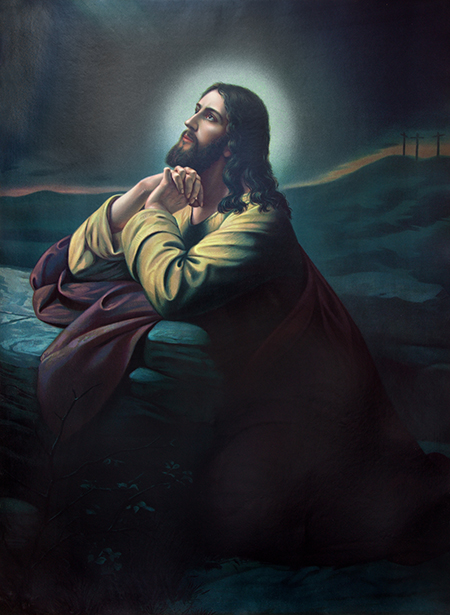
Prayer accompanied many of His recorded miracles and healings, and though he prayed in the Temple, He often went off by Himself to pray. He taught His followers how to pray and gathered His disciples for prayer at the Last Supper. He prayed intensely in the garden on the night before He died. He prayed on the Cross. He promised to send His disciples the Holy Spirit who “will teach you everything” (John 14:26), which, according to Saint Paul, would include “how to pray as we ought” (Rom. 8:26). By His example, His saving mission and the outpouring of the Holy Spirit, Jesus made it possible for His first disciples—and us—“to pray always and not to lose heart” (Luke 18:1).
The story of the early Church described in The Acts of the Apostles frequently testifies to the importance of communal and personal prayer in the life of the nascent Christian community. Following Christ’s example and adapting their Jewish customs, Jesus’ first followers prayed at the beginning and the end of the day, at sunrise and sunset. Other fixed hours for prayer came to be included in their spiritual routine, both communally and personally, especially the hours associated with the events of Jesus’ Passion. The Acts of the Apostles describes the disciples entering into prayer at the third (9 a.m.), the sixth (noon) and the ninth (3 p.m.) hours of the day, as well as praying during the night (cf. Acts 2:1-15, 3:1, 10:9, and 16:25). These times of prayer sanctified the passage of each day and consciously connected the disciples to the Risen Lord and the guidance of the Holy Spirit. Eventually, these times of common prayer formed a distinct sequence and structure for the Church’s liturgical Hours of prayer. Permeated by the Word of God, the Liturgy of the Hours or Divine Office included praying the psalms, Old and New Testament Canticles, intercessions, hymns and various readings from Scripture and the writings of saints, theologians and magisterial teachings. These Hours became one of the most significant means for the community of believers to express its faith and mission as prayer—“a prayer of praise and petition, and, indeed, the prayer of the Church with Christ and to Christ” (The General Instruction of the Liturgy of the Hours [GILOH], 2). In fact, “the public and communal prayer of the People of God is rightly considered to be among the primary duties of the Church” (GILOH, 1).
The Voice of the Church
Prior to the liturgical renewal initiated by the Second Vatican Council, from 1962 to 1965, most Catholics only knew of the Liturgy of the Hours as the Divine Office contained in the ritual prayerbook (the breviary) that clergy and some consecrated religious prayed. The Council desired to expand this understanding by returning to the early Church’s practice of the Hours truly being communal prayer—that is, the prayer of the whole Church: clergy, religious and lay faithful. In its Constitution on the Sacred Liturgy (SC), the Council noted that Christ continues His priestly work through His Body, the Church. This includes the prayer and praise of all the Baptized “and interceding for the salvation of the whole world. [The Church] does this not only by celebrating the [Eucharist], but also in other ways, especially by praying the [Divine Office]” (SC, 83).
Calling for the revision of the Divine Office, the Council noted that the purpose of the Office is to sanctify the day. Therefore, the traditional sequence of the Hours was to be restored. Those who prayed the Office were encouraged, as far as possible, to pray each Hour at or near the time of day to which it was related while taking “into account the modern conditions in which daily life has to be lived” (SC, 88), especially by those in active ministry. Accordingly, the Council observed what we see in the graphic below.
The bishops at the Second Vatican Council hoped that the Divine Office would become a significant “source of piety and nourishment for personal prayer” (SC, 90) precisely because it is the public liturgical prayer of the Church. They called upon all those who pray the Hours “to attune their minds to their voices when praying it” (SC, 90). In this way, their vocal prayer would move their hearts and souls to the deeper experience of meditation and contemplative prayer, in keeping with the Church’s belief that liturgical prayer leads to encountering the Risen Christ in His Paschal Mystery. The Council recognized the vast potential for spiritual growth, conversion of life and the healing of souls contained within the Church’s prayer of praise, thanksgiving and intercession that is the Divine Office. Without hesitation, then, the Council’s bishops declared: “The laity, too, are encouraged to recite the Divine Office either with the priests, or among themselves, or even individually” (SC, 100).
Morning Prayer (Lauds)
and Evening Prayer (Vespers)
are “the two hinges on which the daily office turns” (SC, 89a) and must be celebrated as the primary Hours of the day.
Night Prayer (Compline)
will be revised so as to more suitably express the Church’s prayer at the conclusion of the day.
The Office of Readings (Matins)
should include three psalms, a longer Scripture reading and a reading chosen from the Church’s theological and spiritual heritage. Although this Hour was traditionally prayed during the night hours—particularly in monastic communities—it could be prayed at any hour of the day to allow more time for meditation upon its rich texts.
Midmorning Prayer (Terce)
Midday Prayer (Sext) and Midafternoon Prayer (None) are collectively known as Daytime Prayer and should still be prayed communally in local religious houses. Outside of that context, individuals or small groups need only choose whichever one of the three Hours best suits the time of day.
While many of the faithful have incorporated the Liturgy of Hours into their spiritual exercises and some parishes have introduced either Morning or Evening Prayer into their community’s liturgical life, for the vast majority of Catholics, the vision of the Council has yet to be achieved. As the Church in the United States awaits the publication of a new edition of the Liturgy of the Hours in 2027, the hope and the vision of the Council are being reborn. The United States Conference of Catholic Bishops’ Committee on Divine Worship, various liturgical organizations like the Federation of Diocesan Liturgical Commissions, local diocesan Worship Offices and commissioned publishers are preparing catechetical resources, practical guides, and various print and media materials to inspire all members of the Catholic community to pray the Liturgy of the Hours. After all, the Council clearly taught: “[Divine Office] is the voice of the Church, that is, of the whole [Mystical Body] publicly praising God” (SC, 99).
Each volume includes the same fundamental content and structure found in the current edition of the Liturgy of the Hours, but as a new translation of the Latin texts. The volumes incorporate: the four-week cycle of psalms and canticles for each of the Hours of the day; the texts uniquely associated with the Office of Readings for the particular liturgical seasons of the year; the texts for celebrating the sanctoral cycle of solemnities, feasts and memorials of the Lord’s mysteries and of the saints, especially for those saints added to the general liturgical calendar by the past three Holy Fathers and Pope Leo XIV; the common texts for celebrating the anniversary of the dedication of a church and for celebrating the Blessed Virgin Mary, the Apostles and other saints; and the Office for the Dead.
One major change which will be noticed immediately by those already praying the current edition is the new edition’s use of the Revised Grail Psalter’s translation of the psalms and canticles. This translation provided by the Benedictine monks of Conception Abbey is faithful to the original Hebrew psalm texts and is set to facilitate their being sung or chanted. The new edition will also include almost 300 hymns, many of which are ancient and newly translated for this edition.
The USCCB’s Committee on Divine Worship has chosen two publishers to produce the four-volume Liturgy of the Hours: Ascension Press and Word on Fire Publishing. They will have Volume II: Lent/Easter available for purchase in January of 2027, with the other three volumes being published incrementally throughout the course of the year. The first-use date for the new edition of the Liturgy of the Hours in the United States is Ash Wednesday, February 10, 2027. The mandatory-use date is the First Sunday of Advent in 2028, December 3.
In addition, four publishers—Catholic Book Publishing, Liturgical Press, Magnificat and Midwest Theological Forum—will produce one-volume editions containing at least Morning Prayer, Evening Prayer and Night Prayer. These are expected to go on sale in mid-2028. Other various minor extracts of the Liturgy of the Hours—Daytime Prayer, Night Prayer, etc.—are scheduled to be published as individual small volumes at some point during 2027 or 2028. The licensing of Liturgy of the Hours apps and web-based media is still being negotiated with various vendors. When they will be available has not yet been determined.
The promulgation of a new edition of the Liturgy of the Hours affords us an opportunity to advance the hope and vision of the Second Vatican Council by helping individual Catholics, as well as our parishes, prayer groups, faith formation participants, Bible study groups and more discover the grace-filled potential and rich heritage found in praying the Liturgy of the Hours. Even when prayed individually, these Hours remain the voice of the whole Church united as Head and members, as Christ our Lord and us, His Body. The General Instruction of the Liturgy of the Hours affirms this (GILOH, 7) when it quotes Saint Augustine’s view on the Church’s prayer: “When we speak to God in prayer, we do not separate the Son from God, and when the Body of the Son prays it does not separate its Head from itself. Our Lord Jesus Christ … prays for us, prays in us, and is prayed to by us. He prays for us as our Priest, He prays in us as our Head, and He is prayed to by us as our God. Accordingly, we must recognize our voices in Him, and His in us” (St. Augustine, Enarrat. In psalm, 85: 1: CCL 39, 1176).
Each volume includes the same fundamental content and structure found in the current edition of the Liturgy of the Hours but as a new translation of the Latin texts. The volumes incorporate: the four-week cycle of psalms and canticles for each of the Hours of the day; the texts uniquely associated with the Office of Readings for the particular liturgical seasons of the year; the texts for celebrating the sanctoral cycle of solemnities, feasts and memorials of the Lord’s mysteries and of the saints, especially for those saints added to the general liturgical calendar by the past three Holy Fathers and Pope Leo XIV; the common texts for celebrating the anniversary of the dedication of a church and for celebrating the Blessed Virgin Mary, the Apostles and other saints; and the Office for the Dead.
The New Edition of The Liturgy of the Hours: What to Expect
The revised edition of the Liturgy of the Hours prepared after the Second Vatican Council appeared in its Latin typical edition in 1970. The English translation of this version has been used in the United States since 1975. The Vatican promulgated a second Latin typical edition in 1985. This second edition has been foundational in guiding the work of the International Commission on English in the Liturgy and the USCCB’s Committee on Divine Worship in preparing the new English edition of the Liturgy of the Hours. Like the first edition, the new edition will include four volumes of the ritual books covering the complete Divine Office for the liturgical year:
Volume I contains the seasons of Advent and Christmas.
Volume II contains the seasons of Lent and Easter.
Volume III contains Weeks 1 through 17 of Ordinary Time.
Volume IV contains Weeks 18 through 34 of Ordinary Time.