
When I was six years old and had just started the first grade, a few older boys decided to pick on the new kid. I was small for my age, which made me an easy target. But Victor Tomasello, an eighth-grader—and bigger than all of them—stood between me and the other boys. That’s all it took. Those boys never bothered me again.
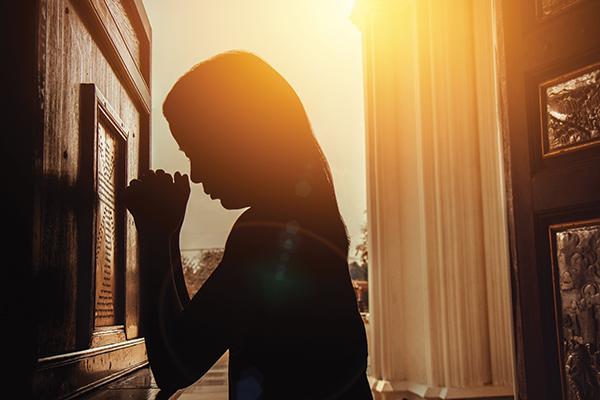
I was always grateful to Victor for protecting me. What he did was to “stand in the way” between me and those boys. “Stand in the way” happens to be the meaning of the Hebrew word for intercession, paga, which can also mean “standing in the gap.” Intercessory prayer is exactly that—standing in the gap between a person, a people or any part of God’s creation and a need. But instead of physically standing in the gap as Victor did, we stand in the gap through prayer.
Praying for people and situations plays a substantial role in our Catholic faith, from everyday petitions for our family and loved ones to petitions holding a prominent place in our liturgies. But intercessory prayer is certainly not a modern practice. In fact, its origin is much earlier than Christianity. I imagine intercessory prayers existed as far back as when humanity first acknowledged a Creator.
There are many examples in Hebrew Scripture that can assist us in using intercessory prayer in our contemporary situations. We can use Psalm 80 to help us pray for healing in our Church: “Stir up your power, come to save us”(3). We can look to Psalm 122 to help us pray for peace: “For the peace of Jerusalem pray … May peace be within your ramparts, prosperity within your towers” (6-7). In these times of discord within our Church and outside of it, we can use Psalm 133 to pray for unity: “How good it is, how pleasant, where the people dwell as one”(1).
Abraham teaches us that even when things seem hopeless, God welcomes and listens to our prayers. Abraham laments to God while looking over the city of Sodom: “Will you really sweep away the righteous with the wicked?” (Genesis 18:23). Then, Abraham intercedes by questioning God: “What if there were 50 righteous people, then 45, 30, 20 and then finally 10 righteous people, would God still destroy Sodom? And each time God responded that for the sake of the righteous ones, “I will not destroy it.” But we know what happened to Sodom after God removed the only few righteous people in the city. It was destroyed.
Now, let’s look at how Moses interceded for the nation of Israel when the impatient Israelites fell back into their pagan practices and worshiped a golden calf. God wanted to wipe them out, but Moses interceded for them: “Turn from your burning wrath; change your mind about punishing your people” (Exodus 32:12). Do you know people who chase after useless ‘”idols” leading them to self-destruction? Who may benefit from this prayer? Maybe, you and I? From these accounts, we know that God listens, so we offer prayer!
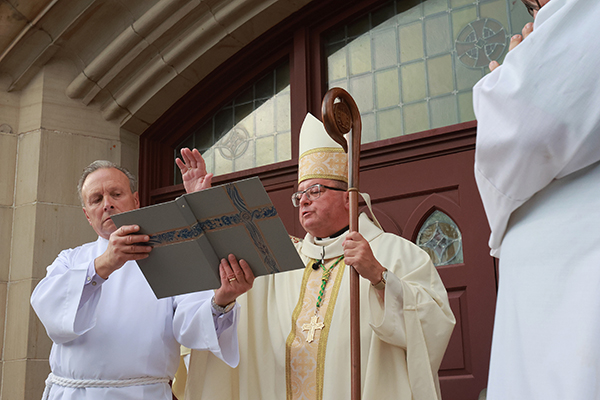
There are many more examples in the Old Testament, but let’s take a look in the New Testament. Here, intercessory prayer takes on a different perspective because Jesus— God Himself—teaches us how to intercede with prayer. The most well-known example is the Lord’s Prayer (Matthew 6:9-13), but we also have Jesus’ intercession for unity, that we may be “one” (John 17:20-23)—one with all people, all religions and all civilizations and one with God. You may recognize these words of unity because they are the Episcopal motto of our bishop, the Most Reverend David J. Bonnar, “That All May Be One.” Jesus spoke this prayer the night before His Crucifixion. But how about the prayer He used during His Crucifixion? “Father, forgive them, they know not what they do” (Luke 23:34). How many times could we have used this prayer to save us from hurt feelings and resentment, if we only took the time to ask God to forgive those who hurt us?
Pope Francis wrote about the benefits of our prayer for others in his apostolic exhortation The Joy of the Gospel, when he reflected on the words of Saint Paul: “I constantly pray with you in every one of my prayers for all of you … because I hold you in my heart” (Philippians 1:4, 7). Pope Francis wrote: “Authentic contemplation always has a place for others” (281). What he is implying is the mystical reality of our connectedness in the Body of Christ. Whether we understand it or not, all human souls are inseparable. Even though we live in what seems to be an ever-growing chasm between each other in our digital world, through intercessory prayer Jesus brings us back to this mystical reality that we are all in this together—one community, One Mystical Body of Christ. What’s more, Pope Francis taught us that in our prayers of thanksgiving and gratitude we affirm “what God is doing in the lives of others” (282).
Pope Francis also spoke about the fruit of our prayers for others: “When evangelizers rise from prayer, their hearts are more open; freed of self-absorption, they are desirous of doing good and sharing their lives with others” (282). Have you ever heard the saying that it is hard to hate someone you pray for? That is because intercessory prayer disposes our hearts to generosity, compassion and sharing our lives with others, not hate. It is spiritual calisthenics for discipleship. In short, through intercessory prayer, our hearts become more like the Sacred Heart of Jesus.
Toward the end of our liturgical year, on All Saints Day, the Church celebrates the lives of the saints, who are the greatest intercessors. Those souls who now dwell close to Our Lord in heaven can offer prayers that are so much more pure than any prayer I can offer, which may be distorted by my sin. A plethora of Catholic prayers are used for just this purpose. The Hail Mary, the Memorare and the Saint Michael Prayer are just a few. Just pick your favorite saint and ask them to pray with you.
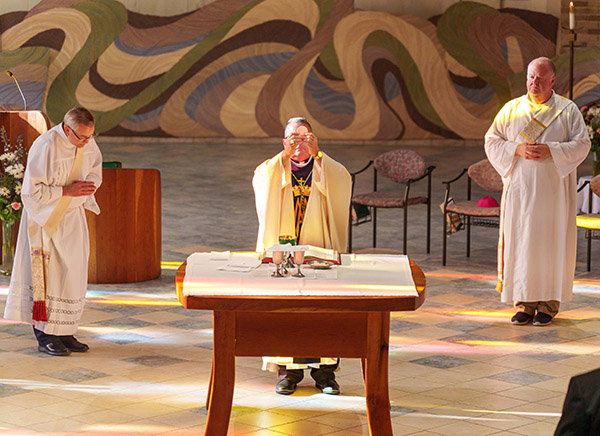
If we ask our first millennial saint, Saint Carlo Acutis, his favorite way to pray, it would be in front of the Eucharist, at Mass or Eucharistic Adoration. This is our way to go straight to Jesus with our prayer. Remember that mystical reality I referred to? We are all connected through the Body of Christ. Think of it like the spiritual high-speed internet. Through the Eucharist, our prayers are already connected to the victims of warring nations, to those who are starving across the globe, to the migrants lost in the deserts of Mexico and to the homeless person we passed on our way home from work.
When I minister to those who are sick, I sometimes give them a prayer assignment, an intercession to pray for another who, like them, is in great need. I truly believe that Jesus is closest to those who are suffering. It makes sense to me that their proximity to Jesus carries more weight than mine. At the very least, it helps them feel that they, too, are still actively part of the Body of Christ, even as they suffer in their own illness.
Saint Paul used an intercessory prayer as a greeting in almost all his letters: “Grace to you and peace from God our Father and the Lord Jesus Christ” (Romans 1:7). What if we consciously brought his intercessory prayer to each human we encounter: each conversation we have with our spouse, our children, our friends, our work associates and, do I dare say, our enemies? What difference would this make in our relationships or in the world? How may it change us for the better?
The Church teaches that intercessory prayer is healthy for both the recipient and the one who prays. This is intentional. But doesn’t God already know what we are about to ask? Yes, that is probably true. So why do we need to pray? Pope Francis tells us that with our prayer “God’s heart is touched … yet in reality He is always there first” (283).