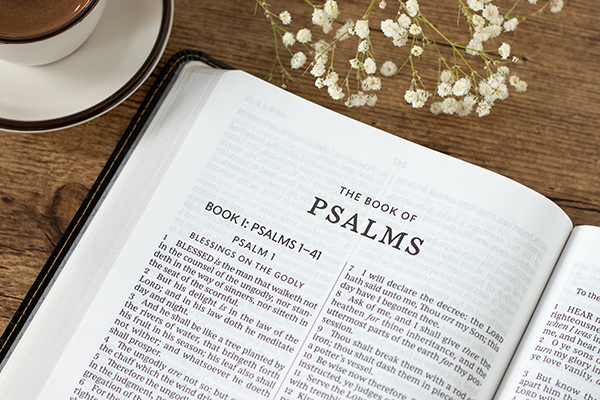
If you have been to Mass, you are familiar with one of the Church’s most ancient forms of prayer—the psalms. During Sunday Mass, they are usually proclaimed by a cantor or choir after the first reading. The Book of Psalms is a collection of 150 poems and prayers of the ancient Hebrew tradition, written over many centuries. More than 73 of them are connected to King David, though the Bible names several other psalmists.
As people begin praying the psalms, they are sometimes taken aback. Instead of more psalms like the “Good Shepherd,” they find texts with strong negative feelings about others—and even about God. They wonder how they are supposed to pray these psalms as their own. While some psalms give words to our own thoughts and feelings, others clearly belong to other people. Indeed, all the psalms were first prayers of other people. Often our prayer comes as we confront and interact with these ancient prayers by other voices.
Mirror and Window
Some see literature as entertainment, but stories and poems tell us how the world works by serving as a mirror or a window. When someone tells me that I must see a certain movie, it means that the film shows them something important about themselves. The psalms can do that as well. Sometimes, a line or phrase captures something that we want or need to say. That psalm or verse has become as a mirror for us.
More often, the psalms offer us a window into the life and world of the psalmist. There is a distance between their world and ours, and we may need information about their world. Their world can have presuppositions different than ours, especially about the roles of men and women and about God. Still, the psalmists were people like us with similar concerns about life and relationships, especially their relationship to God. Just as we must open ourselves when we meet new people, so we must also with the psalms—we must listen with an empathetic heart, even if we disagree. Therefore, it is particularly important to ask who is speaking, because only when we have truly listened can we respond in prayer.
The Psalms and the Church,
the Body of Christ
The early Church made the psalms the building blocks of its prayer. Great teachers, like Origen, found many connections to Christ, and Saint Augustine understood the whole Book of Psalms as the prayer of Christ the Head and Christ the Body. Today, the Church, the Body of Christ, continues to sing and pray the psalms, with voices crying out in praise and petition. Though once the prayers of ancient peoples, the psalms capture the many prayers found in the Body of Christ. They are not just windows into the prayers of another people in another time—they call us to pray with them.
The traditional way of praying the psalms remains the Liturgy of the Hours (find more information in a story by Bishop Michael Woost on page 23), the daily prayer of the Church. Vatican II revised this prayer to make it accessible to the whole Church, and a second revision is about to appear. Shorter versions are a good way to begin, such as those found in Give Us This Day, published by Liturgical Press (https://giveusthisday.org/) or in Magnificat, published by the Magnificat Foundation (https://us.magnificat.net/).
Finally, you can just pray a psalm on your own. A simple way to engage with the psalms is to choose one and read it slowly two or three times, asking what the psalmist wants to show us. Ask what connection the psalm has to us today or the question it is posing for us to answer. Think about what prayer it is asking you to pray. Let me recommend the following as a place to start:
Psalm 8: a psalmist’s response to looking at the night sky
Psalm 19: creation and the Law (the Scriptures) as a manifestation of God
Psalm 23: the Lord as shepherd and host of the feast
Psalm 44: a lament by a faithful community who feel rejected by God
Psalm 51: the classic psalm of repentance
Psalm 88: the prayer of someone near despair
Psalm 96: praise of God as King
Psalm 103: a celebration of God’s covenant and goodness
Psalm 121: a celebration of God as the pilgrim’s keeper
Psalm 131: a small psalm of humble confidence
Psalm 148: a call for all creation to praise the God who comes close
From there, if you would like to take a more in-depth look at the psalms, below is more of a “deep dive” into the categorization and construction of the psalms, as well as a look at psalms of praise and psalms of prayer.
The Types of Psalms
There are two basic ways to divide psalms. The first uses ideas and so divides psalms into those that deal with wisdom, kingship, Jerusalem and the like. The second divides them according to their form and purpose. For example, a few are narratives and tell Israel’s stories. Many are speeches—speeches to God, to other people or to no one in particular. Some are also “lyric,” meaning they are a poem in which we overhear the poet’s reaction to a situation, such as Psalm 19 that begins
The heavens declare the glory of God;
the firmament proclaims the works of his hands. (19:1)
The psalmist does not direct these lines to anyone but speaks them for whoever will listen. The speeches to others often call them to praise God, while those to God are often prayers for help.
Parallel Lines
Hebrew poetry often moves in parallel lines built on similar ideas, words and grammar. This parallelism is a hallmark of biblical poetry, as we see in Psalm 1, which begins by describing someone “blessed” as one:
who does not walk in the counsel of the wicked,
Nor stand in the way of sinners,
nor sit in company with scoffers.
Though similar, the lines are not the same, and the differences move the ideas forward. The verbs—walk, stand, sit—suggest life’s movement from action to rest. The lines also name “the wicked” (those who are evil), “sinners” (those who do evil) and finally “scoffers” (those who laugh as they do evil). The lines are similar but not the same. Sometimes, the difference is minimal, but they demand attention.
Psalm 1:2 gives us another insight into parallelism:
Rather, the law of the Lord is his joy;
and on his law he meditates day and night.
Here “the law of the Lord” is parallel to “his law” in the second line. The verbs are similar, but the parallelism invites us to see a relationship between meditation and joy. The second line also adds a new idea: “day and night,” a word pair embracing all time.
Repetition appears in poetry everywhere, so we should be alert to repeated words and ideas because they reveal what the text wants to show us. While creating emphasis, repetition also allows us time to imagine and react emotionally. A careful examination of biblical poetry reveals a literature of superb craft and beauty, able to explore the great themes of life and God. We should be ready to expand our hearts.
Psalms of Praise and Thanksgiving
Praise is human, and we praise other people by making statements about them: “You are a good person.” “You have done a fine job.” We praise people to build them up or to ingratiate ourselves to them. We praise them before asking a favor, as we shall see below. However, we also praise things and people we find amazing: an incredible athletic feat, a fine artistic creation, a person’s mastery and accomplishment. Such people or things are so wonderful that we feel compelled to acknowledge them. This is the praise we offer God. The praise of God captures what we must say about who God is and what God has done.
Psalm 8 begins and ends with the same line of praise:
O Lord, our Lord,
how awesome is your name through all the earth!
In between the beginning and the end comes a vision of humanity before the night sky with all creation. This psalmist addresses God directly, but these psalms typically call on others to come and join the praise, as does Psalm 117, which offers a classic example of the form.
call:
“Praise the Lord, all you nations!
Extol him, all you peoples!”
statement about God/reason to praise God:
“His mercy for us is strong;
the faithfulness of the Lord is forever.”
call:
“Hallelujah!” [translation: Praise the Lord!]
The psalm opens with two parallel lines calling all nations and peoples to praise the Lord. The statements that follow serve as the reason why we should praise God and as what we should say in praise. The Hebrew text often introduces this statement with kî, which can mean “indeed” or “for/because.” Usually, English Bibles translate kî as “for/because,” and we see that in Psalm 98:1 at the beginning of the second line:
Sing a new song to the Lord,
for he has done marvelous deeds.
The second line is the reason to “sing a new song” and the song itself: “Indeed! He has done marvelous deeds!”
Thanksgiving, like praise, makes statements about another but with this difference: the person or their action has somehow benefited me, and I feel some responsibility to acknowledge that. The difference between praise and thanks is not always clear-cut, so we should not force the categories. Psalm 30 is an example of thanksgiving:
I praise you, LORD, for you raised me up
and did not let my enemies rejoice over me. (30:2)
We also find examples of thanksgiving by the community, as in Psalm 67 for the harvest and Psalm 124 for deliverance from enemies.
Some psalms contain the affirmation of what I will do, as in Psalm 145.
I will extol you, my God and king;
I will bless your name forever and ever.
Every day I will bless you;
I will praise your name forever and ever. (145:1-2)
As translated, they are vows asserting what I will do. We should not recite these vows thoughtlessly.
Prayer Psalms or Laments
The prayer psalms are many and have the basic elements used to ask anyone for what we need—invocation, description and petition. For an everyday example:
invocation: John,
description: you are a big, strong fellowand I could use some help.
Petition: Help me move a new bookcase into my office so that I can get things
arranged.
Psalms that follow this format call on God to act as the savior. They imply a larger story that we must reconstruct from the psalmist’s words. Herman Gunkel called these psalms “laments” because they tend to focus on a description of the psalmist’s troubles, as in Psalm 6:
I am wearied with sighing;
all night long I drench my bed with tears;
I soak my couch with weeping.
My eyes are dimmed with sorrow,
worn out because of all my foes.” (Psalm 6:7-8)
My old teacher called them “trouble psalms.” Typically, the enemy in some way has attacked the good but weak psalmist, who calls on God to act as the hero.
These psalmists may add questions of frustration with God or even existential questions about the meaning of life. Some add affirmations of trust that God will act for them, as in Psalm 143:8:
In the morning let me hear of your mercy,
for in you I trust.
Show me the path I should walk,
for I entrust my life to you.
Some psalms come in two acts. Act I is the psalmist’s prayer for help, then without any transition, Act II follows with the psalmist announcing that the trouble is over and offering a thanksgiving hymn.
For example, in Psalm 6:1-8, the psalmist makes a cry for help, and in Psalm 6:9-10 they announce salvation:
Away from me, all who do evil!
The Lord has heard the sound of my weeping.
The Lord has heard my plea;
the Lord will receive my prayer.
This twofold division reflects the Cross and Resurrection that gather these psalms into the Christian mystery.
These psalms can grow in complexity. The enemy may be the psalmist’s friend (Psalms 41:10; 55:14) the psalmist’s sin may cause the problem (Psalm 38:4), or God may delay, as in Psalm 13:1:
How long, O LORD? Will you forget me forever?
How long will you hide your face from me?
I call these complex psalms “the Nashville psalms” because they pour out their raw emotions like country music. Some say that psalms contain every emotion. That may be an overstatement, but they lead us through both the heights and the depths of human feeling. As a friend once told me: “The psalms show us that you can say anything to God.” Therefore, we must pay close attention to each voice.
Benedictine Father Harry Hagan, monk and priest of Saint Meinrad Archabbey, has a Doctorate of Sacred Scripture from the Pontifical Biblical Institute. He teaches Old Testament and languages at Saint Meinrad Seminary and School of Theology in Saint Meinrad, Indiana, and has also written hymns.