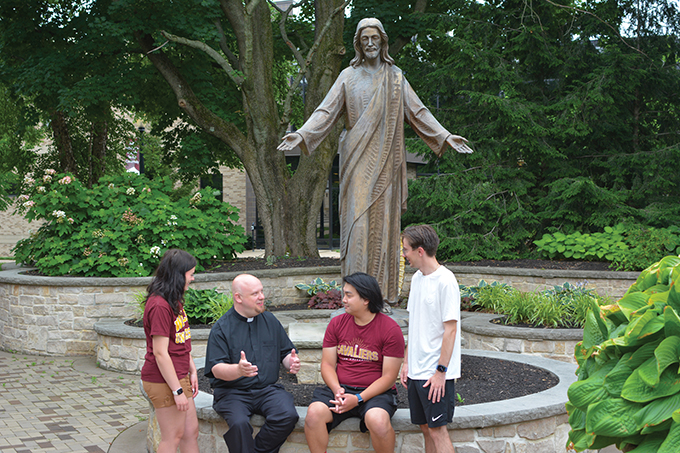
Walk onto Founders Plaza at Walsh University, and you will be greeted by a statue of one of the founders of the Brothers of Christian Instruction, Jean-Marie de LaMennias. Inside Our Lady of Perpetual Help Chapel the brothers’ crest is displayed on the floor.
Now celebrating 65 years of Catholic education in the Diocese of Youngstown, Walsh University remains true to the founding principles of the Brothers of Christian Instruction, who began construction of then-Walsh College in Canton in 1959, said Michael Cinson, chief student experience officer for Walsh University. “Their mission is ingrained within our general education curriculum and our programming. We also try to do a good job of making the brothers physically present,” Cinson noted, referring to the statue and crest.
Cinson oversees residence life, student activities and intramural sports, and works with campus ministry. “One way we live out the brothers’ mission is through campus ministry,” he said. “As an order, the brothers’ mission is to make Jesus Christ better known, loved and served. The university added ‘to make leaders in service to others’ [when it was adapted for the university’s mission], but it was still in the same spirit of the brothers.”
Evidence of the mission can be found in the university’s myriad programs. For example, its Peacemaker Program fuses residence life with campus ministry via peer leaders in the residence halls. “Our Peacemakers live within the halls, lead Bible studies and provide peer support that is available to our residents at any time. Our students commit themselves to the Christian way, becoming great examples, mentors and leaders among their peers. Within that, there is a call to serve communities for the common good, which the brothers did a fantastic job of modeling,” Cinson explained.
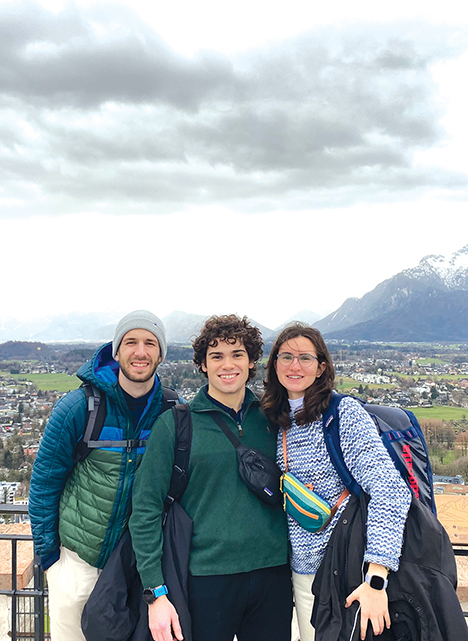
“Our goal is that our students graduate knowing exactly how their skills and interests can contribute to the common good,” says Dr. Nick Morris, faculty director of the Blouin Scholars Program, another program that contributes to the university’s mission. The Blouin Scholars began 13 years ago in honor of Brother Francis Blouin, the third president of Walsh.
“Brother Francis’ feeling was that students should have opportunities to see beyond their own immediate experiences,” Morris explained. “Our brothers came to this community to provide an education, making sure that even those who do not have the money to do so could have those experiences. We carry that forward when we look at poverty and identify its intersection with school performance, or poverty and the experience of aging in our community.”
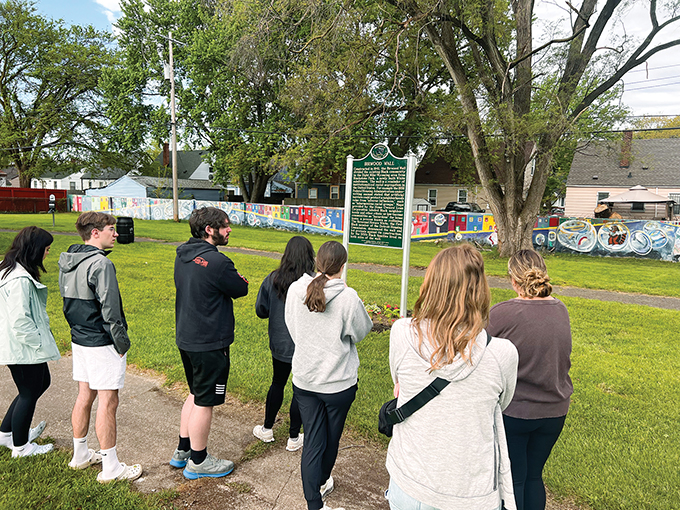
Over the years, the Blouin Scholars Program has taken students on international travels, and, more recently, on domestic road trips. Recent travels include Ypsilanti, Michigan, where students worked with partners at Eastern Michigan University; London, Ontario, with Kings University College and some of its community partners; and Erie, Pennsylvania, with Catholic Charities and the Refugee Education Center. “Our students work with community partners and faculty to unpack the complex issues within an academic framework. It’s also an opportunity for us to see what’s happening in other communities with the intent to bring new information and new perspective to the Canton and Stark County community,” Morris continued.
“One of the best components of the program is that students of different majors are working together on a theme like poverty and aging, recognizing that they’re not limited by their job title. Rather, you think about combining your heart and your mind to give of yourself to something bigger,” Morris said.
Megan Huston, the university’s director for culture and belonging, oversees the systems, processes and partnerships that support Walsh’s international students living in Canton; assisting them academically, culturally and administratively while ensuring compliance with federal immigration regulations through the International Student Program. “This work aligns closely with Walsh’s mission by ensuring students from around the world are supported with dignity and care. At its core, this work is about making sure students who travel thousands of miles to study here never feel like they are navigating Walsh University alone,” said Huston.
The Study Beyond Program, also under Huston’s direction, provides opportunities for all Walsh students to engage globally through study abroad programs, international academic partnerships and short-term, faculty-led experiences.
“Walsh University has a long history of welcoming international students and engaging globally. In recent years, the university has expanded partnerships and aligned global opportunities more closely with academic programs and the founding charism of the Brothers of Christian Instruction. Global engagement is a natural extension of who we are as a Catholic university,” explained Huston.
Noting how global programs have evolved, Huston continued, “We’ve moved from simply supporting students’ enrollment to supporting their entire experience and sense of belonging. Current programs emphasize meaningful engagement with partnerships in Austria, Rome, Ireland and beyond, within global Catholic contexts. While students travel for the academic experience, they also discern what it means to live their faith, and values in a global context,” said Huston.
Students are drawn to Walsh for its academic rigor paired with genuine care for the whole person. “The commitment of the brothers to accessible education, faith formation and educating the whole person continues to shape how Walsh approaches internationalization. That charism resonates across cultures because dignity, service and faith transcend borders,” Huston relates.
Through the experiences of international students and Study Beyond participants, “[Students] develop a deeper appreciation for human dignity, ethical leadership and service to the common good … They leave Walsh understanding that faith calls not inward, but outward toward the needs of others. Walsh’s global impact is ultimately not where our students go, but how they lead when they get there,” Huston said.
As a Catholic university, requirements for theology and philosophy that are within the teaching of the Catholic Church are part of Walsh’s mission of service learning as well. While Catholicism permeates the university, “It’s not recruiting solely Catholic students. It’s not just classes serving only the Catholic population. In that same spirit of the brothers, we are also recruiting those who are in the periphery. We have a high percentage of students who are on some sort of scholarship to make the university more affordable,” Cinson said.
“We want our Walsh graduates to be leaders within their professions, whatever that is, and within their communities as well,” Cinson continued. “We want them to be parish leaders, to be involved in their community, whether that is running for city council, working for a nonprofit or getting involved in service through another organization, within their community or workplace. Whether they’re Catholic or not, whatever their faith background, we want them to be leaders within that faith.”
A Timeline of the Brothers of Christian Instruction and Walsh University
1918—The order was founded in France by Gabriele Deshayes and Jean-Marie de la Mennais. Their mission to educate young men and make Jesus Christ better known and loved, particularly in impoverished areas of France.
1951—The order founded LaMennais College in Alfred, Maine.
1959—At the invitation of Youngstown Bishop Emmet Walsh, they began construction on Walsh College in Canton, on 50 acres of farmland.
November 17, 1960—Walsh College welcomed 67 “gentlemen” as its first students.
January 1, 1993—Walsh College became Walsh University.
2020—The Brothers of Christian Instruction were no longer able to serve at Walsh University due to dwindling vocations.
February 2021—Walsh University became an independent Catholic university, while still maintaining the charism and the history of the brothers.