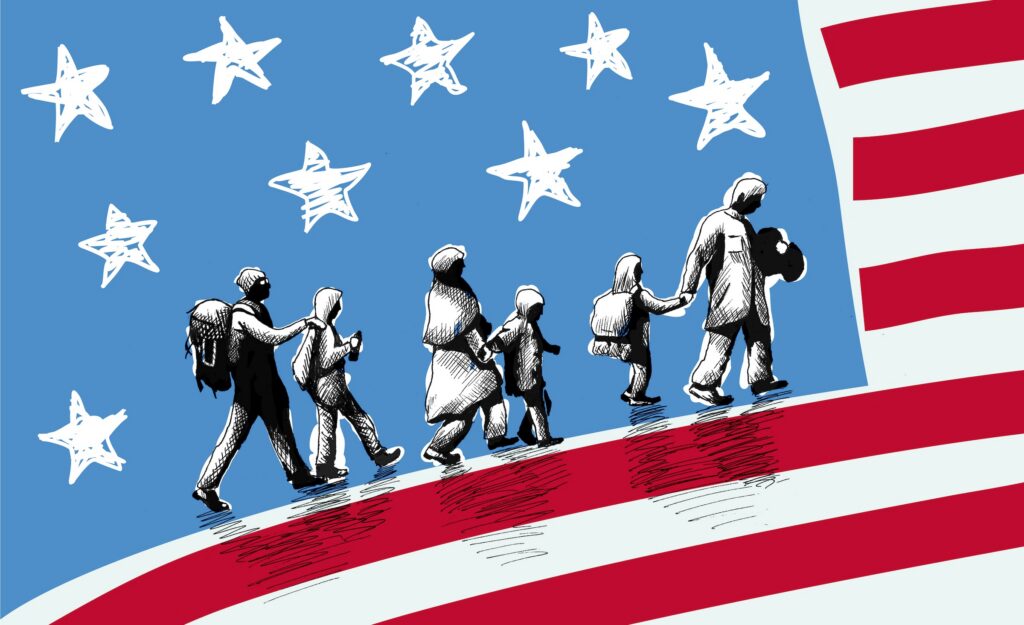
Every minute, 13 people around the world move to a place different from where they were born. In other words, 19,000 people become migrants every day. Whether vulnerable or not, each one faces a series of challenges inherent to starting a new life.
The dioceses of Michigan and Ohio organized a webinar to inform their team of Church leaders about issues relating to immigration and the Church on April 24. It emphasized human dignity and allowed participants to reflect on how to respond collectively to the immigration crisis of today.
Brian Hickey, executive director of the Catholic Conference of Ohio, delivered the welcome on behalf of Paul Long, president of the Michigan Catholic Conference, and all the bishops of Michigan and Ohio. The event began with Archbishop Casey, of the Archdiocese of Cincinnati, offering a prayer for a world of justice—one in which all homelands are safe and secure.
The first presenter was Father Daniel Groody, vice president, associate provost, and professor of Theology and Global Affairs at the University of Notre Dame. In April, Pope Leo XIV appointed Father Groody as a member of the Dicastery for Promoting Integral Human Development, an entity tasked with supporting the universal Church in promoting human dignity and human rights, as well as fostering an understanding of migration and displacement. Father Groody began his presentation, titled “Theology of Migration,” by sharing a world map depicting the migration routes of his own ancestors. He did so to demonstrate that the subject of immigration is nothing new—that it has long been an integral part of history and that migration is, in fact, in our genes. From Abraham to Jesus and the disciples, he noted, migration appears constantly throughout the Bible as an essential element of the faith and of God’s mission. For this reason, migration is not something foreign to Christianity, but rather a fundamental part of our spiritual identity. The Incarnation reveals Christ as the first migrant, he added—one who, upon entering the world and stepping into our human reality, left His “home” to reconcile us with God through the Cross; and thanks to this act, we may one day become citizens of the Kingdom of God.
Regardless of the labels that the law assigns to different cases, he said, we must remember that we are all pilgrims and that the Church must respond with solidarity and compassion, because every person possesses a God-given dignity. Migration is the result of economic inequality, wars, persecution and poverty, which drive many to leave their homes in search of something better.
The priest addressed the various categories of migration—the first of which is economic migration, which drives many to leave their homes in search of better opportunities. He cited statistics such as the fact that 75 percent of the population lives on less than $10 a day, and that the top 1 percent of the world possesses as much wealth as the poorest 57 percent. The second category refers to those who abandon their home countries and arrive in another as refugees, fleeing religious or political persecution, among other causes. Some of them are granted asylum—though only one in every 100 applicants is successful. Currently, almost no one is. The third category concerns those who have relocated within the borders of their own country; yet, despite remaining within their homeland, they remain vulnerable. Finally, there is the group comprising victims of human trafficking and the sex trade. According to data presented at this conference, there are currently more than 304 million international migrants worldwide, along with 123 million refugees. These are individuals living in a place other than their birthplace—while not all of them are vulnerable, they collectively represent one in every 27 people globally who have become migrants. This number grows every day, and despite the policies implemented by various nations to control migration, people will not cease to relocate in response to diverse circumstances.
Father Groody spoke about the various perspectives and attitudes that individuals may hold regarding the issue of migration. He reminded us that Catholic social teaching recognizes that nations have the right to protect their borders but also upholds the right of individuals to live a life of dignity. He shared heart-wrenching stories of the migrants he has interviewed. Many spoke to him about the immense difficulty of crossing borders—not merely due to harsh conditions, but because of the crushing sense that they meant nothing to anyone and that their humanity had been stripped away. Many die as “John Doe,” becoming—in the public eye—nothing more than a statistic.
The first principle of Catholic social teaching, he noted, is that individuals possess the right to remain in their own country; yet, there are those who, while there, must fight to uphold their dignity and their right to live as human beings. The second foundation of the theology of migration refers to “crossing over”—specifically, crossing the divine-human divide. God crossed the boundary between the divine and the human when He became man in Jesus. His story is deeply intertwined with migration, particularly when we recall that His family fled to Egypt as refugees to escape persecution by King Herod. God’s history of salvation began amidst vulnerability and displacement—a reality that invites us to re-examine our own preconceptions regarding immigration. The third foundation is Missio Dei—the Mission of God—manifested when Jesus came to proclaim the Kingdom of God and His universal love for each and every one of us. Jesus invited everyone to His table—sinners, Gentiles, tax collectors and those rejected by society. In doing so, He rejected rejection.
Father Groody concluded his remarks by emphasizing that everything we possess is a gift from God, and that we are here merely as stewards of these goods, not as their absolute owners. He highlighted that what truly unites people is faith—specifically, their dignity as children of God—regardless of their nationality. The true “stranger,” he stated, is not merely the person who lacks documents, but rather the one who is alienated from God, from their neighbor and from their own humanity by failing to recognize the dignity of others. Migrants possess intrinsic rights bestowed by God, and the Church has the mission to build a society that is more just, humane and grounded in solidarity.
David Spicer, director of migration policy and outreach at the United States Conference of Catholic Bishops (USCCB), works on the development of migration and refugee policies guided by the Church’s social and moral teachings. He is also an attorney—a graduate of the University of Notre Dame—who collaborates with dioceses and organizations to promote the common good and combat human trafficking. In his presentation, he explained the current state of immigration in the United States and the mechanics of the country’s immigration system, distinguishing between various types of visas, immigration statuses, asylum, refugee status and temporary protection programs. He also detailed how recent federal policies have impacted humanitarian processes, restrictions placed on certain nationalities, the rise in detentions and changes to programs such as TPS (Temporary Protected Status) and humanitarian parole—a temporary permit granted in cases of emergency. Furthermore, he highlighted that the immigration system is highly complex and that many of its nuances are often lost in the country’s political and public discourse. He outlined the work of the USCCB regarding migration and emphasized the importance of understanding the realities faced by migrants and refugees—particularly those seeking humanitarian protection—reminding the audience that the Church advocates for policies inspired by human dignity and Catholic social teaching. He also underscored the need for informed dialogue in the face of an immigration system that is both complex and frequently misunderstood.
Todd Scribner, assistant director of education and outreach for the USCCB’s Secretariat of Migration, speaking from Washington, D.C., began by noting that last November, the bishops issued a special message regarding immigration—an occurrence that is not very common. Scribner discussed the “You Are Not Alone” initiative, championed by the Catholic bishops of this country—a project that supports migrants affected by deportation through four fundamental resources. The first is emergency and family support, providing financial assistance to families separated due to detention or deportation. The second focuses on solidarity, offering accompaniment through prayer, public witness, processions and religious services. The third provides access to the sacraments and spiritual support for those in detention. Finally, the fourth focuses on strengthening and accompanying the priests, religious and laypeople who dedicate their efforts to assisting migrants.
Tony Stieritz, chief executive officer of Catholic Charities Southwestern Ohio—an agency that has served immigrants since its founding in 1916—was another presenter who spoke about the organization’s work through its social service ministries. This branch of Catholic Charities operates across the 11 counties of Southwestern Ohio, serving the most vulnerable populations—including migrants and refugees—by assisting them with basic necessities such as access to food and housing. Among the programs they offer are the Su Casa Hispanic Center, immigration legal services, bilingual mental health support, English classes and an interpretation service called Accuracy Now. The agency welcomes all individuals “with the love of Christ,” regardless of their immigration status. Since 1980, they have maintained a refugee resettlement program to welcome individuals who have spent years living in refugee camps—a key part of their mission is to help these individuals integrate into society and achieve self-sufficiency.
Although he explained that the refugee resettlement program has declined significantly in recent times, the organization continues to support approximately 1,000 already-resettled individuals with services such as employment assistance, English classes and social support. He added that changes in public policy have reduced benefits and created greater difficulties for the integration of these families; however, the agency continues its legal and pastoral work with migrants, including defense in deportation cases and guidance regarding their rights. Stieritz emphasized that the immigration system is becoming increasingly complex and volatile, making it more difficult for migrants to navigate legal processes. Consequently, the organization is intensifying its support and community education efforts.
In conclusion, Paul Probson, chief executive officer of Catholic Charities of Southeast Michigan, encouraged everyone to get involved and volunteer to support the most vulnerable immigrant communities, as solidarity can make a significant difference in the lives of these migrant families.
He spoke about the 500 pregnant women his organization assists by providing diapers, wipes, formula and counseling services. He also discussed the hundreds of children who learn English every day with the help of volunteer tutors, as well as the services provided to adults—many of whom are often scammed by lawyers who take advantage of their vulnerable situation. The agency, he noted, offers legal aid and assistance with filing tax returns. A noteworthy point, he added in closing, is that many undocumented individuals pay income taxes through the ITIN (Individual Taxpayer Identification Number)—a contribution amounting to over a billion dollars that the country receives from them every year.
The session concluded with Archbishop Edward Weisenburger of Detroit, who, on behalf of the bishops of Michigan and Ohio, thanked the speakers and participants for their interest in this topic. He prayed that strangers might become neighbors and neighbors become family, and that God would bless those who leave their homes and guide their paths through unfamiliar lands.
INMIGRACIÓN Y LA IGLESIA CATÓLICA
Por Paulina Montaldo
Cada minuto, 13 personas en todo el mundo se trasladan a un lugar distinto de aquel donde nacieron. En otras palabras, 19.000 personas se convierten en migrantes cada día. Sean vulnerables o no, cada una de ellas enfrenta una serie de desafíos inherentes al inicio de una nueva vida.
Las dióceses de Michigan y Ohio organizaron un seminario en línea el pasado 24 de abril para informar a su equipo de líderes eclesiásticos sobre cuestiones relacionadas con la inmigración y la Iglesia. Este hizo hincapié en la dignidad humana y permitió a los participantes reflexionar sobre cómo responder colectivamente a la crisis migratoria actual.
Brian Hickey, director ejecutivo de la Conferencia Católica de Ohio, dio la bienvenida en nombre de Paul Long, presidente de la Conferencia Católica de Michigan, y de todos los obispos de Michigan y Ohio. El evento comenzó con el arzobispo Casey, de la Arquidiócesis de Cincinnati, ofreciendo una oración por un mundo de justicia: un mundo en el que todas las patrias sean seguras y estén protegidas.
El primer orador fue el Padre Daniel Groody, vicepresidente, vicerrector asociado y profesor de Teología y Asuntos Globales en la Universidad de Notre Dame. En abril, el Papa León XIV nombró al Padre Groody miembro del Dicasterio para el Servicio del Desarrollo Humano Integral, una entidad encargada de apoyar a la Iglesia universal en la promoción de la dignidad humana y los derechos humanos, así como de fomentar la comprensión de la migración y el desplazamiento. El Padre Groody comenzó su presentación, titulada “Teología de la migración”, compartiendo un mapa mundial que mostraba las rutas migratorias de sus propios antepasados. Lo hizo para demostrar que el tema de la inmigración no es algo nuevo; que ha sido, desde hace mucho tiempo, una parte integral de la historia y que la migración está, de hecho, en nuestros genes. Desde Abraham hasta Jesús y los discípulos, señaló, la migración aparece constantemente a lo largo de la Biblia como un elemento esencial de la fe y de la misión de Dios. Por esta razón, la migración no es algo ajeno al cristianismo, sino más bien una parte fundamental de nuestra identidad espiritual. La Encarnación revela a Cristo como el primer migrante, añadió: aquel que, al entrar en el mundo y adentrarse en nuestra realidad humana, dejó su “hogar” para reconciliarnos con Dios a través de la Cruz; y gracias a este acto, algún día podremos convertirnos en ciudadanos del Reino de Dios.
Independientemente de las etiquetas que la ley asigne a los distintos casos, dijo, debemos recordar que todos somos peregrinos y que la Iglesia debe responder con solidaridad y compasión, pues toda persona posee una dignidad otorgada por Dios. La migración es el resultado de la desigualdad económica, las guerras, la persecución y la pobreza, factores que impulsan a muchos a abandonar sus hogares en busca de algo mejor.
El sacerdote abordó las diversas categorías de migración; la primera de ellas es la migración económica, la cual impulsa a muchos a dejarsus hogares en busca de mejores oportunidades. Citó estadísticas tales como el hecho de que el 75 por ciento de la población vive con menos de 10 dólares al día, y que el 1 por ciento más rico del mundo posee tanta riqueza como el 57 por ciento más pobre. La segunda categoría se refiere a aquellos que abandonan sus países de origen y llegan a otro en calidad de refugiados, huyendo de persecución religiosa o política, entre otras causas. A algunos de ellos se les concede asilo, aunque solo uno de cada 100 solicitantes lo consigue. Actualmente, casi nadie lo logra. La tercera categoría concierne a aquellos que se han desplazado dentro de las fronteras de su propio país; sin embargo, a pesar de permanecer en su tierra natal, siguen siendo vulnerables. Finalmente, existe el grupo compuesto por las víctimas de la trata de personas y del comercio sexual. Según los datos presentados en esta conferencia, actualmente hay más de 304 millones de migrantes internacionales en todo el mundo, junto con 123 millones de refugiados. Se trata de individuos que viven en un lugar distinto al de su nacimiento; si bien no todos ellos son vulnerables, en conjunto representan a una de cada 27 personas a nivel global que se han convertido en migrantes. Esta cifra aumenta cada día y, a pesar de las políticas implementadas por diversas naciones para controlar la migración, las personas no dejarán de desplazarse en respuesta a circunstancias diversas.
El Padre Groody habló sobre las diversas perspectivas y actitudes que las personas pueden adoptar con respecto al tema de la migración. Nos recordó que la doctrina social católica reconoce que las naciones tienen el derecho de proteger sus fronteras, pero que también defiende el derecho de los individuos a vivir una vida digna. Compartió historias desgarradoras de los migrantes a quienes ha entrevistado. Muchos le hablaron de la inmensa dificultad de cruzar las fronteras; no solo debido a las duras condiciones, sino por la abrumadora sensación de que no significaban nada para nadie y de que se les había despojado de su humanidad. Muchos mueren como “desconocidos”, convirtiéndose, ante la opinión pública, en nada más que una estadística.
El primer principio de la doctrina social católica, señaló, es que los individuos poseen el derecho a permanecer en su propio país; sin embargo, hay quienes, estando allí, deben luchar para salvaguardar su dignidad y su derecho a vivir como seres humanos. El segundo fundamento de la teología de la migración se refiere al “cruce”, específicamente, al cruce de la brecha entre lo divino y lo humano. Dios cruzó la frontera entre lo divino y lo humano cuando se hizo hombre en Jesús. Su historia está profundamente entrelazada con la migración, particularmente si recordamos que su familia huyó a Egipto como refugiados para escapar de la persecución del rey Herodes. La historia de la salvación de Dios comenzó en medio de la vulnerabilidad y el desplazamiento: una realidad que nos invita a reexaminar nuestros propios prejuicios con respecto a la inmigración. El tercer fundamento es la Missio Dei, la Misión de Dios, manifestada cuando Jesús vino a proclamar el Reino de Dios y su amor universal por todos y cada uno de nosotros. Jesús invitó a todos a su mesa: pecadores, gentiles, recaudadores de impuestos y aquellos rechazados por la sociedad. Al hacerlo, rechazó el rechazo.
El Padre Groody concluyó sus palabras enfatizando que todo cuanto poseemos es un don de Dios, y que estamos aquí meramente como administradores de estos bienes, no como sus propietarios absolutos. Destacó que lo que verdaderamente une a las personas es la fe, específicamente, su dignidad como hijos de Dios, independientemente de su nacionalidad. El verdadero “extranjero”, afirmó, no es simplemente la persona que carece de documentos, sino más bien aquella que se encuentra alienada de Dios, de su prójimo y de su propia humanidad al no reconocer la dignidad de los demás. Los migrantes poseen derechos intrínsecos otorgados por Dios, y la Iglesia tiene la misión de construir una sociedad más justa, humana y fundamentada en la solidaridad.
David Spicer, director de política migratoria y divulgación de la Conferencia de Obispos Católicos de los Estados Unidos (USCCB), trabaja en el desarrollo de políticas sobre migración y refugiados, guiado por las enseñanzas sociales y morales de la Iglesia. Es también abogado graduado de la Universidad de Notre Dame, que colabora con diócesis y organizaciones para promover el bien común y combatir la trata de personas. En su presentación, explicó el estado actual de la inmigración en los Estados Unidos y el funcionamiento del sistema migratorio del país, distinguiendo entre diversos tipos de visas, estatus migratorios, asilo, condición de refugiado y programas de protección temporal. También detalló cómo las recientes políticas federales han impactado los procesos humanitarios, las restricciones impuestas a ciertas nacionalidades, el aumento de las detenciones y los cambios en programas como el TPS (Estatus de Protección Temporal) y la libertad condicional humanitarian, un permiso temporal otorgado en casos de emergencia. Además, destacó que el sistema de inmigración es sumamente complejo y que muchos de sus matices a menudo se pierden en el discurso político y público del país. Describió la labor de la USCCB en materia de migración y enfatizó la importancia de comprender las realidades que enfrentan los migrantes y refugiados, particularmente aquellos que buscan protección humanitaria, recordando a la audiencia que la Iglesia aboga por políticas inspiradas en la dignidad humana y en la doctrina social católica. Asimismo, subrayó la necesidad de un diálogo informado ante un sistema de inmigración que es, a la vez, complejo y frecuentemente malinterpretado.
Todd Scribner, subdirector de educación y divulgación del Secretariado de Migración de la USCCB, participando desde Washington, D.C., comenzó señalando que el pasado mes de noviembre los obispos emitieron un mensaje especial sobre la inmigración, un acontecimiento que no suele ser muy habitual. Scribner habló sobre la iniciativa “No estás solo”, impulsada por los obispos católicos de este país: un proyecto que brinda apoyo a los migrantes afectados por la deportación a través de cuatro recursos fundamentales. El primero es el apoyo familiar y de emergencia, que proporciona asistencia económica a las familias separadas a causa de la detención o la deportación. El segundo se centra en la solidaridad, ofreciendo acompañamiento mediante la oración, el testimonio público, las procesiones y los servicios religiosos. El tercero facilita el acceso a los sacramentos y el apoyo espiritual a las personas que se encuentran detenidas. Por último, el cuarto se enfoca en fortalecer y acompañar a los sacerdotes, religiosos y laicos que dedican sus esfuerzos a asistir a los migrantes.
Tony Stieritz, director ejecutivo de Catholic Charities Southwestern Ohio, una agencia que ha prestado servicio a los inmigrantes desde su fundación en 1916, fue otro de los oradores que habló sobre la labor de la organización a través de sus ministerios de servicios sociales. Esta rama de Caridades Católicas opera en los 11 condados del suroeste de Ohio, atendiendo a las poblaciones más vulnerables, incluidos migrantes y refugiados, al brindarles asistencia con necesidades básicas, tales como el acceso a alimentos y vivienda. Entre los programas que ofrecen se encuentran el Su Casa Hispanic Center, servicios legales de inmigración, apoyo bilingüe en salud mental, clases de inglés y un servicio de interpretación llamado Accuracy Now. La agencia acoge a todas las personas “con el amor de Cristo”, independientemente de su estatus migratorio. Desde 1980, han mantenido un programa de reasentamiento de refugiados para dar la bienvenida a personas que han pasado años viviendo en campos de refugiados; una parte fundamental de su misión es ayudar a estas personas a integrarse en la sociedad y alcanzar la autosuficiencia.
Aunque explicó que el programa de reasentamiento de refugiados ha disminuido significativamente en los últimos tiempos, la organización continúa brindando apoyo a aproximadamente 1.000 personas ya reasentadas mediante servicios tales como asistencia laboral, clases de inglés y apoyo social. Añadió que los cambios en las políticas públicas han reducido los beneficios y generado mayores dificultades para la integración de estas familias; no obstante, la agencia prosigue con su labor legal y pastoral con los migrantes, lo que incluye la defensa en casos de deportación y la orientación respecto a sus derechos. Stieritz enfatizó que el sistema de inmigración se está volviendo cada vez más complejo y volátil, lo cual dificulta a los migrantes el manejo de los procesos legales. En consecuencia, la organización está intensificando sus esfuerzos de apoyo y educación comunitaria.
En conclusión, Paul Probson, director ejecutivo de Catholic Charities of Southeast Michigan, animó a todos a involucrarse y ofrecerse como voluntarios para apoyar a las comunidades inmigrantes más vulnerables, ya que la solidaridad puede marcar una diferencia significativa en la vida de estas familias migrantes.
Habló sobre las 500 mujeres embarazadas a las que su organización asiste proporcionándoles pañales, toallitas húmedas, leche de fórmula y servicios de asesoramiento. También se refirió a los cientos de niños que aprenden inglés cada día con la ayuda de tutores voluntarios, así como a los servicios que se prestan a los adultos muchos de los cuales son a menudo estafados por abogados que se aprovechan de su situación de vulnerabilidad. La agencia, señaló, ofrece asistencia legal y ayuda para la presentación de declaraciones de impuestos. Un punto destacable, añadió para concluir, es que muchas personas indocumentadas pagan impuestos sobre la renta a través del ITIN (Número de Identificación Personal del Contribuyente), una contribución que asciende a más de mil millones de dólares que el país recibe de ellos cada año.
La sesión concluyó con el arzobispo Edward Weisenburger de Detroit, quien, en nombre de los obispos de Michigan y Ohio, agradeció a los oradores y participantes su interés en este tema. Rogó para que los extraños se conviertan en vecinos y los vecinos en familia, y para que Dios bendiga a quienes dejan sus hogares y guíe sus caminos a través de tierras desconocidas.