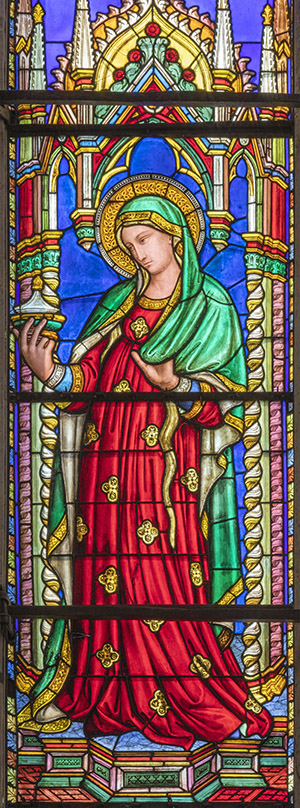
Saint Mary Magdalene, as depicted in the Gospels, was a biblical hero, noted disciple of Jesus, one of the women who stayed with Christ through His Crucifixion, and, by some accounts, the first witness to the Resurrection—often described as “The Apostle to the Apostles.”
Because Mary was a common name, the Gospel writers used designations like “Magdalene” and “Clophas” to distinguish among them. Saint Mary Madgalene, scholars speculate, came from Magdala, a village on the Sea of Galilee. The Gospel of Luke identified her as among the women who accompanied Jesus, who cured her of evil spirits and infirmities. Jesus, according to Luke, had driven seven demons from Saint Mary Madgalene—though scholars have different opinions as to its meaning. Luke 8:2-3 lists Saint Mary Magdalene along with “Joanna, the wife of Herod’s steward Chuza, Susanna, and many others who provided for them out of their resources.” When the women followers of Jesus are named, Saint Mary Magdalene is listed first—as Saint Peter is named first when the apostles are named.
Significantly, Saint Mary Magdalene, according to the Gospels, was present at the Crucifixion and burial of Jesus—as one of two groups known as “The Three Marys.” According to the Gospel of John 19:25, Saint Mary Magdalene, Mary (Mother of Jesus) and Mary (wife of Clopas) stood near the Cross right before Jesus died. Another “Three Marys,” were, according to the Gospel of Mark, present at Jesus’ tomb following His burial, but before the Resurrection. The Church’s Roman Martyrology commemorates Saint Mary Magdalene, Mary of Cleopas and Mary Salome for coming early on Easter morning to Jesus’ tomb.
Though details vary, all four Gospels also have Saint Mary Madgalene—sometimes with other women disciples—present at Jesus’ tomb on Easter morning. In Matthew’s Gospel, Saint Mary Magdalene and Mary (mother of James and Joseph), go to the tomb—first encountering two angels and then seeing the risen Jesus, instructing them to tell the other disciples. Luke 24: 1-12 tells a similar story. Finally, according to John 20:1-18, Saint Mary Magdalene went to the tomb alone while still dark and saw that the stone had already been rolled away. She immediately ran to tell Saint Peter and the “beloved disciple,” who rushed to the tomb and confirmed that it was empty, but returned home without seeing Jesus. Saint Mary Magdalene, waiting alone in the garden outside the tomb, saw two angels sitting where Jesus’s body had been. Then the risen Jesus approached her. Though initially mistaking Him for the gardener, she recognizes Him after Jesus called her by name. Jesus then sent her to tell the other apostles. She did so, proclaiming: “I have seen the Lord.”
According to legend, after the Resurrection, Saint Mary Magdelene remained among the early Christians. One legend tells that, after 14 years, she was put into a boat by Jews, along with several other saints of the early Church, and set adrift. The boat landed in southern France, where she spent her remaining years.
There are popular images of Saint Mary Magdalene with no basis in the Gospels. For example, the prominent idea that she was a repentant prostitute grew out of a 591 A.D. sermon by Pope Gregory I, which seems to have conflated her with two other women depicted in the Gospels—Mary of Bethany, sister of Martha and Lazarus, and the unnamed repentant woman in Luke 7: 36-39, who bathed Jesus’ feet with her tears, wiped them with her hair, kissed them and anointed them with expensive ointment. That reference to Saint Mary Magdalene was widely accepted but still subject to scholarly debate, which continued well into the 20th century.
Even further from the mark is the narrative that Saint Mary Magdalene was the wife of Jesus and bore him a son, creating a bloodline that survives to the present day. That narrative, popularized by Dan Brown’s The Da Vinci Code, has no basis in Scripture and is largely dismissed by serious scholars.
What is most important about Saint Mary Magdalene is her importance as one of Jesus’ disciples, her persevering with Jesus during his Crucifixion, and her presence at Jesus’ tomb on Easter—earning her the title of “Apostle to the Apostles.”
Pope Francis, in his February 2025 Jubilee message, described Saint Mary Magdalene as a model of transformation, trust and hope. St. Mary Magdalene Parish in Youngstown is named in her honor.