
For several years, the Hispanic community of St. Dominic Parish in Youngstown (Mahoning County) has staged a live reenactment of the Stations of the Cross. Each year, the faithful prepare themselves for this Good Friday procession, which commemorates the Passion and Death of our Lord Jesus Christ. However, this year featured a unique element—the event united both the Hispanic and Anglo communities. The parish priest, Dominican Father Frassati Davis, highlighted that the reflections written by Saint Alphonsus Liguor, which were read during each of the Stations, are reflections familiar to members of both the English-speaking and Spanish-speaking communities.
He said, “When we share the tradition of reciting these prayers, language does not matter; the action we witness and the images we are able to contemplate during the living Stations of the Cross help us enter into the mystery of our faith: that Jesus Christ loves us so deeply that He took up His cross for each and every one of us.”
For St. Dominic’s Parochial Vicar, Dominican Father Charles Rooney, this marked the first time he had witnessed the living Stations of the Cross—an experience which, he noted, was both powerful and deeply moving. He added, “To walk outside and witness that drama unfold live—with Jesus suffering beneath the weight of the cross and the brutality of the soldiers—profoundly underscores the intensity of God’s love for us on the Cross, and of Christ’s love for the Father.”

Rosemary Cintrón, Griselle Figueroa Ríos and Zayda Colón organized this Stations of the Cross, but many members of the parish—as well as members of the Juan XXIII Movement—worked for weeks to make this event possible. Despite the rain that threatened to hinder the procession, it proceeded as planned, demonstrating the faith and commitment of all the participants.
The procession wound through the streets surrounding the church in Youngstown, offering a moving portrayal of the Crucifixion and Death of our Lord Jesus Christ. Throughout the route, the profound emotional impact on those in attendance was palpable; some, with tears in their eyes, silently meditated at each station. The reenactment transcended language barriers as neighborhood residents—many of whom were not Spanish speakers—stepped out onto their porches to witness the procession and respectfully followed the narration of the stations in Spanish. The image of Jesus bearing the Cross rose above any cultural or linguistic divide, conveying a universal message of love, sacrifice and hope.
The live Stations of the Cross in Santo Domingo is a community endeavor that unites people of all ages and backgrounds, as Cintrón expressed, “This is a team with whom we have forged a brotherhood. Everyone has contributed equally. Everything you witnessed this year is because the Holy Spirit anointed us, because everyone truly participated. Children, young people, seniors, and—for the first time—English speakers joined us. It has been intense—a lot of hard work—but it has been worth it.”
Edwin Rodríguez, who portrayed one of the soldiers, said, “We are grateful to everyone who was here with us to share in this experience. We reenact the Passion of Jesus Christ so that we may show the whole world the sacrifice He made for each one of us.”
For his part, Luis Silva—a member of the John XXIII Movement who portrayed the disciple John—highlighted the value of both personal and communal experience, “We have come to realize that, with each passing year, the Stations of the Cross becomes a part of our family. We convey messages intended to help everyone share in the pain and sacrifice endured by the Lord; it is a moment of reflection for us all.”
Figueroa expressed her pride in the unity of Hispanics rallying around a common purpose: “Among the participants, there is a great diversity of nationalities, and we are all united to convey a clear message regarding the Passion and death of our Lord Jesus Christ—and so that those who do not yet know Him may come to understand the true love of Jesus.”
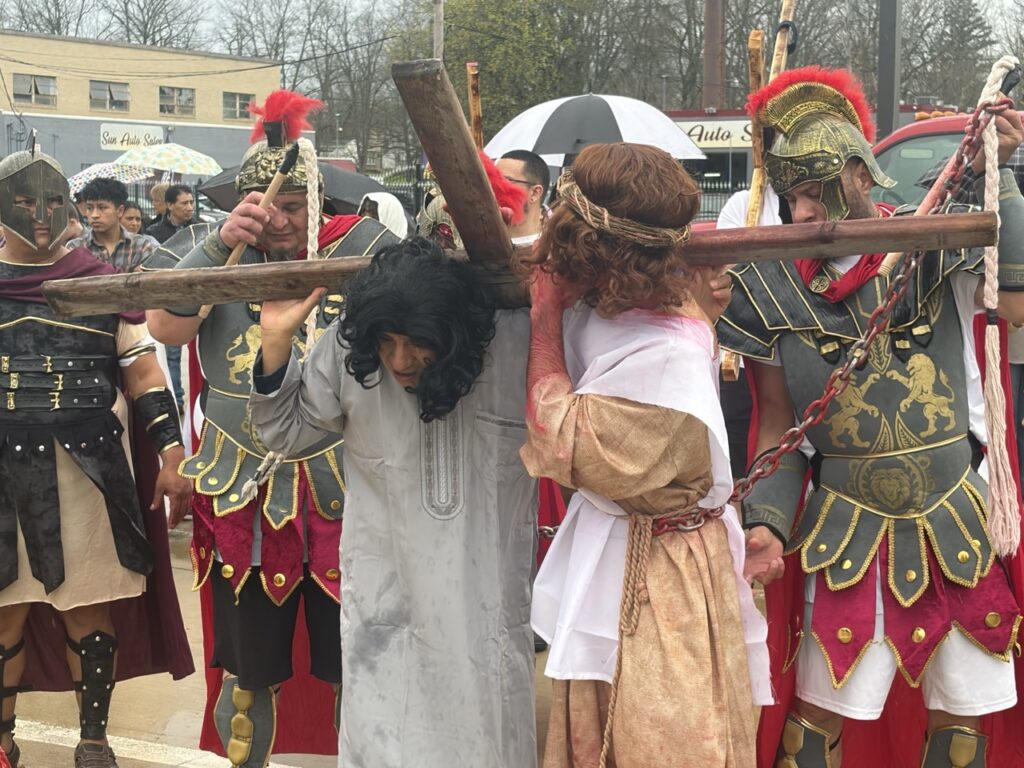
Guatemalan Mario Ruano, who portrayed Jesus for the third consecutive year, emphasized the honor of participating: “It is a great privilege and an immense joy to be able to carry forward this devotion—a unique moment in which we unite ourselves with the suffering that our Lord Jesus endured on Calvary for our sins.”
The integration of the American community was also noteworthy. Tom Landry stated that participating in this procession was a wonderful experience because it united both communities, and participating together demonstrated that, while a language barrier exists, there is something that unites everyone: the love for Christ. Similarly, Samuel Bevilacqua—who played the role of Barabbas—remarked that his participation was enriching because everyone belongs to the same parish, and “it is simply a blessing to be able to take part in this initiative, seeing how the Hispanic community and the English-speaking community cooperate and work together to commemorate the Passion of Christ and His love for us.”
Finally, the message of hope accompanying the Stations of the Cross was emphasized by Father Davis, who said he hoped that participants and attendees would remember that, while the Crucifixion depicts some very heavy, very difficult moments, ultimately there is the Resurrection of Jesus Christ—and that in those difficult times, “we must persevere and have patience, because God is right there beside us, waiting to bring us light in our darkest moments.”
The Hispanic community in Santo Domingo remains very active. It is now preparing for the procession of the Virgin of the Cloud, an object of deep devotion in Ecuador. The procession will take place next Sunday, May 17, alongside a celebration at the parish center.
Estaciones del Vía Crucis de la Parroquia de Santo Domingo

Durante varios años, la comunidad hispana de la Parroquia de Santo Domingo en Youngstown (condado de Mahoning) ha escenificado una representación viviente del Vía Crucis. Cada año, los fieles se preparan para esta procesión de Viernes Santo, la cual conmemora la Pasión y Muerte de nuestro Señor Jesucristo. Sin embargo, este año el evento contó con un elemento singular: unió tanto a la comunidad hispana como a la anglosajona. El párroco, el Padre dominico Frassati Davis, destacó que las reflexiones escritas por San Alfonso de Ligorio, las cuales fueron leídas durante cada una de las Estaciones, resultan familiares para los miembros de ambas comunidades: tanto la de habla inglesa como la de habla hispana.
Él dijo: “Cuando compartimos la tradición de recitar estas oraciones, el idioma no importa; la acción que presenciamos y las imágenes que podemos contemplar durante el Vía Crucis viviente nos ayudan a adentrarnos en el misterio de nuestra fe: que Jesucristo nos ama tan profundamente que tomó su cruz por todos y cada uno de nosotros”.
Para el Vicario Parroquial de Santo Domingo, el Padre dominico Charles Rooney, esta fue la primera vez que presenciaba un Vía Crucis viviente; una experiencia que, según dijo, resultó a la vez poderosa y profundamente conmovedora. Añadió: “Caminar al aire libre y ser testigo de cómo se desarrolla ese drama en vivo, con Jesús sufriendo bajo el peso de la cruz y la brutalidad de los soldados, subraya profundamente la intensidad del amor de Dios por nosotros en la Cruz, así como el amor de Cristo por el Padre”.
Rosemary Cintrón, Griselle Figueroa Ríos y Zayda Colón organizaron este Vía Crucis; sin embargo, muchos miembros de la parroquia, así como miembros del Movimiento Juan XXIII, trabajaron durante semanas para hacer posible este evento. A pesar de la lluvia que amenazaba con obstaculizar la procesión, esta transcurrió según lo previsto, demostrando la fe y el compromiso de todos los participantes.
La procesión recorrió las calles aledañas a la iglesia en Youngstown, ofreciendo una conmovedora representación de la Crucifixión y Muerte de nuestro Señor Jesucristo. A lo largo del recorrido, el profundo impacto emocional en los asistentes fue palpable; algunos, con lágrimas en los ojos, meditaban en silencio ante cada estación. La recreación trascendió las barreras del idioma, pues los residentes del vecindario, muchos de los cuales no hablaban español, salieron a las puertas de sus casas para presenciar la procesión y siguieron respetuosamente la narración de las estaciones en español. La imagen de Jesús cargando la Cruz se elevó por encima de cualquier división cultural o lingüística, transmitiendo un mensaje universal de amor, sacrificio y esperanza.
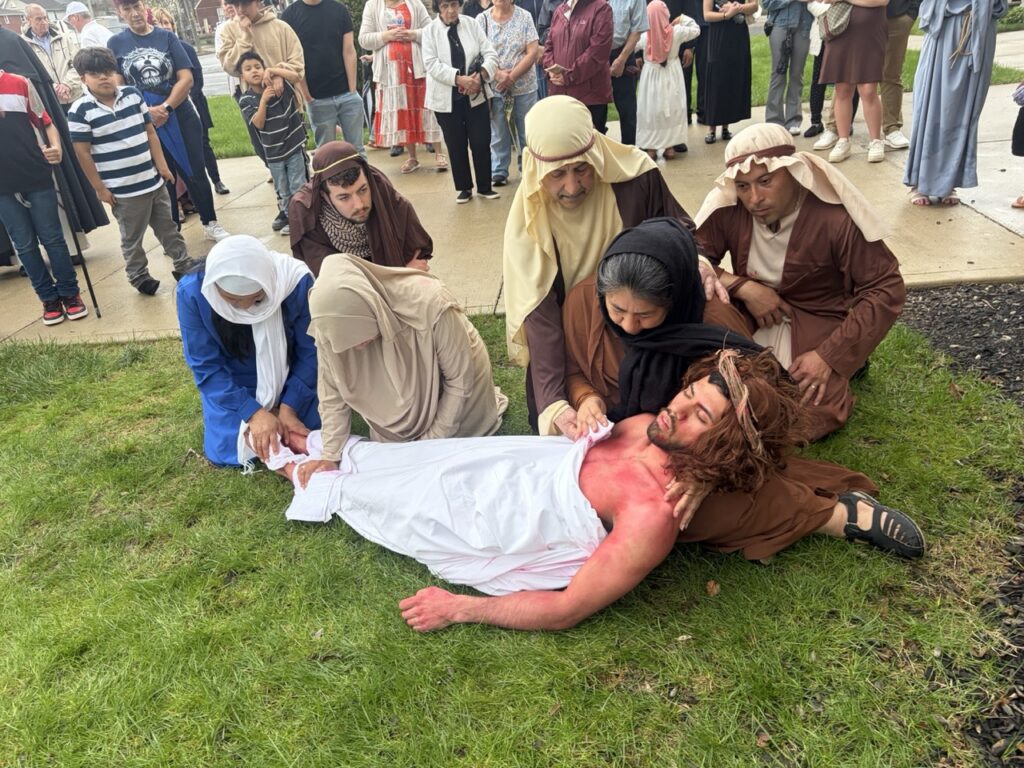
El Vía Crucis viviente en Santo Domingo es una iniciativa comunitaria que une a personas de todas las edades y orígenes; tal como expresó Cintrón: “Este es un equipo con el que hemos forjado una hermandad. Todos han contribuido por igual. Todo lo que presenciaron este año se debe a que el Espíritu Santo nos ungió, a que todos participaron verdaderamente. Niños, jóvenes, personas mayores y, por primera vez, angloparlantes se unieron a nosotros. Ha sido intenso, un trabajo arduo, pero ha valido la pena”.
Edwin Rodríguez, quien interpretó a uno de los soldados, dijo: “Estamos agradecidos con todos los que estuvieron aquí con nosotros para compartir esta experiencia. Representamos la Pasión de Jesucristo para mostrar al mundo entero el sacrificio que Él hizo por cada uno de nosotros”.
Por su parte, Luis Silva, miembro del Movimiento Juan XXIII que interpretó al discípulo Juan, destacó el valor tanto de la experiencia personal como de la comunitaria: “Nos hemos dado cuenta de que, con cada año que pasa, el Vía Crucis se convierte en parte de nuestra familia. Transmitimos mensajes destinados a ayudar a todos a compartir el dolor y el sacrificio que padeció el Señor; es un momento de reflexión para todos nosotros”.
Figueroa expresó su orgullo por la unidad de los hispanos, que se congregan en torno a un propósito común: “Entre los participantes hay una gran diversidad de nacionalidades, y todos estamos unidos para transmitir un mensaje claro respecto a la Pasión y muerte de nuestro Señor Jesucristo, y para que aquellos que aún no lo conocen lleguen a comprender el verdadero amor de Jesús”.
El guatemalteco Mario Ruano, quien interpretó a Jesús por tercer año consecutivo, destacó el honor de participar: “Es un gran privilegio y una inmensa alegría poder llevar adelante esta devoción; un momento único en el que nos unimos al sufrimiento que nuestro Señor Jesús padeció en el Calvario por nuestros pecados”.

La integración de la comunidad estadounidense también resultó digna de mención. Tom Landry afirmó que participar en esta procesión fue una experiencia maravillosa, ya que unió a ambas comunidades; además, el hecho de participar juntos demostró que, si bien existe una barrera del idioma, hay algo que une a todos: el amor por Cristo. Del mismo modo, Samuel Bevilacqua, quien hizo el papel de Barrabás, comentó que su participación fue enriquecedora, dado que todos pertenecen a la misma parroquia, y que “es, sencillamente, una bendición poder formar parte de esta iniciativa, al ver cómo la comunidad hispana y la comunidad angloparlante cooperan y trabajan juntas para conmemorar la Pasión de Cristo y su amor por nosotros”.
Finalmente, el mensaje de esperanza que acompañó a las Estaciones de la Cruz fue enfatizado por el Padre Davis, quien dijo que esperaba que los participantes y los asistentes recordaran que, si bien la Crucifixión representa momentos muy duros y muy difíciles, en última instancia existe la Resurrección de Jesucristo y que, en esos tiempos difíciles, “debemos perseverar y tener paciencia, porque Dios está justo ahí, a nuestro lado, esperando traernos luz en nuestros momentos más oscuros”.
La comunidad hispana en Santo Domingo se mantiene muy activa. Actualmente se prepara para la procesión de la Virgen de la Nube, objeto de profunda devoción en Ecuador. La procesión tendrá lugar el próximo domingo 17 de mayo, junto con una celebración en el centro parroquial.