The Diocese of Youngstown’s Newest Priest

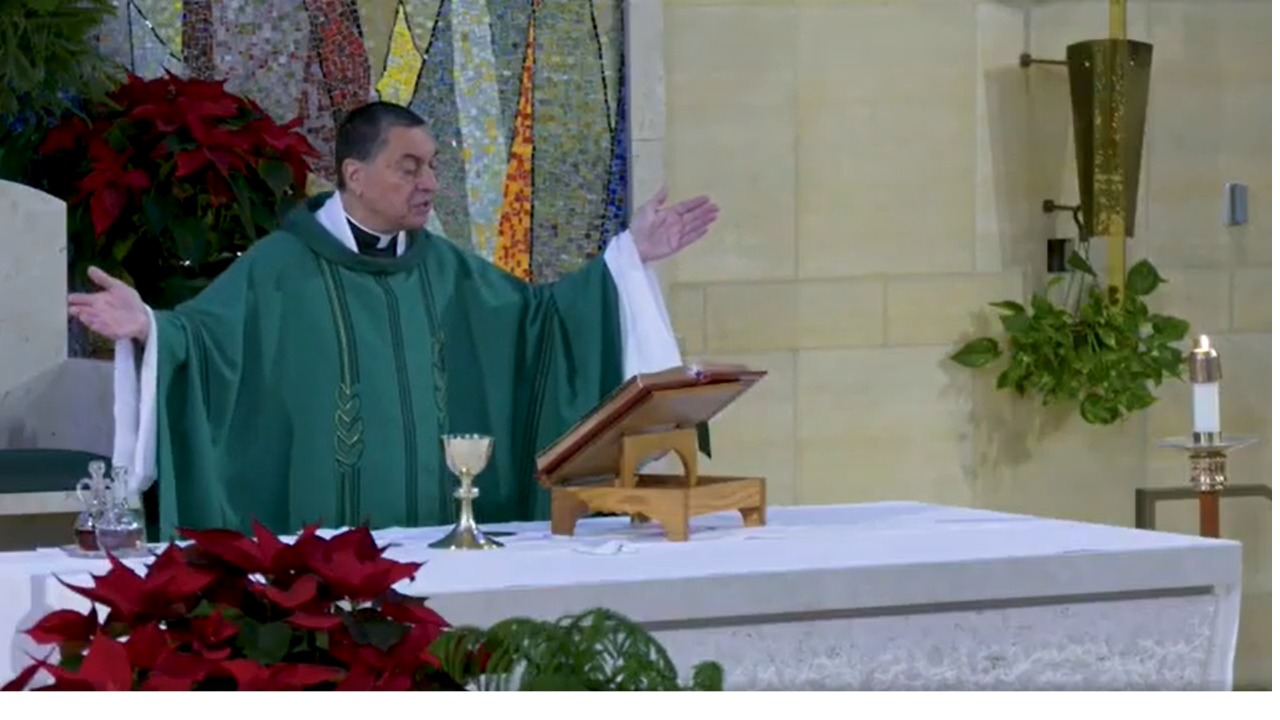
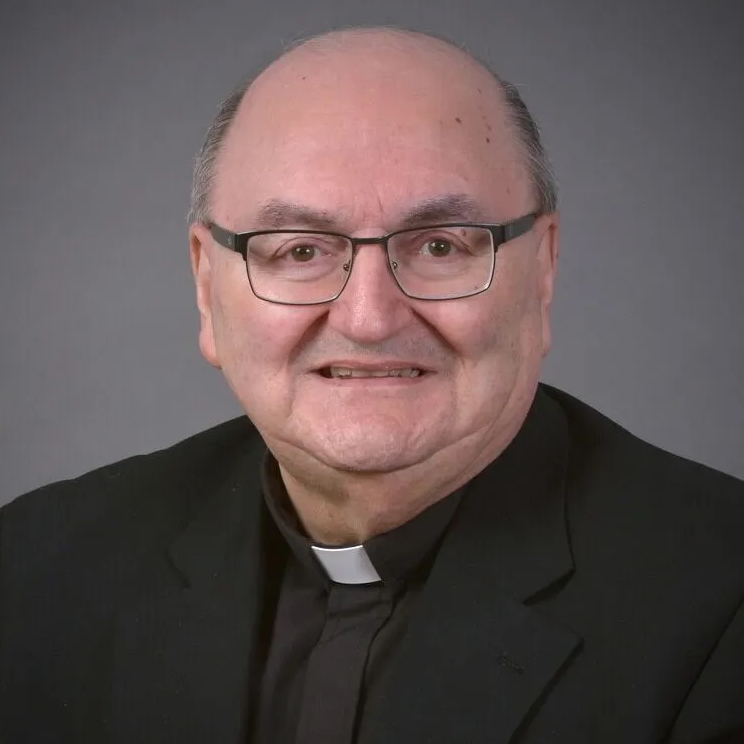
The Diocese of Youngstown’s newest priest, Father Travis Seagraves, was ordained to the priesthood by Bishop David Bonnar on June 7, 2025, at St. Columba Cathedral. Since his ordination, he has been assigned as an associate pastor at SS. Philip and James Parish in Canal Fulton and Divine Mercy Parish in Massillon, where he is settling into life in the rectory on the St. Barbara Church campus. Get to know him in the interview below—including his background, what the discernment process was like for him and what he hopes for his priesthood—which was conducted during the first week of his new assignment, on July 11.
Tell us about your early life.
I’m from the east side of Warren. I went to Howland High School … I guess my story is a little unique. Most people I know now went to Catholic schools, but I’m a product of public education. I graduated Howland in 2012.
I have three sisters, and I have a twin brother [Troy]. My brother and I were always very close. I really liked just spending time with my brother. Since we were twins, we kind of developed our own personal language with each other. Then we had to learn English—so English was like a second language. But we would play video games, and we played board games. Now, I play rather intense board games, like designer board games, which is something Father Kevin Bertleff and myself have in common—same with Father Fritz Schleuter and Father (Connor) Hetzel. We all really enjoy board games together.
I did not grow up Catholic, though. I’ve always been very academic. Like, even as a kid, I just really liked learning. Even today, I still like learning. So when I was in high school … I [got] really into politics, but also really into spirituality. And so I was very much full throttle for both … So, through the workings of one of my sisters, I found myself in a Southern Baptist church in high school. And we both worked really hard to get the rest of our family in there as well. And so our entire family, all seven of us—mom, dad and five kids—were going to the Southern Baptist church in Niles for a couple years.
What did you do after high school?
I went to Ohio State for my undergrad, and I’m still very passionate about my faith. I actually thought about becoming a Baptist preacher … But I went to study history. And my brother—he studied philosophy. And we were learning critical skeptical philosophy as well as the critical historical method … and I started getting kind of worried. I still had my faith, but everything I was learning had to be able to hold water against the challenges that [our educations] were presenting.
Long story short, I did a ton of research because I had to figure out what the truth is. And one thing that you can do when you study history and philosophy is research. You can think critically. Those are the skills that you learn. And so, I eventually found out that my Southern Baptist faith wasn’t going to cut it. I had to find something more historical, more grounded—and I found the Catholic Church. And the thing was, I didn’t have any Catholic friends. So I actually found out the hard way that about half the friends I had—we were all evangelical Protestants—but half of them were, like, very anti-Catholic. So I did end up losing a lot of friends when I was really becoming serious. But I really needed to do this. I needed to go become Catholic.
I almost had to do it by myself. It was kind of a last-second thing that my brother decided to come with me in the RCIA, because I was afraid to go to Mass on my own. Because it’s scary to do things on your own! Plus, I grew up as a twin. So, I never did anything on my own—it was always with him. Actually, while we were going through the RCIA, he was dating the daughter of an Evangelical pastor and feeding her everything that we were learning. The next year, she joins the RCIA. He proposes to her, and now they’re married!
So anyway, we’re sitting in the back of Mass, in the back of the church, and I’m just watching Mass happen. It was at St. Andrew’s Parish in Upper Arlington, by Columbus. When you do history, there’s a ton of footnotes, right? So it was like “fun with footnotes” for the hour that we had Mass. It was All Saints Day, so there were smells and bells and everything. And I remember being like, “Oh, my gosh! The second apology of Saint Justin Martyr talks about this! Saint Clement of Rome—when he’s first led to the Corinthians—talks about this!” And I’m seeing all this and I’m like, “This is amazing!” So right after Mass, we talked to the priest … In 2016, we both entered the Church at Easter.
When did you feel the call to the priesthood?
It was in my senior year of college that I [became Catholic]. And I continued to finish up the degree in history with a minor in philosophy. You can’t help doing that when you live with a philosopher! But it was during the RCIA process that I, again, kind of felt like, “What if I went into ministry, but this time as a Catholic priest?” Which was kind of scary because, I’m not even Catholic yet, and I’m already thinking about becoming a priest! I didn’t want to rush things because, you know, there’s, conversion zeal. You kind of get overwhelmed by all this cool stuff going on … I continued talking to people—even talked to a few priests—and I visited the seminary down in Columbus because it was the closest one. And I felt like, “Yeah, you know, let’s give it a shot. Let’s see what happens.” But they did want me to wait two years because I was a convert, before I would even apply.
How did people react to your decision to enter the seminary?
So I go back home to Warren, and I end up working at Howland Public Schools, as an educational assistant—just for two years … It was kind of funny—I was working with a bunch of these teachers, right? And they were like, “You’re a young, good-looking guy. Why don’t you have a girlfriend?” And I would say, “ Because I’m thinking about becoming a Catholic priest!” They’d say, “Oh, I’m so sorry!” I’m like, “Wait, what?” … But they understood that Catholic priests are not married, and they didn’t want me to—I don’t know—start second-guessing things or something.
My family really didn’t know what to think—especially my dad. Because my mom actually comes from a Methodist background … But my dad, he didn’t have that background. So he would ask, “Why do you want to go be a priest? Why don’t you want to be married?” And I’d say, “It’s not that I don’t want to be married. It’s that I think God has called me to this.” Like, don’t get me wrong. I still love women. They’re wonderful. But I’d say, “I think I’m called to this. I think I’ll be happy this way.” It took two years for him to accept that this was right for me. I remember, actually. I was packing my bags to go move into seminary [in 2018], and my dad was in the kitchen. He was washing dishes, and he just kind of takes a break and comes over and is talking to me … and he said, “You know, I think this is right for you. I think what you’re doing is good.”
What was seminary like?
Definitely the biggest highlight is just the prayer. They say, “in the seminary you take a lot of classes, but the real formation happens in the chapel.” So if you’re not frequently going to chapel, then you’re just not doing it right.
I already studied philosophy, and they made me retake all my philosophy, but it was a nice refresher. I already knew all that stuff—most of it—[now] I was learning it from a Catholic perspective, which was definitely different. And so there were a lot of times when—because, again, I’m a product of public education—I just looked at things differently than my classmates or even my professors did. [It] was always a little tough when they would say something like, “Oh, yeah, obviously.” And I’d say, “I’m not so sure about that.” … So I was a lot more hesitant about things, and maybe it’s just because I was trained that way at Ohio State. There was a clear distinction between those who definitely grew up in a more Catholic bubble and those who didn’t … And there were very few of us who didn’t, but we did kind of find each other and find that camaraderie with each other. … After a few years, [I realized] I’m just as much of a member of this community as anybody else is, and our differences are not problems. Our differences help enrich the community itself.
Did you focus your theology studies on any specific topics?
For my MA, my thesis [focused] on the Sacrament of Reconciliation. It’s kind of funny—it’s the one sacrament where you need to fail before you can go receive it. You can’t do the sacrament unless you have sins to confess … And it’s scary too. When you go through the training for Reconciliation, you have to learn all these different euphemisms, because we’re afraid to say what we actually did.
Tell us about some of your pastoral assignments.
As a [transitional deacon], I was up in Ashtabula County at four parishes … the bishop had asked me to learn Spanish—there is a Hispanic community in Ashtabula, so I was able to minister to them a little bit. I’m still working on [my Spanish]. I went to Columbus for like eight weeks and did a pseudo-immersion program. The following summer, after I became a deacon, I was in El Salvador for five weeks, and I had to kind of learn Spanish as I was going. To be entirely honest, it was the most difficult thing I’ve done in my life … But I definitely learned a lot of Spanish. There’s just that psychological hurdle you need to get over. You just need to accept that you’re going to fail all the time and just be okay with that—and actually just kind of have fun with it.
What has the past six months been like for you?
It was definitely a difficult time. I mean, it’s scary leading up to Ordination. This is a really big change in your life … And there’s always the concern of, “Well, what if?” Like, “What if, like, I do this for a few years and then I realize it’s not for me?” “What if I fall in love?” “What if I’m just not a very good priest?” And so it is scary. But then you also learn to really abandon yourself … and you just kind of say, “Well, God, you’re in charge. Whatever happens, happens, and I must trust You.”
What was your Ordination Mass like for you?
Again, it was kind of scary. But everything in my life was leading up to this point … I remember the whole thing. I don’t remember exactly the songs that were being sung—I wasn’t paying attention to that—but I remember the Bishop’s homily. And I remember the vesting—that, like, really hit me. There’s this phrase from the Gospel of John when Jesus is talking to Peter. He talks about how when you were young, you clothed yourself and went wherever you wanted to go. But when you are older, others will clothe you and send you where you don’t want to go … There’s a reason why, when you are ordained, you don’t vest yourself, and others vest you. It’s not that you’re sent where you don’t want to go, but rather you are sent on mission, and you realize, “My life doesn’t belong to me anymore.”
That’s one of the reasons why I really like wearing my collar. Because … I don’t belong to me anymore. I belong to God. I’m not trying to show off to anyone else. It’s a reminder for me.
What has your first priestly assignment been like so far?
I moved in on June 16. I think my assignment officially started July 1. It’s a lot of, you know, learning from mistakes. My first Mass [I] said here, I was like, “Where’s the preface?!” So I’m opening up the book and saying to myself, “I got trained how to do this. I know how to open the book.” It’s just sometimes you just … second-guess things. But the people are very, very patient.
What do you hope to accomplish as a priest?
I do hope to improve my Spanish. Especially being here—we have a lot of Guatemalans, and when you talk to them, you realize that these are people that really need to be ministered to. Especially with everything that’s happening in politics right now. People are scared. And you need to give them the Gospel. Give them the peace that Christ alone gives us.
We also have two schools—one in Canal Fulton and one in Massillon. When school starts up, I hope to be more present for them. And, honestly, [I want to] just learn how to be a good and holy priest, because everything’s new.
What advice would you give to someone who thinks they may be experiencing a call?
Two things: 1). Pray. Like, actually, really pray. Especially if you’re scared. 2) Do it. Because … it’s comparable to asking out a girl. You’re like, “I think she’s pretty. I like her personality. I think we would work out, so let’s go ask her,” right? How are you going to be able to figure anything out if you don’t go ask her? Like, there’s a point where all theory, all thoughts, all dreams aside, you just have to go do it. And even if you completely fall flat on your face, that’s OK. Seminary is now [seven or more] years. It’s a long time, and it’s supposed to be that long! You don’t wake up one day and be like, “Yep, I’m going to be a priest.” It takes a long time, and you will change. You might say, “But I have all these flaws, I have sins,” right? And yes, all of us do. But those change. You will change. But it all starts with that step of actually doing it, actually talking to your priest, actually filling out the paperwork.