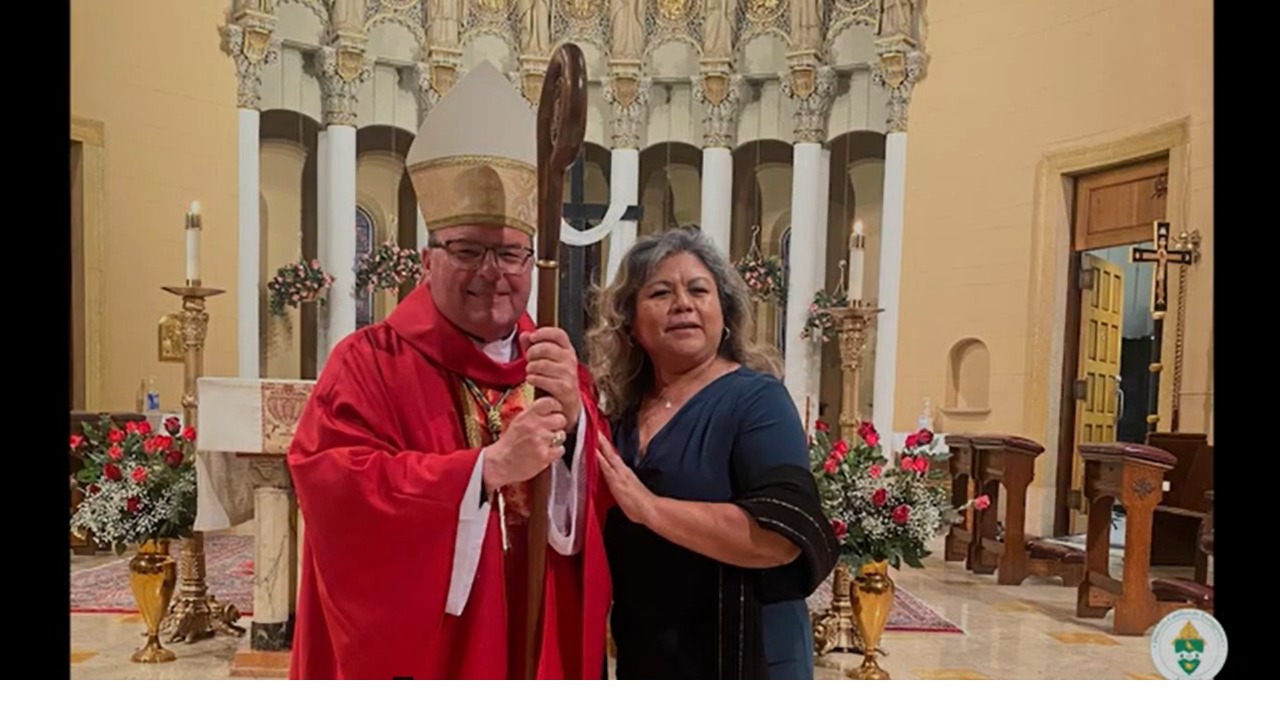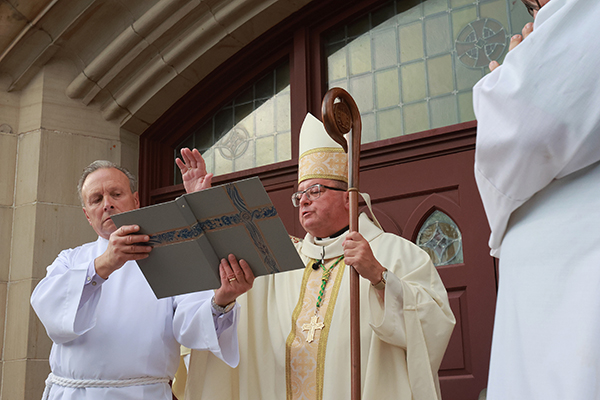
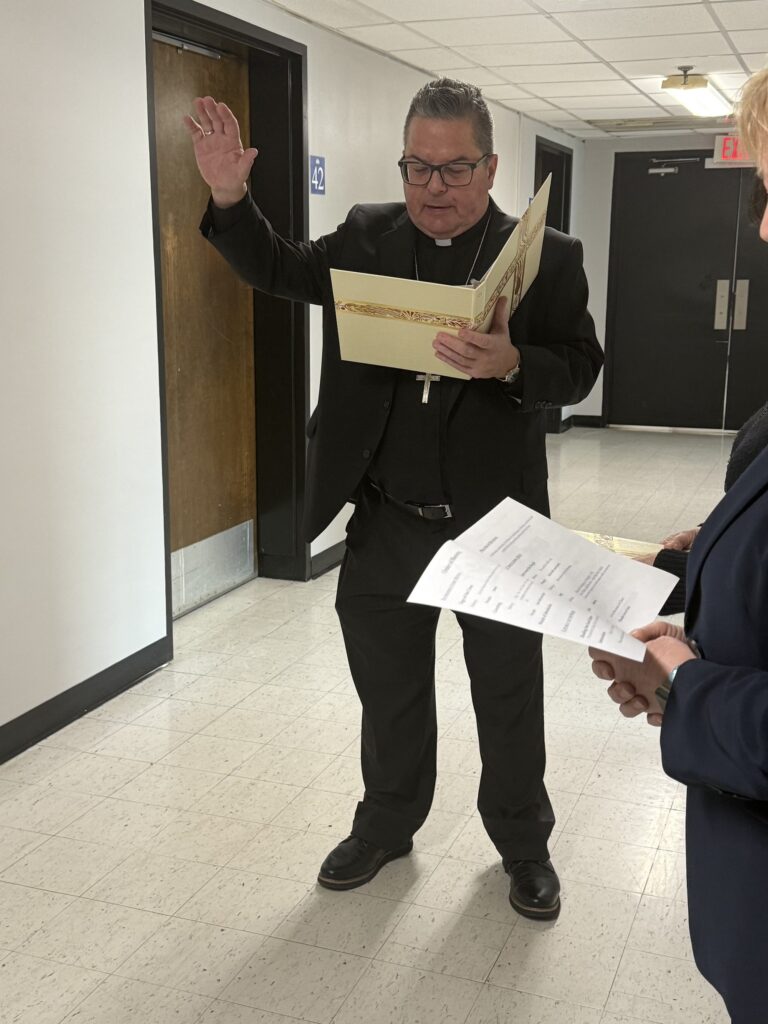
The blessing of Respite of Hope by Bishop David Bonnar on January 8 was more than a ribbon-cutting—it was the culmination of a faith-driven idea shaped by sacrifice, collaboration and a commitment to restoring dignity to the most vulnerable.
The new medical respite care facility, located at Meridian HealthCare in Youngstown, provides short-term residential care for individuals who are medically stable but lack safe housing to fully recover from illnesses or injuries. The project is the inaugural medical respite initiative of Catholic Charities Regional Agency and was developed in partnership with Mercy Health St. Elizabeth Youngstown Hospital, Mercy Health Foundation Mahoning Valley, Meridian HealthCare, the Ursuline Sisters of Youngstown, the Sisters of the Humility of Mary and private donors.
The idea for Respite of Hope began with Dr. Melinda Smith, a retired physician who saw firsthand how patients without stable housing often fall through the cracks of traditional medical care. Smith said the concept took root after she read about a similar medical respite program developed by Benedictine sisters in Bismarck, North Dakota.
“I thought, if a small place like Bismarck could use one of these, why wouldn’t Youngstown?” Smith said.
Smith brought the idea to Mercy Health leaders, including Dr. James Kravec, chief clinical officer for Mercy Health in Youngstown and Lorain, and to hospital social workers who regularly faced the challenge of discharging medically stable patients with nowhere safe to go.
“The social workers immediately said yes—absolutely, we need this,” Smith said. “These are the people on the front lines, day in and day out, trying to place patients who aren’t sick enough to stay in the hospital but aren’t well enough to go to a shelter.”
Shelters, Smith noted, often cannot accommodate patients with medical needs such as IV antibiotics, oxygen or limited mobility—and many require residents to leave during the day.
“What do you do if you’re recovering from surgery or an infection and you don’t have a home?” she said. “That’s the gap this program fills.”
Kravec said those early conversations revealed both the scale of the need and the necessity of collaboration.
“At first, we asked if this was something Mercy could do on its own,” Kravec said. “It became very clear, very quickly, that it couldn’t be. This would take Catholic Charities, the religious communities, Meridian and many others. None of us could do it alone.”

Tami Cook, market director of care management at Mercy Health, said her team regularly encounters patients whose recovery is delayed—or derailed—by a lack of safe housing.
“If you don’t have running water, how do you heal an IV site?” Cook said. “If you’re homeless and need prep for a colonoscopy or recovery after anesthesia, where do you go? A place like this becomes a bridge.”
As planning continued, Catholic Charities Regional Agency emerged as the lead agency, with Mercy Health Foundation Mahoning Valley serving as fiscal sponsor. The search for a physical location ultimately led to Meridian HealthCare, which offered space at its West Chalmers Street facility.
“That was a turning point,” said Nancy Voitus, executive director of Catholic Charities Regional Agency. “Meridian immediately said yes. They see the same people we see. They understand the health issues tied to housing instability.”
Larry Moliterno, president and CEO of Meridian HealthCare, said the project reflects the organization’s long-standing mission to address the full scope of a person’s well-being.
“This building was once a nursing home, and now it’s come full circle,” Moliterno said. “Our goal has always been to care for the whole person—physical health, emotional health, housing, relationships. This partnership does exactly that.”
Voitus said the project was sustained by a shared sense of purpose that kept the focus on service rather than credit.
“Everyone left their ego at the door,” she said. “This has been about the mission from the beginning.”
Kravec, Smith and Cook also noted that the work will now shift to sustainability. They said that because Ohio is not a state that offers coverage for this care, it will be important to spread the word to secure funding through various avenues.
“This is going to take great effort from the community,” Kravec said. “With the gaps that this facility fills—and the help it will provide to so many—I know people will continue to come together to ensure its future.”
That spirit of unity was echoed during the blessing by Bishop Bonnar, who praised the project as a tangible expression of the Church’s call to accompany the poor, the sick and the vulnerable.
“This is what it means to continue the mission of Jesus,” Bishop Bonnar said. “We are always stronger when we work together—especially when the work serves those most in need.”