Associating a saint with a particular cause is usually the work of the people in the pews. They hear the story of a saint and see something in his or her life that applies to their own life or situation.
It’s usually very straightforward: Saints Cosmas and Damian were doctors, so they are the patron of doctors; during her martyrdom, all of Saint Apollonia’s teeth were knocked out, so she is invoked against a toothache; Saint Joseph labored as a carpenter, so he is the patron of all workers.
But once in a great while, the pope steps forward and formally declares a particular saint to be patron of a particular cause. That is what happened in 1979, when Pope Saint John Paul II proclaimed Saint Francis of Assisi the patron saint of the environment.
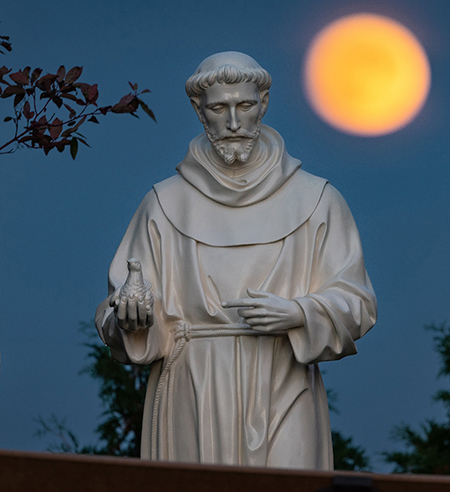
It’s not unusual to find statues of Saint Francis standing amid a flowerbed or perched on the edge of a birdbath. Some of them are handsome works of art, and some are fairly sentimental, with cute bunnies and fawns at Francis’ feet and birds sitting in the palm of his hand.
Sentimental yard art can be a little hard to take, but there are worse things that have happened to poor Saint Francis. Francis—one of the most popular saints among Catholics and non-Catholics—has sometimes been recast as a sun-and-moon worshipping pantheist. This characterization of Saint Francis is deeply flawed.
The man was profoundly, unshakably committed to the Catholic faith. When he contemplated the natural world, he did not see a collection of “spirits,” but a gloriously complex, interrelated system that reflected the splendor, the goodness and the generosity of God. His famous Canticle of the Sun is a hymn of praise and thanksgiving to the Creator for all the wonders of creation.
It is because Saint Francis loved and cherished the universe God made and all the creatures in it that Saint John Paul named him the patron of the environmental movement.
Francis began composing the Canticle of the Sun in 1225. He wrote in the style of the troubadours, the romantic poets he had tried to imitate when he was a teenager running the streets of Assisi. In order for his hymn to reach the widest possible audience, he wrote it in Italian rather than Latin. From time to time, he added new verses. It’s likely that some of these were lost because Francis appears to have added verses spontaneously to fit a particular moment.
He composed some lines on the virtue of forgiveness (this verse has come down to us) after he had arbitrated a dispute between the bishop of Assisi and the governor of the town. He made his final addition to the Canticle as he lay on his deathbed. “Praised be my Lord for our Sister mortal death, from whom no man alive will escape,” Francis sang.
Saint Francis is the patron saint of animals and animal welfare societies. He is also one of the patron saints of Italy, and of the Archdioceses of Denver, San Francisco and Santa Fe, New Mexico. His feast day is October 4.
The late Thomas Craughwell was the author of more than 30 books, including Saints Behaving Badly and This Saint Will Change Your Life.
Saint Francis of Assisi’s Jubilee Year
On October 4, Catholics across the world will celebrate Saint Francis’ Feast Day, but this year is special. Pope Leo has declared 2026 the Jubilee Year of Saint Francis, marking the 800th year of Saint Francis’ death. Included on page 7 are local events marking this important jubilee year. For additional jubilee resources, visit www.DOY.org/year-of-st-francis/.