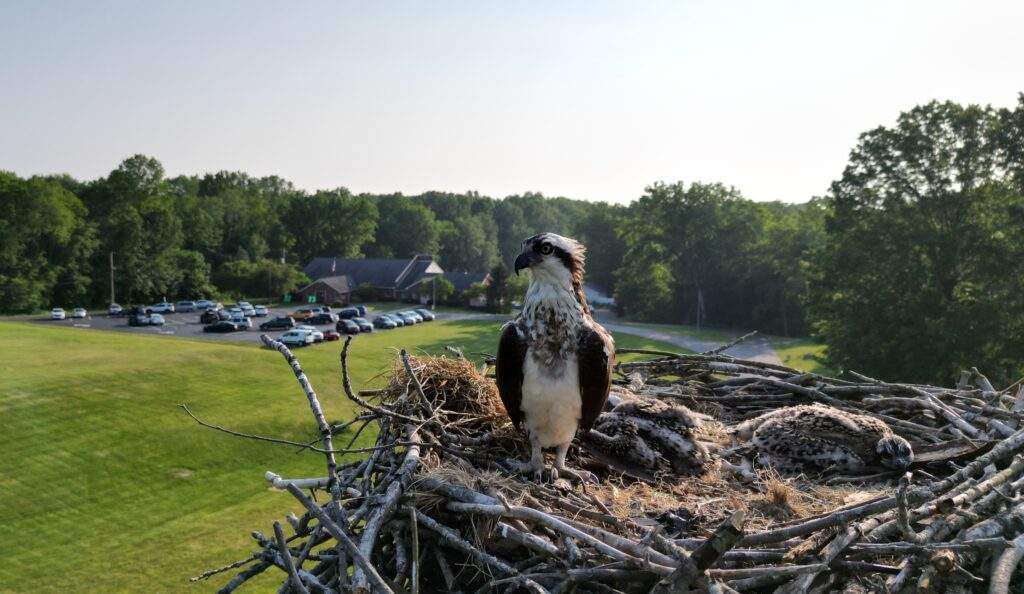
About a decade ago a new family came to St. Robert Bellarmine Parish—but they never registered.
One spring, a family of ospreys, a large fish-eating raptor or bird of prey, took up residence atop an electric pole on the parish grounds, noted Father Carl Kish, recently-retired longtime pastor of St. Robert’s in Cortland, a Trumbull County parish north of Warren.
The osprey have been coming back every year since.
“They come, usually in March and April. They go to Mosquito Lake and a couple other local waterways to feed,” Father Kish said. “They have their little ospreys and around fall they head back and go wherever they go.
“Thank God, Ohio Edison built a five-foot extension with a platform for the utility pole” to ensure that the birds are not threatened by the power lines, he explained.
Heather Merritt, director of Birds in Flight Sanctuary, a wildlife rescue, rehabilitation and treatment center and educational outreach operating in Ohio and parts of Pennsylvania, is familiar with the osprey at St. Robert and has worked with Ohio Edison in helping to ensure the safety of the nesting osprey at various locations. “Ohio Edison has gone to considerable expense.”
The brown and white raptors are a striking sight. They are often mistaken at a distance for eagles, Merritt continued. “They appear much larger than they actually are because of their wide wingspan”—which can be 60 or 70 inches. “They are smaller than eagles, closer to the size of red-tailed hawks.”
Father Kish had photos of the ospreys on his desk when the Catholic Echo spoke to him but he was far from the only parishioner taken by these birds that are frequently seen over the parish grounds with their long wings in flight, as well as sitting in their nests tending to their young ones.
“They are somewhat of an attraction,” explains veteran parishioner Ed Chopko, who said that people drive on to the parish grounds to watch the osprey from the driveway.
“You have to be awed,” said John Martin, who for 25 years served on the parish council. “They are magnificent birds. They hunt at dawn and dusk—and at all hours really—and you see them swoop down.”
“They are quite fascinating to watch,” noted V.J. Carr, parish groundskeeper, custodian and maintenance manager.
After coming in the spring to “they lay their eggs—they usually have about three babies—you can see them bringing fish back to their babies. It’s neat,” Carr commented. “The babies or fledglings start flying on their own about July.”
“People look for them when they go to Mass.” Martin commented. “You could say that the parish adopted those birds.”
“I hope that they don’t get transferred to another parish,” one waggish anonymous parishioner quipped.
Merritt pointed out that those outside of the birdwatching community might be unfamiliar with ospreys or the fact that there are so many in Northeast Ohio. Though more people are aware of the presence of bald eagles, “osprey are probably here in greater numbers.
“If you drive up Route 11 toward Ashtabula, just about every tower you pass will have an osprey nest,” Merritt said. “Osprey can build a nest almost everywhere that is close to water and fish and Ohio has a lot of water.”
Decades ago, the osprey were endangered like the bald eagle, but like the bald eagle, the osprey have come back—particularly with the banning of the pesticide DDT, Merritt explained.
In addition, Merritt noted, efforts by the state division of wildlife to stock various bodies of water has also fostered the growth of the osprey population.
“They are really cool birds. To watch them fish is something,” Merritt said. “They’ll go all the way under the water to catch a fish.”
Though the general population is less aware of the osprey, St. Robert parishioners have had had ample opportunity to experience them in full view.
“They really represent the grandeur of nature,” Martin remarked. “God really know what He was doing when He created those birds.”