In 1951 Father George P. Mulroy had a problem. His 85-year-old church built in Kent just after the end of the Civil War was woefully undersized for the booming growth of St. Patrick Parish. So Father Mulroy put together a fundraising team to personally meet every parishioner and secure their pledge for a new church. The pastor also mailed out a poster-sized form to encourage memorial donations for everything inside the new church, including 16 stained glass windows in the nave.
“Windows can be memorialized in the name of a saint,” the poster form promised. Father Mulroy’s team of fundraising captains collected 16 $1,000 donations for windows in the nave—all 16 donors are listed in the 1952 list of memorials. For example, parishioner George J. Altman chose the St. Margaret May window. And least one of the window donors chose a window of his own patron saint. Mr. and Mrs. Rocco Flogge likely donated the St. Rocco window—an unusual saint to find alongside the mostly apostles in the other windows. The bandaged leg of Saint Rocco and the dog that brought him sustenance are prominently pictured. Particularly interesting is the St. Thomas window, where Thomas scowls in the moment that he doesn’t believe that Jesus had been raised from the dead. His arms are crossed in a stubborn stance.


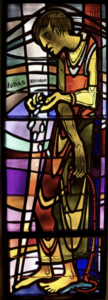
Perhaps Father Mulroy couldn’t install a specific donor plaque at the base of each window, because after construction began, it was discovered that there wouldn’t be room for eight windows on each side—as was originally planned. Instead, the south side of the nave would need to have ten windows and the north side of the nave would have seven. With 17 windows funded by donors, one window would not be in the nave—it would have to be on the south wall of the narthex on the south entrance. But what saint deserved to be relegated to the one wall, not in the main body of the church?
Judas was chosen for the window that wouldn’t be in the nave.
There is no record of who chose this window, but the Judas window in the narthex was listed as having been donated by Mrs. John C. Green and Francis A. Green. In the 1950 federal census, Francis Green was a rubber company electrical engineer residing with his wife and two children at 145 Chestnut Street, along with his 83-year-old widowed mother, Mrs. John C. Green, who was separately listed as the head of the house at that same address.
Apparently, the two of them shared the cost of the window. The Judas window is striking. Eight silver coins fall from his left hand as he holds a piece of rope in his right. His eyes are sunken, and a shadow covers his face—which is a picture of exhaustion. In 2014, Collette M. Jenkins, religion writer for the Akron Beacon Journal, interviewed Father Rick Pentello, the pastor at the time, on the significance of a Judas window in the church.
Father Pentello said, “Jesus loved Judas like the other apostles … Peter lived because he knew he could be forgiven. Judas believed he couldn’t be forgiven and died,” Father Pentello continued. “The message for us is no matter what we’ve done, we can be forgiven. “That’s who God is—a merciful, loving, forgiving God.”