Few words in the Gospel are so familiar—and sometimes taken for granted—as Jesus’ greeting to His disciples in the Upper Room after the Resurrection: “Peace be with you.” We hear these same words at every Mass. We share them ourselves in the sign of peace as an essential preparation before receiving Holy Eucharist. And yet, in these four simple words, we discover a gift from our Lord that has the power to transform our hearts and lives.
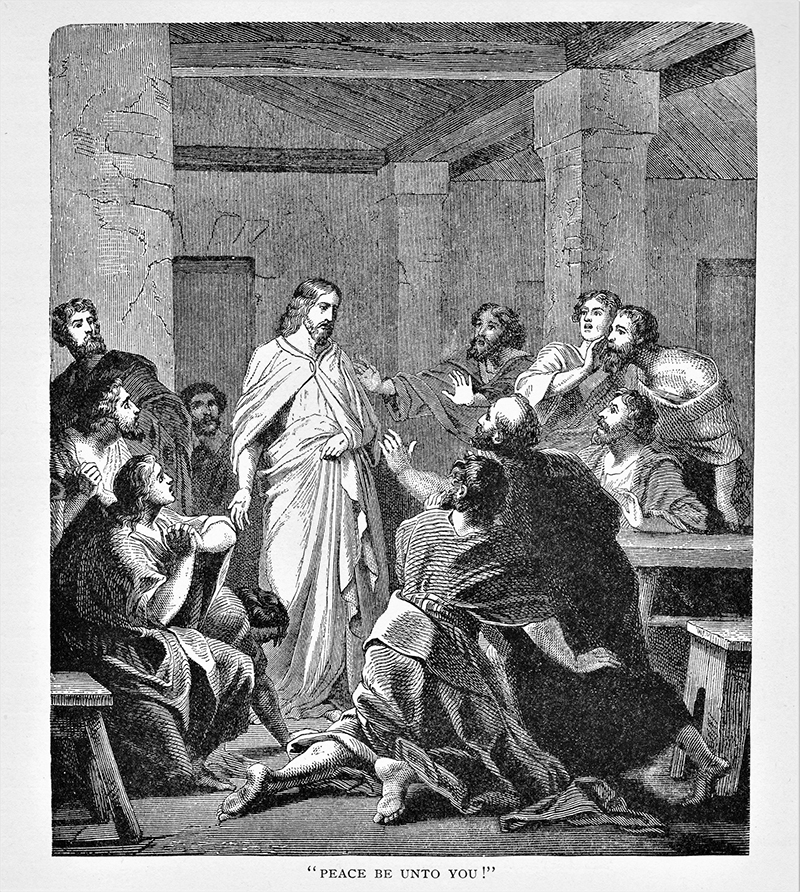
The setting in which Jesus shares these words on the evening of that first Easter Sunday matters to His first disciples and to us. “On the evening of that first day of the week, when the doors were locked, where the disciples were, for fear of the Jews, Jesus came and stood in their midst and said to them, ‘Peace be with you’” (John 20:19). To further set the scene: Peter had denied Jesus, and some of the disciples fled and abandoned Jesus at His darkest hour. They each must have felt like a failure. They were confused and ashamed.
It is precisely into that emotional mess that the Risen Christ appears—and He does not come with rebuke or disappointment, as if to question how they could have abandoned Him. Instead, He lovingly says to them, “Peace be with you.”
What Jesus does next is significant in understanding the peace He offers to those disciples in the Upper Room—and in turn to all of us. John tells us, “When He had said this, He showed them His hands and His side” (John 20:20). Jesus does this “above all to verify that the risen body in which He appears to them is the same body that had been tortured and crucified, for it still bears the traces of His passion” (CCC §645). The presence of the wounds on Jesus’ resurrected body reveal to us that He will forever bear them as signs of His victory over sin and death. In other words, the existence of the wounds on that First Easter teaches us that the glory of the Resurrection comes through the wounds of the Cross.
When Jesus says, “Peace be with you” and shows the disciples His hands and side that still bear the scars of love, He is revealing that the peace He offers is not a peace that avoids wounds—but a peace that passes through wounds. The peace Jesus shares is not void of suffering and pain but is a peace that can endure even through agony.
When we hear the word “peace,” we might think of it in a worldly sense, meaning a time and place without struggle or a freedom from hostility and war. However, in the Scriptures, peace (“shalom”) means something far more than simply the absence of conflict. Peace in the biblical sense signifies wholeness, harmony and right relationship with God, with others and with ourselves. Understood in this sense, we can receive the peace of Christ and embody it in our lives, even in times of struggle—even in the depth of our wounds.
This is an important lesson for us as disciples. We live in a world that is desperately seeking peace, yet we so often search for it in the wrong places. We try to fabricate our own sense of peace by controlling outcomes, avoiding discomfort and numbing ourselves to pain. We presume that peace can only be discovered when we have everything in order and every conflict in our lives resolved. But the peace Jesus offers is different—it is not dependent on circumstances. It is a peace rooted in His presence.
The disciples in the Upper Room did not suddenly find themselves in the best of circumstances. The threats against them and their reasons for being afraid had not diminished—and yet everything was different because the Risen Christ was standing in their midst, and their fear gave way to joy. John tells us, “The disciples rejoiced when they saw the Lord” (John 20:20). Peace did not come from a change in circumstances external to that Upper Room—peace came through an encounter with the Risen Christ.
The same peace is offered to each of us. Often, we might be tempted to postpone peace—until a health issue is resolved, or when the difficulties in our relationships improve, or when we have a certain degree of financial stability. Jesus is not waiting for us to get our lives together to share His peace with us. He comes into the rooms in our lives that we have locked—into our anxiety, our shame, our uncertainty, and He says to us, amidst those struggles, “Peace be with you.”
The gift our Lord offers us in sharing His peace has the power to change our lives because whatever our suffering might be, we can discover true and lasting peace, even as we endure our brokenness. If we allow Jesus to enter into our wounds and if we can see them in His hands and side, then by His grace, those wounds can become the very place where the light of His Resurrection can transform us. It is often through our wounds where we can deeply encounter the Risen Lord, and where He says to us, “Peace be with you.” The peace the world offers is unstable because it depends on the circumstances of our lives. Christ’s peace is not on the other side of our suffering—His peace is also in the suffering, because He is intimately in our broken humanity with us!
While this may bring us some degree of consolation, admittedly, it can take time for us to become more receptive to the Lord’s presence and peace while experiencing our wounds. That receptivity can be strengthened when we overcome the temptation to isolate ourselves by exposing our hurt to a trustworthy friend—especially to God through vulnerable and humble prayer. By offering our pain to the Lord, we can begin to trust that those wounds can become places of victory rather than shame. We can reject any lies we might believe about ourselves by spending time with our Lord in Eucharistic Adoration. Spending time in silence with our Eucharistic Lord can strengthen our openness in receiving His perfect love for us—not despite our wounds, but precisely because of them.
Finally, we can refuse any notion of self-sufficiency by deepening our encounter with the Risen Lord through the sacraments, especially Holy Eucharist and Reconciliation. By increasing our dependence on His presence and forgiveness, those familiar words will transform our lives: “Peace be with you.”
Few words in the Gospel are so powerful. May we allow the peace of the Risen Christ to pass through our wounds. His peace is stronger than our brokenness. His peace is stronger than even sin and death. His peace can change everything!