During the Second Vatican Council, the Church published a document on her relationship with the world, known as Gaudium et Spes: The Pastoral Constitution on the Church in the Modern World. Contained within this document is a statement that becomes more relevant each year: “Man is growing conscious that the forces he has unleashed are in his own hands and that it is up to them to control them or be enslaved by them. Here lies the modern dilemma.”
That modern dilemma articulated by the Council Fathers nearly 61 years ago is just as real today—especially regarding the development of Artificial Intelligence (AI). The Holy Father, Pope Leo XIV, has been quite vocal about AI and its impact on the world, not to mention the human soul and one’s dignity. In an AI Forum last November, Pope Leo acknowledged that technological innovation can be a form of participation in the divine work of creation. At the same time, the Holy Father noted that these innovations—especially relative to AI—contain “an ethical and spiritual weight, for every design choice expresses a vision of humanity.” As such, Pope Leo called on AI builders to create programs and systems that “reflect justice, solidarity and on a genuine reverence for life,” which cannot happen without love, freedom and a relationship with God.
In an address on December 5, 2025, to members of the Centisimus Annus Pro Pontifice Foundation and participants in the Strategic Alliance of Catholic Research Universities, the Holy Father stated that AI can have a negative impact on human persons and their ability to think critically, discern, learn and engage in interpersonal relationships. The Holy Father asked, “How can we ensure that the development of artificial intelligence truly serves the common good and is not just used to accumulate wealth and power in the hands of a few?”
The Holy Father called for greater reflection on what it means to be human at this time and to share in the work of God’s creation rather than become “passive consumers of content generated by artificial intelligence.” He said, “Our dignity lies in our ability to reflect, choose freely, love unconditionally and enter into authentic relationships with others.”
The Holy Father also addressed the implications of AI in medicine, in a message to the International Congress of the Pontifical Academy For Life last November. In February of this year, he warned clerics against using AI to write their homilies, during a conversation with priests from the Diocese of Rome.
Before he died, Pope Francis wrote the beautiful encyclical letter Dilexit Nos, (“He Loved Us”) on the human and divine love of the Heart of Jesus Christ. In this classic work—which in many ways spawned our diocesan initiative on the Sacred Heart of Jesus—he wrote, “In this age of artificial intelligence, we cannot forget that poetry and love are necessary to save our humanity” (No. 20). Pope Francis also said, “Yet we cannot attain our fulfillment as human beings unless we open our hearts to others; only through love do we become fully ourselves” (No. 59).
What Pope Francis is seeking to express is that we cannot relate to one another and live in this world without the human heart. The changing of the world, according to Pope Francis, hinges on the heart. He wrote, “It is only by starting from the heart that our communities will succeed in uniting and reconciling differing minds and wills, so that the Spirit can guide us in unity as brothers and sisters. Reconciliation and peace are born from the heart.”
We can marvel at the data, information and immediate results of artificial intelligence. The possibilities of this technological venture are seemingly endless. Nevertheless, what is lacking in this endeavor is not only an ethical path forward that respects human dignity and upholds the common good but also the element of the heart. Technology can analyze, organize, synthesize and think—spewing out all kinds of data and information—but there is no heart or feeling involved. God help us if we go so deep into AI that we undermine human dignity, diminish the common good and forget our hearts.
Perhaps you can see, now, how vital it is that we rediscover our devotion to the Sacred Heart of Jesus, which we celebrate in a particular way as a Church during the month of June. In fact, Pope Francis stated, “The Heart of Christ is ecstasy, openness, gift and encounter. In that Heart, we learn to relate to one another in wholesome and happy ways, and to build up in this world God’s kingdom of love and justice. Our hearts, united with the Heart of Christ, are capable of working this social miracle” (No. 28).
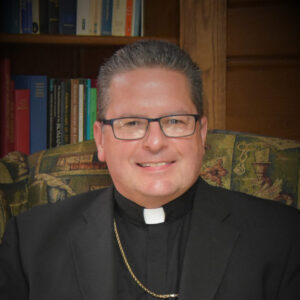
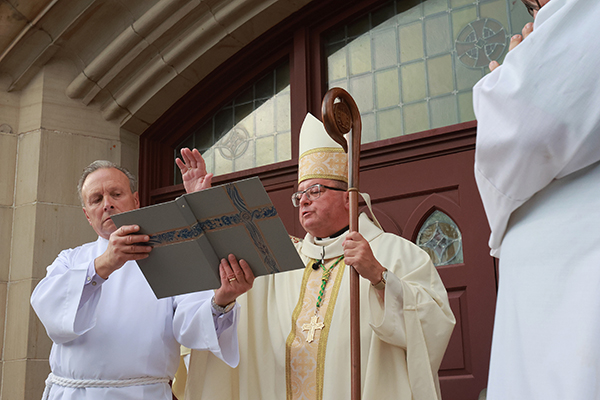
This column was adapted from Bishop Bonnar’s speech at an artificial intelligence presentation, held at St. Michael Parish in Canfield on April 20. Get the full story on the conference on page 28.
Durante el Concilio Vaticano II, la Iglesia publicó un documento sobre su relación con el mundo, conocido como Gaudium et Spes: la Constitución pastoral sobre la Iglesia en el mundo actual. En este documento se encuentra una afirmación que cobra mayor relevancia cada año: “El hombre va tomando conciencia de que las fuerzas que ha desatado están en sus propias manos y de que depende de él controlarlas o ser esclavizado por ellas. En esto radica el dilema moderno”.
Ese dilema moderno, articulado por los Padres Conciliares hace casi 61 años, continúa siendo igual de real hoy en día, especialmente en lo que respecta al desarrollo de la Inteligencia Artificial (IA). El Santo Padre, el Papa León XIV, se ha pronunciado con firmeza sobre la IA y su impacto en el mundo, por no mencionar su repercusión en el alma humana y en la dignidad de la persona. En un foro sobre IA celebrado el pasado mes de noviembre, el Papa León reconoció que la innovación tecnológica puede constituir una forma de participación en la obra divina de la creación. Al mismo tiempo, el Santo Padre señaló que estas innovaciones, especialmente las relativas a la IA, poseen “un peso ético y espiritual, pues cada elección de diseño expresa una visión de la humanidad”. En este sentido, el Papa Francisco exhortó a todos los desarrolladores de IA a crear programas y sistemas que “reflejen justicia, solidaridad y una genuina reverencia por la vida”, algo que no puede lograrse sin amor, libertad y una relación con Dios.
En un discurso pronunciado el 5 de diciembre de 2025 ante los miembros de la Fundación Centesimus Annus Pro Pontifice y los participantes de la Alianza Estratégica de Universidades Católicas de Investigación, el Santo Padre afirmó que la inteligencia artificial puede tener un impacto negativo en la persona humana y en su capacidad para pensar críticamente, discernir, aprender y entablar relaciones interpersonales. El Santo Padre preguntó: “¿Cómo podemos asegurar que el desarrollo de la inteligencia artificial sirva verdaderamente al bien común y no se utilice únicamente para acumular riqueza y poder en manos de unos pocos?”.
El Santo Padre hizo un llamado a una mayor reflexión sobre lo que significa ser humano en este tiempo, y a participar en la obra de la creación de Dios, y no simplemente convertirse en “consumidores pasivos de contenido generado por la inteligencia artificial”. Afirmó que: “Nuestra dignidad reside en nuestra capacidad de reflexionar, elegir libremente, amar incondicionalmente y entablar relaciones auténticas con los demás”.
El Santo Padre también abordó las implicaciones de la IA en la medicina en un mensaje dirigido al Congreso Internacional de la Pontificia Academia para la Vida el pasado mes de noviembre; asimismo, en febrero de este año, advirtió a los clérigos contra el uso de la IA para redactar sus homilías, durante una conversación con sacerdotes de la Diócesis de Roma.
Antes de morir, el Papa Francisco escribió una hermosa carta encíclica Dilexit Nos (“Él nos amó”), sobre el amor humano y divino del Corazón de Jesucristo. En esta obra clásica que, en muchos sentidos, dio origen a nuestra iniciativa diocesana sobre el Sagrado Corazón de Jesús, él escribió: “En el tiempo de la inteligencia artificial, no podemos olvidar que para salvar lo humano hacen falta la poesía y el amor” (n.º 20). El Papa Francisco también afirmó: “Pero no alcanzamos nuestra humanidad plena si no salimos de nosotros mismos, y no llegamos a ser enteramente nosotros mismos si no amamos. De manera que el centro íntimo de nuestra persona, creado para el amor, sólo realizará el proyecto de Dios cuando ame.” (n.º 59).
Lo que el Papa Francisco está buscando es expresar es que no podemos relacionarnos con los demás y vivir en este mundo sin un corazón humano. El cambio del mundo, de acuerdo con el Papa Francisco, depende del corazón. Él escribe, “solo partiendo del corazón nuestras comunidades lograrán unirse y reconciliar mentes y voluntades diversas, para que el Espíritu pueda guiarnos en unidad como hermanos y hermanas. La reconciliación y la paz nacen del corazón”.
Podemos maravillarnos ante los datos, la información y los resultados inmediatos de la inteligencia artificial. Las posibilidades de esta iniciativa tecnológica parecen infinitas. Podemos maravillarnos ante los datos, la información y los resultados inmediatos de la inteligencia artificial. Las posibilidades de esta empresa tecnológica parecen infinitas. No obstante , lo que falta en este empeño no es solo camino ético que respite la dignidad humana y salvaguarde el bien común, sino también el elemento del corazón. La tecnología puede analizar, organizar, sintetizar y pensar, arrojando todo tipo de datos e información, pero en ello no intervienen ni el corazón ni los sentimientos. Que Dios nos ampare si nos adentramos tan profundamente en la IA que socavamos la dignidad humana, menoscabamos el bien común y olvidamos nuestros corazones.
Quizá ahora puedan ver cuán vital es que redescubramos nuestra devoción al Sagrado Corazón de Jesús, la cual celebramos de manera particular como Iglesia durante el mes de junio. De hecho, el Papa Francisco afirmó que: “El Corazón de Cristo es éxtasis, es salida, es donación, es encuentro. En él nos volvemos capaces de relacionarnos de un modo sano y feliz, y de construir en este mundo el Reino de amor y de justicia. Nuestro corazón unido al de Cristo es capaz de este milagro social.” (No. 28).
Esta columna fue adaptada del discurso del Obispo Bonnar en la presentación sobre Inteligencia Artificial, la cual se llevó a cabo en la Parroquia de San Miguel en Canfield el 20 de abril. Lea la historia completa sobre esta conferencia en la página 28.