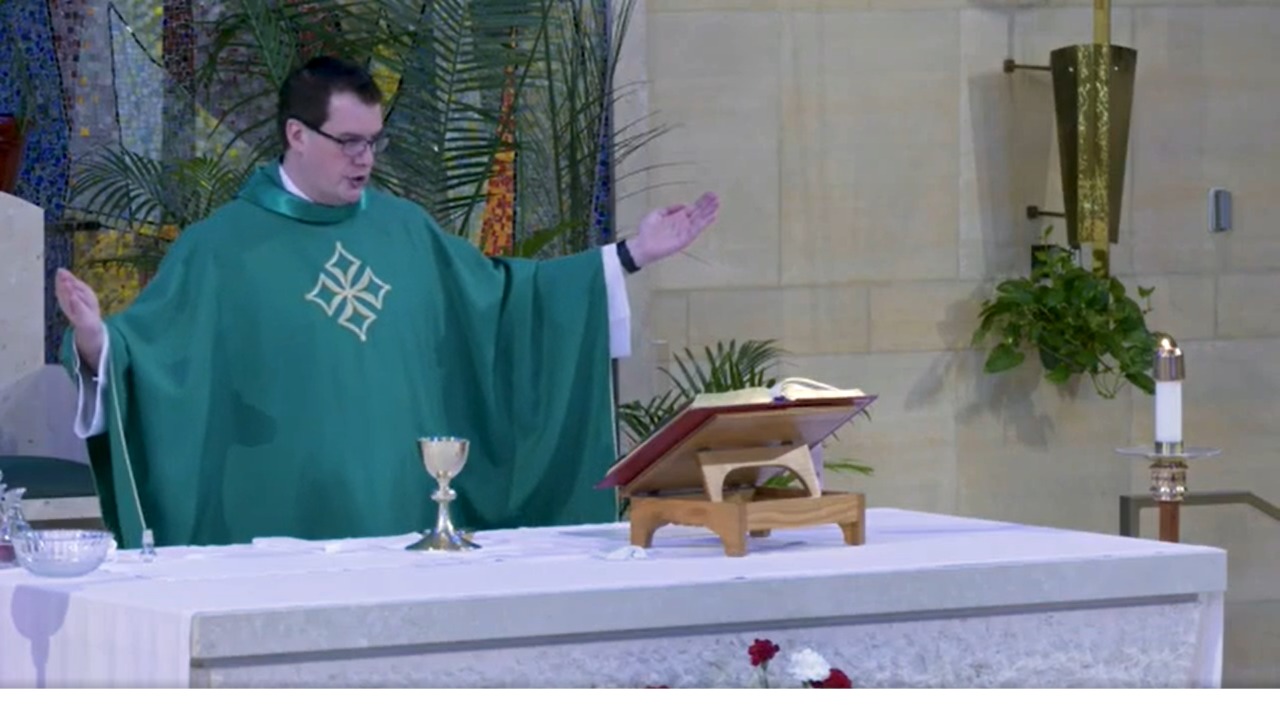
The diocese confronts AI’s promise—and its limits
On Monday, April 20, inside the Family Life Center at Saint Michael Parish, a room full of priests and Diocese of Youngstown staff gathered for a working lunch on artificial intelligence (AI).
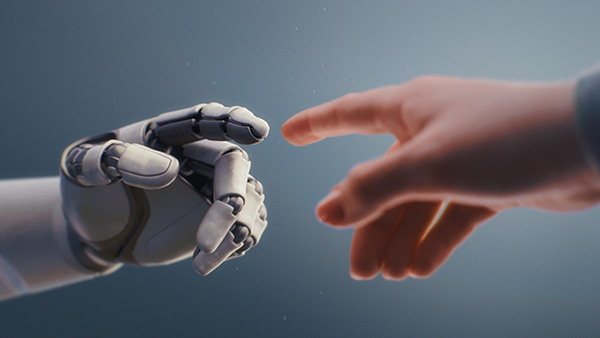
What they got instead was a question: What does it mean to be human, when machines can think?
The two-hour session, hosted by the Diocese of Youngstown, was designed to examine the growing role of AI—not just as a tool, but as a force reshaping how people learn, work and communicate. At the center of the discussion was Dr. Mario Garcia, a global media consultant and adjunct professor at Columbia University Graduate School of Journalism, who has spent decades helping newsrooms adapt to technological change.
His message was direct. “Artificial intelligence can process more information than any human ever could,” Garcia said. “But it does not feel. It does not suffer. It does not love.”
Garcia, founder of Garcia Media, has led hundreds of media transformations worldwide and recently authored Consulting with Heart, a reflection on creativity and leadership in the age of AI.
Despite the Church’s growing awareness of the technology, Garcia said its response remains largely theoretical. “The Church has spoken beautifully at the theological level,” he said. “But we don’t yet have clear, practical guidelines. What is good use of AI? What is not acceptable? That’s still missing.”
Still, he said, attitudes are changing. “People come in skeptical,” Garcia said. “They leave curious.”
Garcia often returns to a phrase he coined to describe what separates human creativity from machine output: “the scent of the human.”
“It’s the trace of a life lived,” Garcia said. “Your scars, your memories, your contradictions—those are things no machine can replicate. AI can organize what exists, but only a human being can create what has never been felt before.”
The phrase, drawn from his ongoing work and writing on artificial intelligence, points to something intangible but essential—the lived experience behind every word, decision and act of creation.
And it is precisely that “scent,” he suggests, that will matter most as artificial intelligence becomes more capable—and more convincing.
A tool—or a threat?
For Bishop Bonnar, the issue is not whether AI will be used—but how. “AI can be a companion and a resource,” Bishop Bonnar said. “But we must not allow ourselves to be enslaved by it. We must master it.”
He warned that rapid technological growth can distance people from what matters most. “In a culture of technology, it’s easy to lose touch with what we cannot see—most notably, the human heart,” he said.
The Church, he added, has a responsibility to guide both clergy and laity through the ethical and spiritual implications of AI. “We need to help the faithful understand both the dangers and the opportunities,” Bishop Bonnar said, “and to move forward in a holy way.”
Classrooms have changed
The impact is already being felt in Catholic schools, according to Dr. Steven Jones, superintendent of schools for the diocese. “If the Church isn’t present when something this big emerges, we’re just cleaning up afterward. We need to help shape it before that happens,” said Jones.
One immediate challenge: academic integrity. “Policies that just say ‘don’t cheat’ aren’t going to work anymore,” he said. “AI creates something new every time—you won’t recognize it.”
Instead of relying on enforcement alone, Jones said educators must rethink how they approach learning itself. “We need to talk about why doing your own work matters,” he said. “And that means we have to be honest about how we use AI ourselves.”
What AI can’t do
Throughout the discussion, one theme remained constant: AI can generate answers, but it cannot replace human experience.
It can organize information, mimic language and produce convincing results in seconds. But it cannot enter into the human experience. It cannot suffer. It cannot love. That distinction, speakers said, is where the Church must remain grounded—especially as the technology becomes more integrated into daily life.
The Diocese of Youngstown is expected to continue developing guidelines for AI use, particularly in education and ministry, as the technology evolves. For now, the takeaway was clear: artificial intelligence may change how people think and work, but it cannot replace what makes them human.