Dr. Chrisanne Gordon, then a Columbus-area rehabilitation physician, one day in November of 1996 experienced a traumatic brain injury—“that hopeless, darkest, most oppressive day” and the lonely, tortuous, journey of rehabilitation that ensued.
Yet, that ordeal would lead her to a mission on behalf of military veterans who also experienced traumatic brain injury (TBI) and have faced bureaucratic and other obstacles to their treatment and recovery. Her organization, Resurrecting Lives Foundation, was founded in 2012 “to provide a future for our veterans.”
“It took losing my brain to find my mission,” Gordon wrote in her 2018 book, Turn the Lights On: A Physician’s Personal Journey from the Darkness of Traumatic Brain Injury (TBI) to Hope, Healing, and Recovery. For more than a decade, Gordon has been an advocate for military veterans whose lives have been afflicted by TBI, and she is hoping that the Catholic Church and the larger faith community can work to be a part of the solution.
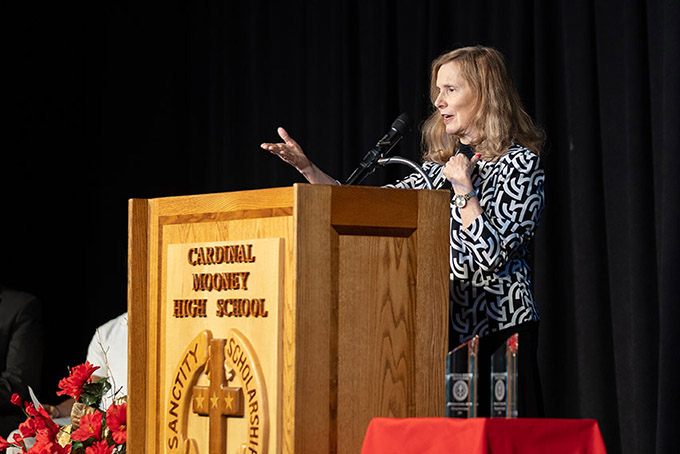
Gordon, a Youngstown-area native and a 1971 graduate of Cardinal Mooney High School, received Mooney’s distinguished alumni award in 2024 for her work on behalf of veterans.
After Mooney, she graduated from Duquesne University in Pittsburgh and Ohio State Medical School before beginning her medical practice. Gordon was working as a medical rehabilitation physician in the Columbus area in 1996, when, on Thanksgiving weekend, she was moving boxes of Christmas decorations in and out of a crawl space in her Dublin, Ohio, home. Suddenly, she struck her head against a brick wall, leaving her unconscious for about 30 minutes. She was unable to talk, barely able to move and had impaired vision. A few hours later, a friend who was meeting her for dinner came by and was stunned to see the state that Gordon was in. Gordon was able to write “E.R.” on a pad, and her friend took her to the hospital. She was diagnosed with a concussion but the CAT scan did not reveal the true seriousness of her injury. Unable to discern how serious her condition was because her vital signs seemed normal, the emergency room staff sent her home with instructions and hopes that her recovery would commence with rest.
Unfortunately, her recovery was virtually non-existent. She felt as if her brain had been wiped clean and experienced feelings of physical darkness. By Monday, she managed to get to work with someone driving her, but Gordon still found herself seriously impaired, and most were unable to discern her condition. Her impairment hindered her from knowing exactly what was wrong and what she needed—and, as a single woman living alone, she lacked an advocate to help her deal with the system.
It was only two weeks later that, with the help of her assistant, she was able to contact a former medical school professor “who took the time” to communicate with her—asking questions and having her respond with one sound for “yes” two sounds for “no.” Her former professor began to discern the true seriousness of her condition, prescribing amantadine, a medication used to treat Parkinson’s disease and other ailments. Taking it that evening, she began to experience sudden—though incomplete—improvement over the next few hours. “It was like a light switch being turned on,” Gordon said—with her speech, her vision and her sense of hope restored.
Still, her recovery was limited—like a car that had been successfully jump-started but still not functioning on all cylinders. She felt “trapped within my own mind, unable to make my brain function” as she was accustomed to. Her medicine had taken her to a certain point but was not taking her further. Her motor skills were still shaky, her energy level low, and she still felt an internal darkness.
So, Gordon said, she began her own personally designed rehabilitation regimen attempting to “reboot my brain”—going on an older desktop Apple computer to recover what she had lost. She began with typing “The Gettysburg Address,” which she had memorized in grade school. She progressed to basic arithmetic, made a little headway on geography and then moved on to music and poetry—hopeful that such “right brain” activities would stimulate different sections of her brain.
Gordon found hope in what she calls “the all or nothing phenomenon.” She realized that progress in brain injury recovery often happens not step-by-step or even in half-steps but in “starts and stops”—sporadic eruptions of successful activity following long periods of seemingly futile efforts.Then, at eight weeks, she felt a surging of electricity and experienced her brain rebooting. She found that 65 percent of what had been lost to her had come back.
She returned to a normal work schedule and, over the next several years, found her recovery still happening in fits and starts. But the experience had opened her to the complexity of what is involved in concussion and brain injury and how someone who sustained such injuries could recover.
The September 11, 2001, terrorist attacks on the World Trade Center, the Pentagon and United Airlines Flight 93 and the subsequent U.S. military response in Afghanistan and Iraq were the beginning of her interest in what military veterans were experiencing. In 2008, she began serving at a Veterans Affairs (VA) hospital doing brain injury assessment for veterans coming back from Afghanistan and Iraq.
She found that many veterans who had been originally diagnosed with post-traumatic stress disorder (PTSD) had actually suffered TBI.
Convincing the VA and the medical establishment of the prevalence of TBI and the need to treat the brain injury rather than the assumed PTSD alone took much effort and time. Amid her efforts to help individual veterans she became aware of the difficulties faced by many veterans suffering from TBI, including finding available help, substance abuse, suicide and unemployment. As she encountered others in her efforts to aid veterans with TBI, she began working cooperatively with various individuals and organizations to make veterans and the larger public aware of the problem. Toward that end, she filmed the documentary Operation Resurrection, which was completed in 2011. In 2012, her Resurrecting Lives Foundation was granted nonprofit status.
“This is when we really got going. We actually funded the first national study—with assistance from the AMVETS post of Mansfield, Ohio—to prove that there was a link between the IED explosions and TBI.” The foundation, working with others, also strived to pass legislation and implement programs at the national and state levels to raise awareness of TBI and to aid veterans in their struggles.
In 2019, with support from the Blue Star Mothers, Gordon went on a national book tour promoting Turn the Lights On, which she describes as “a manual of hope for those with TBI.”
The Resurrecting Lives Foundation became heavily involved in suicide prevention, Gordon said, pointing out that veterans have a suicide rate five times higher than the national average. Holding up her cell phone, she said, “I have taken suicide calls from veterans in 29 states.” Subsequently, Resurrecting Lives Foundation has established a suicide prevention telephone network to handle such urgent calls.
Though much has been accomplished, Gordon said, a lot still needs to be done. VA clinics and others have improved their ability to diagnose TBI, but “there are fewer VA clinics in rural areas, and 45 percent of all volunteer military are from rural areas.”
Gordon is working on her latest book, Guarding the Guardians, scheduled to come out in 2026, which focuses on the transition from military to the civilian life. “We’re working to get our veterans more integrated with the community —health care, employment, education.”
Another goal of hers is to establish “veteran- and military-friendly congregations,” where veterans can feel welcome. “From my experiences, I know the value of faith in recovery. These veterans can benefit from involvement with churches and the Church can benefit from the presence of these dedicated men and women.”
Those who work with Gordon are fulsome in their praise of her efforts and personal commitment.
Dr. Christopher Brown, medical director and former health commissioner for the Ross County, Ohio, Health Department, and a former Resurrecting Lives Foundation board member, called Gordon “a force, a remarkable woman, incredibly warm-hearted, who made me realize how important this endeavor is—working with and sometimes challenging the VA, and helping veterans. She is selfless, but with fire. She has such grit.”
Ed Heckathorn, a veteran of the Army Rangers who served in Afghanistan and other locales overseas, said that he first encountered Gordon as a patient, but became involved in her efforts to aid veterans and to raise awareness of TBI. “She was dead-set to make an impact … I’ve never seen such a passion for veterans in someone who hasn’t been in the military.”
Curtis Armstrong, an Army military police veteran who served in Iraq, praised Gordon’s efforts to make healthcare professionals and the larger public aware of the prevalence of TBI. “Without people like Dr. Gordon, TBI would still be just another acronym.”
Gordon cites members of her board and other individuals that she has worked with for progress being made, but emphasizes that much more needs to be done. She calls not just for institutions, organizations, healthcare professionals and those working with veterans to step up—but anyone who encounters veterans in everyday life.
“To a TBI patient, your intervention—no matter how small a gesture in your eyes—just might be the saving grace in theirs. Be the light that they are searching for.”
Learn more about the Resurrecting Lives Foundation at www.resurrectinglives.org.