Feast Day: September 5
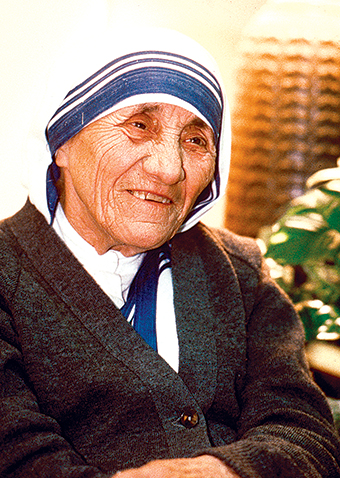
Saint Mother Teresa of Calcutta was born Agnes Gonxha Bojaxhiu on August 26, 1910, in Skopje—now North Macedonia. She was the youngest child of Nikola and Drane Bojaxhiu, who were of Kosovar Albanian ancestry. Her father died when she was eight, leaving her family in financial straits.
Active in her vibrant Jesuit-run parish, Sacred Heart, she was inspired to pursue missionary work. At age 18, she joined the Sisters of Loreto in Ireland. She took the name Sister Mary Teresa, after Saint Therese of Lisieux—the Little Flower—but spelled it “Teresa” to avoid confusion with another sister in her community known as Sister Theresa. In 1931, after making her first profession, she was assigned to Calcutta, India, to teach at St. Mary’s School for girls. Her family later moved to Albania, but she was never able to see her mother or sister again because the Albanian Communist government would not allow her to come to Albania. She would not go there again until after their deaths, in 1991.
She became school principal in 1944. During this time, she became aware of the poverty in Calcutta, as well as Hindu-Muslim violence. In 1946, while on a train to her annual retreat, she experienced visions of Jesus lamenting the poverty and neglect of His people and their lack of knowledge of Him—and calling her to serve them. “Come be My light,” she heard Jesus say. “I cannot go alone.” After a period of discernment, she left the Loretto Sisters in 1948 and enrolled in a course with the Medical Mission Sisters before beginning her ministry in Calcutta, living temporarily with the Little Sisters of the Poor. Going to Calcutta’s slums, she visited families, washed the sores of some children, cared for an old man lying sick on the road and nursed a woman dying of hunger and tuberculosis. Starting each day with Communion, she went out to find and serve Jesus amongst “the unwanted, the unloved, the uncared for,” as she would recount. Months later, she was joined, one by one, by former students.
Mother Teresa’s new congregation, the Missionaries of Charity, was officially established in 1950 by the Archdiocese of Calcutta. Struggling with only scant resources during her first year, Mother Teresa was forced to beg for food and supplies—and suffered doubt, loneliness and the temptation to return to the comfort of convent life. Yet she persevered, attracting the attention of the Indian government and political leaders. For her sisters, Mother Teresa selected white and blue saris as their habits—reflecting the simple garb of poor Bengali women.
By the early 1960s, she began sending her sisters to other parts of India. In 1965, with papal encouragement, she opened a house in Venezuela—soon followed by foundations in Rome and Tanzania and, eventually, on almost every continent. During the 1980s and through the 1990s, Mother Teresa opened houses in almost all communist and former Communist countries. From the 1960s to the 1980s, she founded a related order of brothers, a contemplative affiliate of sisters and later brothers, and in 1984, the Missionaries of Charity Fathers. She would also form the Co-Workers of Mother Teresa and the Sick and Suffering Co-Workers—including people of many faiths and nationalities—and the Lay Missionaries of Charity. Responding to requests from many priests, in 1981 Mother Teresa launched the Corpus Christi Movement for Priests.
Mother Teresa not only traveled to many nations to foster her orders’ ministries, but she also personally intervened in trouble spots around the world—Beirut in 1982, Ethiopia during famine, Chernobyl and Armenia following the 1988 earthquake.
While speaking as she traveled, Mother Teresa urged everyone to go out and serve the poor and lonely in their communities and to foster their own spiritual life through prayer, noting that “Holiness is not the luxury of the few,” but “a simple duty for each one of us.” She urged everyone to do “something beautiful for God.” Though leading was a massive effort, Mother Teresa remained actively involved in the day-to-day work of her order.
Today, her orders number more than 5,000 sisters and more than 450 brothers, who manage orphanages, schools, shelters, AIDS hospices and charity centers to care for refugees, the blind, the disabled, the aged, alcoholics, the poor and the homeless in 139 countries.
While working for the “poorest of the poor,” she spoke out against abortion and called for love as the remedy for the loneliness afflicting the world. As she aged, Mother Teresa battled health problems. It was after her death that it became know that she struggled for decades with spiritual aridity—“dark night of the soul”—feeling alienated from God. Yet, she never lost her faith.
In 1979, she received the Nobel Peace Prize, which she accepted on behalf of the world’s poor. Despite her honors and widespread popularity, she had detractors—sometimes from polar opposites—but by every measure she was abundantly beloved and acclaimed.
Mother Teresa died September 5, 1997. Canonization efforts began not long after her death. She was canonized in 2016.
Mother Teresa is remembered in the Diocese of Youngstown for her 1982 visit to then-Walsh College and Our Lady of Peace Church in Canton. This year, the newly merged parish, St. Teresa of Calcutta in Warren, was named in her honor.