
Holy men and women influenced by Franciscan teaching
In honor of the eighth centenary of Saint Francis’ death in 1226, Pope Leo XIV has decreed 2026 a special jubilee year. In his announcement of the jubilee year, Pope Leo XIV wrote:
“Our time is not very different from that in which Francis lived … when Christian charity languishes, ignorance spreads like immorality, and those who exalt concord among people do so more out of selfishness than out of a sincere Christian spirit; when the virtual takes over the real, disagreements and social violence are part of everyday life and peace becomes more insecure and distant every day, this Year of Saint Francis spurs all of us, each according to our possibilities, to imitate the poor man of Assisi, to form ourselves as far as possible on the model of Christ.”

Who was Saint Francis?
Saint Francis of Assisi, the son of a rich silk merchant who embraced a life of poverty and spiritual devotion to Christ, is beloved and venerated around the world as the patron saint of animals and ecology. The 12th-century mystic was known to preach to wild animals, seeing all of nature—animals, trees and even the elements—as a reflection of God’s divinity. While it may not seem unusual to seek God in nature today, that is because of the enormous influence wielded by Saint Francis eight centuries ago.
Saint Francis was born in Assisi in 1182—a time of great strife in the Church and the world. In the early 13th century, Saint Francis was praying in a dilapidated chapel in San Damiano, near Assisi, when he received a vision of Christ, who said, “Francis, go and repair My house which, as you see, is falling into ruin.”
At the time, Saint Francis was lacking direction. He had been a prisoner of war for over a year and, upon his release, had lost his taste for war and for the earthly delights which had previously been his obsession. He began wandering the countryside, searching for a purpose, when he received the vision at San Damiano. At first, Saint Francis took the vision literally and began begging for stones with which he could rebuild the chapel, but it was not until later, when he met a leper on the road, that he came to understand his full calling from Christ—as he embraced the leper and gave him alms, he realized that he embraced his Lord. Francis began ministering to lepers and, through his fearless example of asceticism, drew others seeking spiritual renewal to himself. Thus, the foundation of the Franciscan Order was formed, with the simple rule “to follow the teachings of Our Lord Jesus Christ and to walk in His footsteps.” Later, Saint Francis and Saint Clare of Assisi founded an order for women, the Poor Clares.
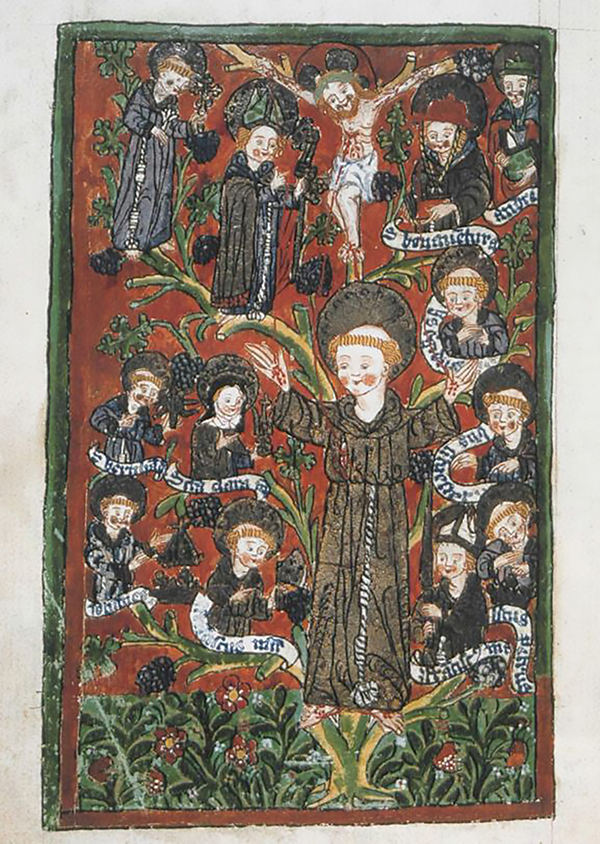
Saint Francis’ writings remain widely read to this day, including The Canticle of the Sun, The Testament and The Rules, the latter outlining his order. He taught that it is our duty as Christians to resist the temptation of despair, for even in the darkest of times renewal is possible. His life inspired dozens of others to become saints of the Church—producing a fruitful tree of Christianity.
In celebration of Saint Francis and this special jubilee year, let’s examine some of the most important saints that sprouted from the branches of his tree.
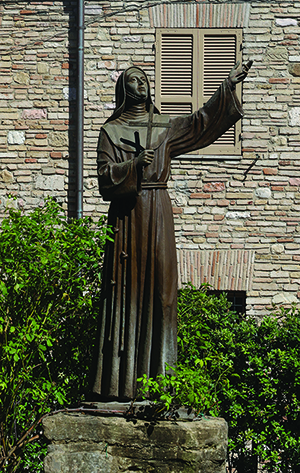
Saint Clare of Assisi
Feast Day: August 11
Saint Clare of Assisi was a contemporary of Saint Francis and the first female follower of the Franciscans. She was inspired by Saint Francis’ commitment to poverty after hearing him preaching at the church of San Giorgio in Assisi. From a wealthy family, the Offreduccios, Saint Clare was expected to marry politically, but she instead approached Saint Francis to seek his aid in entering the religious life. On Palm Sunday in 1212, she met Saint Francis at the chapel of Porziuncula, where she cropped her hair and exchanged her expensive clothes for a plain robe and veil, taking her first steps into monastic sisterhood.
Saint Francis placed her in a Benedictine convent in San Paulo, where her family, shocked by her departure, attempted to entice her to marry with promises of wealth and privilege—Saint Clare refused, saying she would only have Jesus Christ as her husband. Eventually, the Offreduccios tried to seize her by force, but Saint Clare clung to the chapel’s altar; it was only upon seeing Saint Clare’s cropped hair during the struggle that her family understood her true commitment to the religious life and left her in peace. A few days after that event, Saint Francis moved Saint Clare to the more remote Benedictine monastery of Sant’Angelo in Panzo, to grant her more separation from the outside world.
However, the intrusions of secular life did not end there. Soon after being moved to the Sant’Angelo monastery, Saint Clare’s sister Caterina ran away to join her. This caused an even greater stir in the Offreduccio family, as now two marriageable daughters had fled to join a convent. Once again, her family came to take a daughter home, but once again they were foiled. They left in failure, and Saint Francis himself bestowed on her the name Agnes. The arrival of Agnes led to an avalanche of young women coming to join Saint Clare in the solitude of religious devotion, so much so that at the age of 21, Saint Francis made her abbess of a “Second Order” of Franciscan monastics, the Order of the Poor Ladies, for females. The community was eventually housed next to the repaired church of San Damiano, where Saint Francis had his first vision.
Like Saint Francis, Saint Clare and her Poor Ladies observed the strictest rules of poverty and humility, spending their days in near total silence, serving the sick and begging for their meals. This lifestyle became contentious within the Church after the Fourth Lateran Council in 1215, which decreed that new religious communities would have to adopt an “established order,” similar to the Rule of Saint Benedict. While personally ascetic, Saint Clare’s rule of poverty was even more extreme, disallowing the ownership of any property, even by the community itself (which is traditionally how monastic orders maintained themselves), and she had to receive special permission from the Pope to maintain it.
Saint Clare suffered severe maladies during the last two decades of her life, often leaving her confined to her room and unable to attend Mass. Despite these limitations, she exerted immense influence in the Catholic Church and even against Muslim armies. Two days before her death, Pope Innocent IV approved Saint Clare’s monastic rules, ensuring that the Poor Ladies could maintain their practices long after she had passed. She died on August 11, 1253. Her last words were reported to be: “Blessed be You, O God, for having created me.” She was canonized as Saint Clare of Assisi two years later on September 26, 1255, by Pope Alexander IV.
The Poor Clares of Perpetual Adoration in Canton are one of the branches of the Order of Saint Clare, with roots in the 13th-century Franciscan movement.
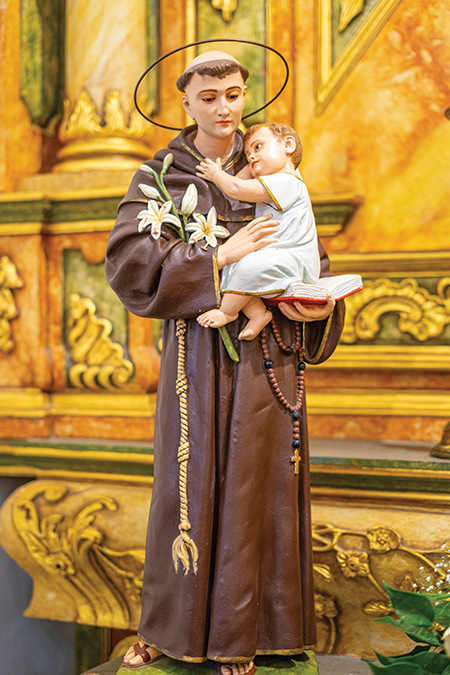
Saint Anthony of Padua Feast Day: June 13
Saint Anthony was born Fernando Martins de Bulhoes—to wealthy Portuguese family in Lisbon—on August 15, 1195, and is undoubtedly one of the most popular Franciscan saints. Another contemporary of Saint Francis, Saint Anthony was famous for his impassioned preaching, which, combined with his sonorous voice and insight into the Gospel, left a powerful impact on all who heard him speak.
As a child, Saint Anthony was educated at the cathedral school in Lisbon before joining the Canons Regular of the Order of the Holy Cross as a novitiate at 15 years old. He first studied at the Abbey of Saint Vincent, and in 1212, he moved to the Monastery of the Holy Cross in Coimbra for further study. While Saint Anthony would not remain with this order forever, it was a particularly fruitful time of his life, as it was here that he would learn the Augustinian theology that he would eventually meld with the Franciscan vision, leading to his famously evocative homilies.
Soon after he was ordained to the priesthood, Saint Anthony was named the abbey’s guest master at just 19. This was considered a very important posting and not one usually given to such a young priest—a sign that he was being positioned to eventually enter a leadership role in the order. However, some Franciscans moved to a nearby hermitage outside Coimbra, and Saint Anthony was attracted to their commitment to simplicity, poverty and evangelism. When news arrived in Portugal of the killing of Berard of Carbio and his companions in Morocco—the first Franciscans to be martyred—Saint Anthony was inspired by their sacrifice and obtained permission from the Church to leave the Canons Regular and join the Franciscans. He ended up joining the small hermitage near Coimbra and took the name Anthony.
From there, Saint Anthony set out for Morocco to continue the evangelism the Franciscans were pursuing. However, he fell seriously ill during his journey and attempted to return to Portugal to recover his health. God had other plans for Saint Anthony, though—his ship was blown off course and landed in Sicily instead. He eventually settled in a rural hermitage near Forli.
It was in Italy where Saint Anthony would truly flourish as a priest. His first noteworthy homily was delivered almost by accident when a group of visiting Dominicans arrived in Forli for an ordination. Both the Franciscans and Dominicans assumed that the other group would be delivering the homily. Thus, with no homily prepared, the prior called upon Saint Anthony to give an impromptu address.
His sermon was so impactful that it changed the trajectory of his life and thrust him into the public eye as a travelling preacher. Saint Francis himself was so impressed by Saint Anthony that in 1224, he was entrusted with the instruction of all the Franciscan friars in sacred theology. For Saint Francis, who was distrustful of the merits of education, this was a huge endorsement of both Saint Anthony’s holiness and his knowledge.
In 1226, he was appointed as the Provincial superior of northern Italy and moved to the city of Padua. Saint Anthony, who had always been sickly, was not to live a long life. He spent the final seven years of his life teaching the friars and delivering sermons to crowds that sometimes numbered in the tens of thousands. His preaching was referred to by Pope Gregory IX as a “jewel case of the Bible,” and he described Saint Anthony himself as the “Ark of the Testament.” Anthony fell ill in 1231 and passed away on the road back to Padua on June 13 of that year.
His influence and holiness were so great that Saint Anthony was canonized as a saint less than a year after his death on May 30, 1232. In 1946, he was named a Doctor of the Church by Pope Pius XII for his evangelic work. In the Diocese of Youngstown, St. Anthony of Padua Church, which is part of the Mt. Carmel Basilica Parish, has been operating since 1923—originally serving Italian-speaking immigrants in Youngstown.
In addition, for a century, Catholics in Canton were ministered to by St. Anthony Church, which is now part of St. Francis of Assisi Parish. St. Anthony Wayside Shrine on the grounds of St. Paul Monastery in Canfield also draws about 5,000 pilgrims annually.

Saint Bonaventure
Feast Day: July 15
If Saint Anthony was the great preacher of the early Franciscans, then Saint Bonaventure was their great theologian. Known for his extensive collection of brilliant theological writing, including The Journey of the Mind to God, The Tree of Life, The Triple Way and even The Life of Saint Francis, Saint Bonaventure was adept at blending the mysticism and simplicity of the Franciscan order with the superior academic rigor that earned him the degree of master from the University of Paris—the equivalent of a doctorate today.
Little is known about Saint Bonaventure’s life before he joined the Franciscans in 1243, but according to Saint Bonaventure himself, he owed everything to Saint Francis—including his life and even the name by which we know him today. As Saint Bonaventure reports, he suffered from a serious disease as a child and was cured by the prayers of Saint Francis. Saint Francis, who was said to be a good judge of people’s character, proclaimed that the boy was blessed with “good fortune”—“Buona Ventura” in Latin—and the phrase stuck.
What distinguished Saint Bonaventure’s theology was his insistence that great earthly knowledge was neither a substitute nor requisite for devotion to God, saying that the most humble and uneducated could know more about loving Christ than any theological doctor.
In this way, Saint Bonaventure proved himself not only a capable theologian but also an adept leader of the Franciscan order. His unapologetic belief that the intellect should operate in service of one’s faith allowed him to chart a moderate course for the Order of Friars Minor as its seventh Minister General, a post to which he was elected in 1257. Considered a “Second Founder” of the Order, Saint Bonaventure is credited with stabilizing the Franciscans after Saint Francis’ death and ensuring their status as the preeminently influential Catholic order, until the arrival of the Jesuits. One of his main contributions to the Franciscans was the establishment of a unified constitution that brought the two emerging factions—the Spirituales and the Relaxti, who were arguing over the proper interpretation of the order’s poverty—back into harmony. Essential to this unification was Saint Bonaventure’s production of a new biography of Saint Francis, as there were multiple conflicting accounts of his life springing up in the order.
In 1265, Saint Bonaventure was appointed the archbishop of York, but he respectfully declined. After he proved instrumental in securing the election of Pope Gregory X, he was made the Cardinal Bishop of Albano—a post which he could not decline. Pope Gregory X requested his presence at the Second Council of Lyon, in an attempt to end the Great Schism. Saint Bonaventure was also successful in achieving a temporary union between the Eastern and Western Churches, but it was doomed to fail due to political interference shortly afterward.
Saint Bonaventure died while the council was still in session, under somewhat suspicious circumstances, suggesting that he may have been poisoned. He was canonized on April 14, 1482, by Pope Sixtus IV, and just over a century later was declared a Doctor of the Church by Pope Sixtus V in 1588.

Saint Elizabeth of Hungary
Feast Day: November 17
Revered as the patroness of Catholic Charities and the Secular Franciscan Order, Saint Elizabeth of Hungary lived a tragically brief but impactful life as the daughter of a king who chose a life of faithful service to the poor over the luxury to which she was born. Saint Elizabeth was born on July 7, 1207. Some sources claim she was born in Hungary, while later sources identify her birthplace as Slovakia. From an early age, Saint Elizabeth was betrothed to a nobleman, Louis IV, a landgrave of Thuringia (roughly equivalent to a duke). Unlike many political marriages of that era, Saint Elizabeth and Louis appeared to love each other deeply, and they were married in 1221, the same year he was enthroned as landgrave. The couple had three children together.
Saint Elizabeth was first exposed to Franciscan spirituality when they arrived in Thuringia in 1223, and she was immediately enamored with their teachings and way of life, and began living by them. Paramount to her beliefs was her profusive almsgiving to the poor, in which her husband supported her.
Sadly, she was widowed after just six years of marriage, when Louis died of a fever while en route to join the Sixth Crusade in 1227, just a few weeks before the birth of their daughter Gertrude. She joined the Third Order of Saint Francis in 1228, which was established by Saint Francis to allow men and women who were otherwise barred from joining religious orders—whether due to marriage or because they’d already entered consecrated life as hermits—to partake in Franciscan spirituality.
Saint Elizabeth’s family did not appreciate her charitable nature as her husband had, and she was removed from the palace where she lived. Shortly afterward, she took solemn vows to her confessor, Konrad von Marburg, who was extremely harsh. She received physical beatings and even had to send away her children. Her vow of celibacy created a political conflict—her family wanted her to remarry, but Elizabeth maintained her vows and even threatened to cut off her nose so that no man would wish to marry her.
With the return of Louis’ allies from the Crusade, however, Elizabeth was restored to the throne as the landgravine of Thuringia and used her dowry—which was returned to her after Louis’ death—to build a hospital for the poor, where she and her companions worked. Every day, Saint Elizabeth was known to take bread to hundreds of peasants who would come to her estate seeking aid.
Little is known of Saint Elizabeth’s death, other than that she declined in health quickly and passed away at the young age of 24. Soon afterward, there were reports of miraculous healings of those housed in her hospital. Due to Saint Elizabeth’s extraordinary popularity, she was canonized just four years after her death by Pope Gregory IX. Her body was laid to rest in Marburg, which became the center of the Teutonic Order, whose members adopted her as their secondary patroness.
In the Diocese of Youngstown, St. Elizabeth Youngstown Hospital and St. Elizabeth Boardman Hospital are named in honor of Saint Elizabeth of Hungary. St. Elizabeth Church, which ministered to Catholics in Campbell for close to a century, was also named in her honor.
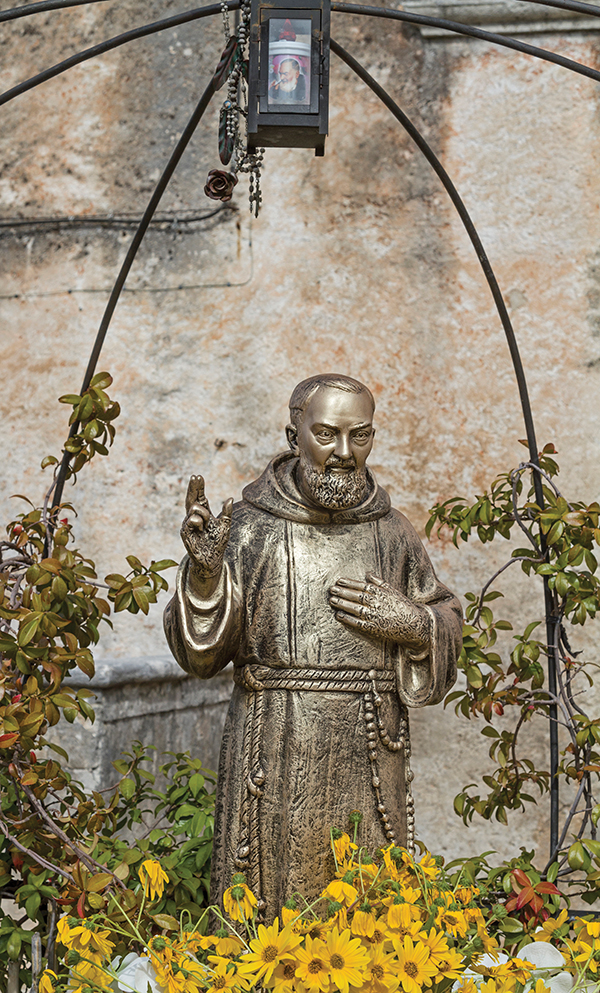
Saint Padre Pio
Feast Day: September 23
One of the most prolific mystics of the Franciscan order since the days of its founder, Saint Padre Pio is venerated by swaths of admirers around the world for his apparent sanctity and the numerous miracles attributed to him throughout his life.
Born Francesco Forgione on May 25, 1887, Saint Pio joined the Capuchins at the young age of 15 and took the name “Pio” in honor of Pope Pius I. The Capuchins are a reformed group of Franciscan Friars Minor, started in the 1500s, with the purpose of returning to the original way of life envisaged by Saint Francis centuries earlier. The Capuchins quickly grew and, today, are one of the three branches comprising the First Order Franciscans, alongside the Observants and Minorites.
The Forgiones were a poor but deeply religious family of farmers, with two of Saint Pio’s siblings also entering religious life. According to Saint Pio himself, he had already made the decision to devote his life to God as a young boy and, despite his numerous illnesses, had experienced heavenly visions and ecstasies. He felt drawn to the life of the Capuchins after listening to a traveling friar who was wandering the countryside seeking donations. His parents traveled to the Capuchin community in Morcone, 13 miles north of their hometown of Pietrelcina, to see if Saint Pio could enter the order, but they were told that he needed further education if his aspirations were to be fulfilled.
Saint Pio’s father, in an amazing act of devotion to his son’s calling, travelled to the United States to look for work so he could afford his tutoring. Saint Pio responded by dedicating himself to his studies and achieving the academic requirements. On January 6, 1903, he entered the novitiate at Morcone.
So began his seven-year period of study to enter the priesthood. Saint Pio soon left for the friary of Saint Francis in Umbria, where the stories of his sanctity began to grow: however, as his sanctity increased, so too did his poor health. From 1905 to 1916, Saint Pio lived away from his order, even returning to Pietrelcina to convalesce. Despite this, he continued along the path of ordination and made his religious profession on January 27, 1907. With his health seemingly improved, Saint Pio was able to return to community life in late 1916, when he moved to the Convento Dei Cappuccini di Santa Maria delle Grazie in San Giovanni Rotondo. It was here that Saint Pio would remain for most of his life and where his legend would grow to attract hundreds of believers daily.
During World War I, many of Saint Padre Pio’s brothers were drafted for military service, leaving him in charge of the community. In November 1915, he, too, was drafted and assigned to the 10th Medical Corps in Naples. His health problems, however, led to his being continually discharged and recalled until March 1918, when he was declared unfit for service—resulting in a full discharge. In the aftermath of the war, people returning to this region of Italy began to hear of a Capuchin who was said to be endowed with incredible spiritual gifts, including healing, bilocation, levitation and even stigmata. People flocked to him, and Saint Pio spent many hours hearing confessions and giving spiritual direction. His simple habit for spiritual growth included five rules: weekly confession, daily Communion, spiritual reading, meditation and examination of conscience.
In the years between World War I and World War II, Saint Pio had converted an old convent building into a medical clinic. In 1947, construction began on a larger clinic, which was finally completed in 1956. Saint Padre Pio handed the clinic over to the Vatican, but Pope Pius XII granted him a dispensation from his vow of poverty so that Saint Pio could directly oversee the project. The clinic opened in 1957 under the name La Casa Sollievo della Sofferenza (Home for the Relief of Suffering), which is still in operation today.
On September 22, 1968, Saint Padre Pio celebrated a Mass for the 50th anniversary of the appearance of his stigmata. His health had deteriorated throughout the 1960s, however, and he nearly collapsed at the conclusion of Mass. He passed away early the next morning, and his funeral was attended by an estimated 100,000 people.
An investigation into the canonization of Saint Pio was opened in 1982, and he was canonized 20 years later on June 16, with a Mass celebrated by Pope John Paul II. Saint Pio’s monastery remains an incredibly popular pilgrimage site, and there are prayer groups inspired by him, worldwide, totaling three million members.
Who are the other members of the family?
The branches and leaves of the tree
The branches of the Franciscan Family Tree are the orders that were founded on his principles. The First Order (Friars Minor), stems directly from Saint Francis and includes The Order of Friars Minor (OFM), the Order of Friars Minor Conventual (OFM Conv) and the Order of Friars Minor Capuchin (OFM Cap). The Second Order originated from Saint Clare of Assisi, as explained on page 16, the Poor Clares. The Third Order has two branches, including the Secular Franciscan Order, which consists of lay men and women, and the Third Order Regular, which are vowed religious.
The previous pages give color to some of the most significant leaves that sprouted from the branches of this tree, but today, there are more than 90 Franciscan saints or groups of saints—and there are even more who are on track to become saints, as well as saints who felt his influence, even if they were not associated with a Franciscan order.
Franciscan Saints
Order of Friars Minor
Saint Anthony of Padua (1195-1231)
Saint Antonio of Saint Anne Galvao (founder of the Conceptionist Sisters, 1739-1822)
Saint Benedict Larcari (1526-1589)
Saint Benvenute of Osimo (Bishop, died 1282)
Protomartyrs of the Franciscan Order—Saint Berard and his companions (died 1220)
Saint Bernard of Corleone (1605-1667)
Saint Bernardin of Siena (1380-1444)
Saint Bonaventure (Cardinal, 1221-1274)
*Saint Camillus de Lellis (Capuchin novitiate before founding The Order of the Ministers of the Sick, 1550-1614)
Saint Charles of Sezze (1613 – 1670)
Saint Crispin of Viterbo (1668-1750)
Saint Didacus of Alcalá (1400-1463)
Saint Felix de Cantalice (1515-1587)
Saint Francis Anthony Fasani (1681-1742)
Saint Francis Mary of Camporosso (1804-1866)
Saint Francis of Paola (Founder of The Order of Minims, 1416-1507)
Saint Francisco Solano (1549-1610)
Saint Giles Mary of St. Joseph (1729–1812)
Saint Giovanni of Triora (1760-1816)
Saint Ignatius of Laconi (1701-1781)
Saint Ignatius of Santhia (1686-1770)
Saint James de la Marche (1391-1476)
Saint John Capistrano (1386-1456)
Saints John Jones and John Wall (1530-1598; 1620-1679)
Saint John of Dukla (1414-1484)
Saint John Zhang Huan (Franciscan seminarian, 1878-1900)
Saint John-Joseph of the Cross (1654-1839)
Saint Joseph de Leonisse (1556-1612)
Saint Joseph of Cupertino (1603-1663)
Saint Junipero Serra (1713-1784)
Saint Konrad of Parzham (1818-1894)
Saint Lawrence of Brindisi (1559-1619)
Saint Leonard de Port-Maurice (1676-1751)
Saint Leopold Mandic of Castelnovo (1866-1942)
Saint Louis of Toulouse (Bishop, 1274-1297)
Martyrs of China—Saint Gregory Grassi & Companions (also includes Third Order Franciscans, died in the Boxer Rebellion, 1900)
Martyrs of Damascas—Eight Franciscan Friars and Three Maronite Laymen (died 1860)
Martyrs of Holland—St. Nicholas Pieck & Companions (died 1572)
Martyrs of Japan (also includes Third Order Secular, died 1597)
Martyrs of Japan (also includes Third Order Regular and Secular, died 1617-1628)
Martyrs of Morocco—Saint Daniel & Companions (died 1227)
Martyrs of Palestine—Saint Nicholas Tavelic & Companions (died 1391)
Saint Maximilian Kolbe (1894-1941)
Saint Nicholas of Flüe (1447-1487)
Saint Pacificus of Severino (1653-1721)
Saint Padre Pio of Pietrelcina (1887-1968)
Saint Paschal Baylon (1540-1592)
Saint Peter of Alcántara (1499-1562)
Saint Peter Regalado (1390-1456)
Saint Salvator of Horta (1520-1567)
Saint Seraphin of Montegranaro (1540-1604)
Saint Theophilus of Corte (1676-1740)
Saint Thomas of Cori (1655-1720)
Poor Clares
Saint Agnes of Assisi (Saint Clare’s sister, 1197-1253)
Saint Agnes of Prague (1205-1282)
Saint Alphonsa of the Immaculate Conception (1910-1946)
Saint Beatrice of Silva (founder of the Conceptionist Poor Clares, 1424-1492)
Saint Camilla Battista da Varano (Princess, 1458-1524)
Saint Catherine of Bologna (1413-1463)
Saint Clare of Assisi (founder of The Poor Clares, 1194-1253)
Saint Colette de Corbie (founder of The Colettin Poor Clares, 1381-1447)
Saint Elizabeth of Portugal (1271-1336)
Saint Eustochia Calafato (1434-1485)
Saint Eustochium of Messine (1434-1485)
Saint Fidelis of Sigmaringen (1577-1622)
Saint Kunigunde of Poland (1224-1292)
Saint Veronica Giuliani (1660-1727)
Third Order Secular
Saint Albert Chmielowski (founder of Brothers of the Third Order of Saint Francis, Servants to the Poor, 1845-1916)
Saint Amato Ronconi (1225-1292)
Saint Angela of Foligno (1248-1309)
*Saint Bartolomea Capitanio (co-founder of Sisters of Charity of Lovere, 1807-1833)
Saint Benedict Joseph Labré (1748-1783)
Saint Bernadette Soubirous (1844-1879)
Saint Charles Borromeo (1538-1584)
Saint Conrad de Plaisance (died 1351)
*Saint Dominic (founder of the Dominican Order, 1170-1221)
Saint Elizabeth of Hungary (1207-1231)
Saint Elzear of Sabran (1285-1323)
Saint King Ferdinand III King of Spain (1199-1252)
Saint Frances of Rome (1384-1440)
*Saint Francis de Sales (Bishop, 1567-1622)
Saint Joan of Arc (1412-1431)
Saint Joaquina Vedruna de Mas (founder of the Carmelite Sisters of Charity, 1783-1854)
Saint John Bosco (1815-1888)
Saint John Vianney (1786-1859)
Saint Pope John XXIII (1881-1963)
Saint Joseph Benedict Cottolengo (founder of The Little House of Divine Providence, 1786-1842)
Saint Joseph Cafasso (1811-1860)
Saints Louis and Zélie Martin (Spouses, died 1894 & 1877)
Saint Louis IX King of France (1214-1270)
Saint Luigi Scrosoppi of Udine (1804-1884)
Saint Margaret of Cortona (1247-1297)
Saint Marguerite Bays (1815-1879)
Saint Mariana of Jesus de Paredes (1618-1645)
Saint Mary Frances of the Five Wounds (1715-1791)
*Saint Mary Joseph Rosello (founder of The Daughters of Our Lady of Mercy, 1811-1880)
Saint Pedro de San Jose Betancur (founder of The Order of Our Lady of Bethlehem,1626-1667)
Saint Peter Zhang Banniu (1849-1900)
Saint Pope Pius X (1835-1914)
*Saint Riccardo Pampuri (joined the Brothers Hospitallers of Saint John of God, 1897-1930)
Saint Roch of Montpellier (1295-1327)
Saint Rose of Viterbo (1233-1251)
Saint Thomas More (Bishop, 1478-1535)
Saint Veridiana (1182-1242)
Saint Vincent Pallotti (founder of The Pallottine Fathers, 1795-1850)
*Saint Vincenta Gerosa (c-founder of The Sisters of Charity of Lovere, 1784-1847)
Saint Yves of Brittany (1253-1303)
Saint Zita of Luca (1212-1272)
Saint Zygmunt Szczesny Felinski (Archbishop and founder of The Franciscan Sisters of the Family of Mary, 1822-1895)
Third Order Regular
*Saint Angela Merici (founder of the Ursuline Sisters, 1474-1540)
Saint Hyacintha de Mariscotti (1585-1640)
Saint Jane of Valois (founder of The Franciscan Order of the Annonciades, 1464-1505)
Saint Maria Crescentia Höss (1682-1744)
Saint Marianne Cope (1838-1918)
Saint Marie-Bernard Bütler (founder of The Franciscan Missionary Sisters of Our Lady of Help of Sinners, 1848-1924)
Saint Marie-Madeleine Postel (founder of The Sisters of the Christian Schools of Mercy, 1756-1846)
*Saints with a star indicate that they were not known formally as a Franciscan but, at one point in their lives, they were associated with a Franciscan order, were a cord-bearer—meaning they personally vowed to follow Saint Francis’ teachings—or they were affiliated with Saint Francis himself.
Information adapted from “Franciscan Saints, Blesseds and Feasts,” published by the Secular Franciscan Order of the United States
The saints contained in this story have direct ties to Franciscan orders, but how many more ordinary people—and holy people on the path to sainthood—have been inspired by Saint Francis’ message of living out the Gospel, of finding joy in God’s creation and of embracing humanity? In this Franciscan Jubilee year, let us give thanks to God for the example of his servant Saint Francis and all the Franciscan saints following in his footsteps.
As Pope Leo has ordained, plenary indulgences can be obtained by the faithful—under the conditions of a sacramental confession, communion and prayer for the intentions of the pope—by making a pilgrimage to any Franciscan conventual church or place of worship dedicated to Saint Francis.
Visit www.doy.org/year-of-st-francis/ for information on diocesan observances.