Advent traditions across the Diocese of Youngstown
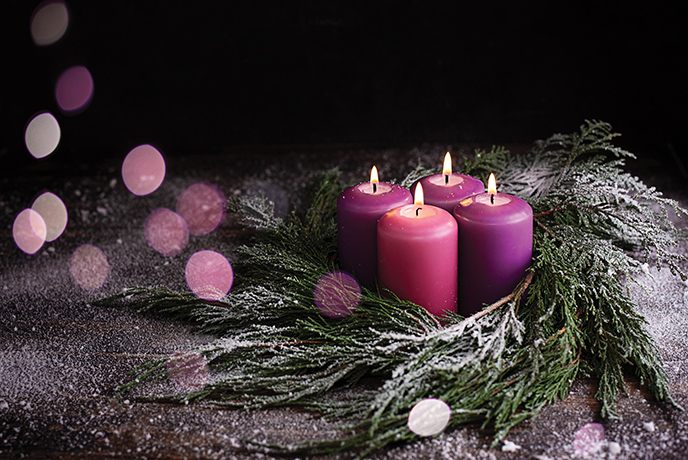
Your front lawn is awash in a rust and gold-colored quilt of fallen leaves. The windshield of your car is adorned in ice, and your breath catches white in the stinging morning air. You look up and the sun feels farther away. But there is a warm glow coming through the windows of the house, where you’re wanted. Inside blooms the sweet and earthy scent of nutmeg and cinnamon. Maybe a football game is on the TV, and you can hear the crowd cheering. There’s a fire crackling and snapping in the hearth. And perhaps on the dining table, there sits a wreath with four candles; three purple, one pink.
This is the season of the coming of the Lord. No other time in the liturgical calendar of our Church is as joyful as Advent. Easter, of course, is joyful, but it is preceded by the sorrow of the Passion. The Christmas season alone is untouched by some form of suffering, and it comes in the dead of winter.
The early Church first began to celebrate Advent in the fourth century, as a period of penance, prayer and fasting in preparation for the birth of Christ, similar to Lent. By the 9th century, the distinct liturgical season of Advent had come to be focused on both cultivating a spirit of penitence as well as the hopeful anticipation that we all feel as the 25th approaches, a shift attributed to Pope Gregory the Great.
It’s no surprise, then, that there are so many unique traditions from all around the world for celebrating this special time. But you need not be a world traveler to experience them—there are all kinds of special traditions happening right here in the Diocese of Youngstown!
Seven Fishes
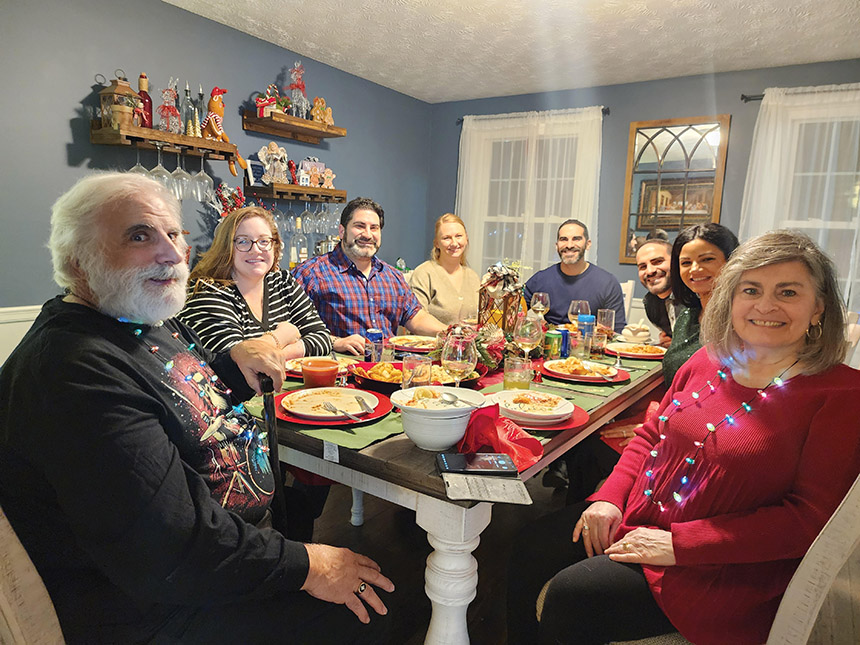
Michael Biviano radiates the joy of hazy, youthful memories when he recalls the Christmas Eves of years past spent at the Feast of the Seven Fishes hosted by his grandmother.
“It was special,” he said. “It wasn’t just my immediate family … even my relatives that weren’t related to my Grandma Netty got to experience that tradition with us, which was pretty cool. And the food, of course, was always great. My grandma was a great cook.”
The Feast of the Seven Fishes originated in Italian American families, but it has roots in Southern Italy, where seaside hubs like Naples, Sicily and Calabria would prepare elaborate seafood dishes. The “seven fishes” aspect is more of an immigrant practice that took root in the early 20th century. Though there is no concretely established reason for having seven dishes, many families relate the number to the seven sacraments of the Church, the seven days of creation, the seven virtues or even the seven hills of Rome.
Although he says that he and his siblings and cousins—including his brother, diocesan public relations manager Dennis Biviano—were not “huge” on seafood as kids, the vast plethora of options ensured that there was always something a picky eater could enjoy. His dad’s signature dish—calamari stuffed with crab meat, which he named dirigibles—is a particular favorite, then and now.
Biviano was born and raised in Niles. He and his wife Alyssa met as friends and stayed in contact while he was living in California. Over time, their friendship grew into a relationship, and now, with four kids of their own, their family has become the center of the Feast of the Seven Fishes tradition. Last year, Michael and Alyssa hosted the celebration at their home.
“I’m not an anxious person, but I was like, ‘How are we going to pull this off?’ But we pulled it off, somehow, some way!” he said.
Despite the stress of getting the house, the food and the kids ready for the evening, Biviano wanted to ensure that next generation of Bivianos got to experience the feast.
“I hear a lot of especially Italian Americans who say, ‘Oh that was something I’d do when I was a kid.’ I don’t want this to be something that I just did it as a kid and that I can’t pass on,” he said.
Once upon a time, all the food was homemade—much of it prepared by Biviano’s grandmother Netty. Nowadays, the family focuses on making their favorite dishes—the famous dirigibles, linguini and clam sauce, etc.—at home and ordering the rest from local restaurant Vernon’s Café. That allows Biviano to avoid making his least favorite dish—fried smelt—himself.
ADVENT WREATH

Mickee and Terry Murphy can thank their careers at the diocese for bringing them together. They first met more than 40 years ago at a class Terry was teaching, when Mickee was “a budding director of religious education.” She can’t remember the subject, but denies that she was too distracted by the teacher to remember. “The Gospel of John,” her husband helpfully chimes in.
Shortly after they met, Terry became the head of the religious education department at St. Thomas Aquinas High School in Canton, where he spent the rest of his career. Four kids and 11 grandkids later, the couple, now retired, is still deeply involved at St. Joseph Parish in Mantua—they teach at the parish, lector at Masses and volunteer at the famous Ox Roast festival every year.
The Murphys’ Advent wreath is a sight to behold. On first glance, it might appear to be nothing more than a bowl of stones holding the Advent candles. Closer inspection reveals that this is far from standard Christmas décor. Some of the stones have been painted by the Murphy grandchildren, some have special intentions or images carved in them and some simply showcase the natural striation of God’s design. But what they all share is that they’ve been gathered from special places all around the world.
“There’s rocks in there from Florence, Italy, Avila, Spain and from New Zealand, Andora, Malaysia—wherever family members go or friends go, they bring us back a rock and we mark it and it reminds us to pray for peace in the world,” Mickee said.
When they first began the wreath, they chose rocks from some of the gravel quarries near their home. “There are many gravel pits here in Shalersville and Mantua,” she said. “I gathered stones from here … to commemorate the fact that that’s where we live and that’s how people make their living here, and then we started to add stones from other places.”
Mickee feels that the hard-working roots of Shalersville impact the parishioners’ relationship to the Church and to each other, as evidenced by St. Joseph’s quarterly practice of community “giveaways,” where parishioners bring clothing and useful household items for those in need to take home.
“The people that mine here—that’s a wonderful thing about this community. They provide the gravel for roads and construction and things like that and that’s what the people here do, and it’s a really noble profession,” she said.
Mickee hopes that her grandchildren will continue adding to the stones. The oldest is 24, and the youngest just two, so “they have a lot of living to do,” she says with a laugh.
Helping Others

Karen Millburg made her work at Our Lady of Peace Parish in Ashtabula part of her family’s Advent tradition, and it has made an impact across three generations.
Mark and Karen married in 1976 and soon became full-time parishioners at Our Lady of Peace Parish. Karen was introduced to the parish’s “Share Your Christmas” ministry by Notre Dame Sister Mary Laurie Divoky and took over as coordinator when she retired. Karen would get a list of families in need from Catholic Charities and set up a Christmas tree in the church with items they needed. She served as the coordinator for the Christmas ministry for more than 10 years.
Kristy, Karen’s oldest daughter, said that participating in the charitable program with her mother had a huge impact on how their whole family understood the season of Advent and Christmas. “[The gifts] weren’t needless things—it was socks and clothes and things that we take for granted and as a teenager, seeing that—that that’s what people wanted for Christmas … it really made us more grateful for what we had and made the spirit of Christmas come through for our family.”
Now with three kids of her own, Kristy’s family still participates in the “Share Your Christmas” program. Kristy also praised her kids’ school—Saint John School, where she also works—for emphasizing charity work as part of its curriculum, saying it has really helped solidify the importance of giving as part of her children’s faith.
“They do food drives and clothing drives,” she said. “[Our family is very] faith-based, we’re very community-oriented.
It surrounds us all the time, it’s at school, it’s at home. It is a part of who they are because it’s how they’ve been raised.”
Community service isn’t the only Millburg Advent tradition, however. For as long as Kristy can remember, their whole extended family will get together a few weeks ahead of Christmas to prepare their homemade ravioli for their Christmas Day feast—plus a few extra for the rest of the year.
“My husband, who is not Italian, loves the ravioli and so he has kind of taken over the whole process. He makes sure that we do it,” said Kristy with a laugh.
Karen loves seeing how much her grandchildren enjoy getting together to make the ravioli. “They love it. They want to get in on it for sure. Get their little hands in there, get those rolling pins going and the forks.”
LAS POSADAS

Las Posadas, a popular Latin American Advent celebration, has come to our diocese all the way from Guatemala and found a home at Salem’s St. Paul Parish.
Las Posadas—which means “inn” or “lodging” in Spanish—is a nine-day celebration beginning on December 16 that reenacts the Holy Family’s journey to Bethlehem in anticipation of the birth of Christ. Its history can be traced back to the Middle Ages in Spain, where Catholics held processions and plays to reenact biblical stories.
The modern Latin American tradition began when Spanish missionaries arrived in the Americas in the 16th century, with the earliest recorded instance occurring in 1586 in the city of San Agustín in Acolman, Mexico, introduced by Augustinian Friars to help focus the native Aztec people on Christ. Over the centuries in the New World, Las Posadas developed its own unique practices that continue to be celebrated by Hispanic Catholics today.
Each night of the celebration, participants begin at their church by saying a rosary together. They then set out on foot—often led by children dressed as angels and with many of the participants dressed as Mary and Joseph—singing Christmas carols as they go home-to-home, asking to be given “posada,” or shelter. The procession is refused until reaching the final designated home, which grants the carolers entry.
Once inside the home, the carolers celebrate by reading the day’s Scripture together, singing Advent hymns and drinking hot chocolate or a traditional Guatemalan fruit punch. According to parishioner Roberto Ixcoy, whose words were translated by Father Frassati Davis, the receiving family for the night invites their close friends for a home-cooked meal as well. The procession continues until Christmas Eve, when the community gathers for a midnight Christmas Vigil Mass.
Ixcoy says that the tradition helps his family relate their experience as immigrants through the Nativity story.
“One feels … something in the heart, the coming of Jesus in our culture. When we arrive to the U.S., the focus is on work. On the other hand, the songs make you think about the baby Jesus, who is going to arrive,” he said.
Ixcoy also feels that sharing simple things like hot chocolate or food—rather than gifts—encourages a “feeling of peace.”
Father Frasatti, who is the pastor of St. Dominic Parish in Youngstown as well as the Hispanic ministry sacramental minister at St. Paul Parish, praised Las Posadas’ anticipatory nature as a way of better preparing oneself to meet Christ again at Christmas.
“At the core of [Las Posadas] is a novena, and a novena implies that there’s a particular intention, and as Catholics we should have an intention every Christmas to receive Jesus anew,” Father Frasatti said. “It’s a reminder to families that after a long year, there’s a lot to be thankful for, but there’s also a lot that Jesus has to teach us every time He comes into our hearts in a new way. And when we pray these nine days, it helps prepare us to receive Him at Christmas.”
The tradition of Las Posadas has been going strong at St. Paul Parish for several years, and just two years ago, Father Frasatti introduced the tradition at St. Dominic Parish.
There are so many ways to start an advent tradition
It doesn’t matter if it’s big or small—the important thing is to remember the gratitude of the season and to set time apart to celebrate the coming of our Lord with your family.
Read your parish bulletin to learn about any events your parish may have this season.
Visit www.doy.org to learn about diocesan events.