Civics education in our Catholic schools
Catholic schools strive to not only cultivate faith, spiritual growth and academic rigor but also prepare students for the responsibilities of citizenship.
Through textbooks, class lectures, field trips, service projects and other activities, diocesan school officials and the Youngstown diocesan schools work at both the elementary and high school levels, to ensure that students are informed about citizenship and its responsibilities.
“Catholic schools have an interesting history regarding citizenship,” said Dr. Steven Jones, diocesan superintendent of schools and author of Religious Schooling in America: Private Lives and Public Obligation. When the Bishops of the United States were developing Catholic schools in the 1800s, there was a goal of maintaining and strengthening a sense of Catholic identity during a time when public schools were seen as “Protestant.”
“If you look back even into the late 1800s and early 1900s, Catholic schools were very suspect,” Jones said, because they were seen as separatist and because the U.S. Catholic population included a large number of immigrants.
The Catholic Church responded to that perception in a variety of ways. As the U.S. got involved in World War I, the U.S. Bishops—including representatives of 68 dioceses and 27 Catholic organizations—came together for the first time in decades to study, coordinate, unify and put in operation all Catholic activities incidental to the war. Out of that assembly came the National Catholic War Council. Following the war and growing out of the Bishops’ previous initiative, an even larger gathering of Bishops sought to affirm their collective presence and witness through establishing the National Catholic Welfare Council, which would eventually evolve into the United States Conference of Catholic Bishops. Through the Bishops’ leadership in the National War Council, Catholic schools stepped up their efforts to foster patriotism, Jones said—an effort that has persisted more than a century later.
“You still have a real push in the schools to emphasize patriotism and good citizenship,” Jones explained. “What we do now is to promote a sense of attachment and pride in our national accomplishments.”
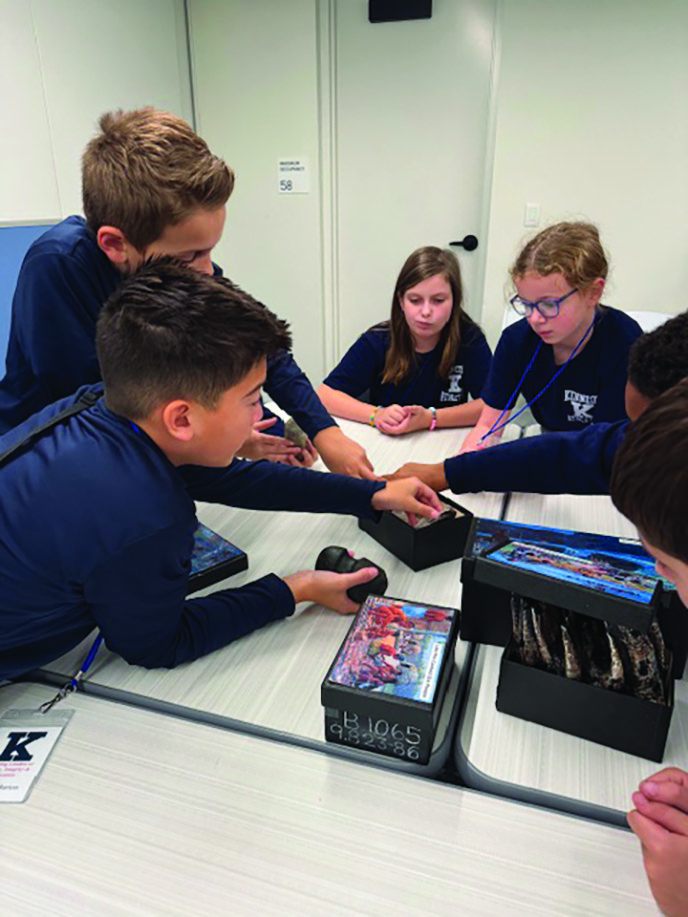
Dr. Jacque Mumford, director of continuous improvement for the diocesan Office of Catholic Schools, a former professor at Walsh University and a former Catholic school principal, noted that diocesan schools follow state mandates for the teaching of history and civics in diocesan elementary and secondary schools throughout the six counties of the diocese. She explained that they combine these mandates with the Catholic sense of community and the commitment to the common good.
“We have at least six core integrations,” Mumford said, including diocesan and Ohio Learning Standards for Social Studies, which encompass civic education at all grade levels. These include: the structure of government at the local, state and national levels; rights and responsibilities of citizens; voting and elections; the Constitution and rule of law; and public policy and civic participation. In addition, she said, “Most diocesan schools incorporate service learning, with students participating in real-world community service connected to classroom learning,” Mumford said. “This is integral to our Catholic charism.”
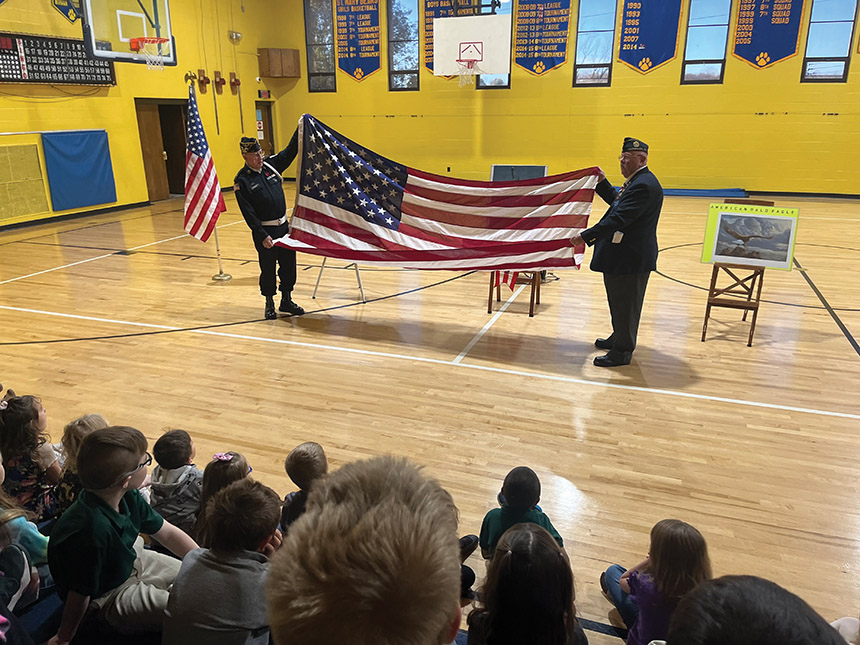
“Educating for Citizenship is a pretty big theme in Catholic Schools Week,” which is celebrated each January, Jones explained. Within the larger curriculum framework, the schools implement that commitment in various ways—including classroom instruction and the marking of special days like Memorial Day and Constitution Day (September 17, the date on which delegates to the U.S. Constitutional Convention in Philadelphia in 1787 voted to approve the Constitution)—bringing in speakers to discuss issues related to citizenship, government and civic involvement and engaging in service projects, “which take the students out of the schools into the larger community.”
“It’s so ingrained into what we’re doing, and [it is] carried out in different ways. Some schools go to museums, or they’ll go to some of the American history sites in the region,” Jones said. “We are doing a theme year about Catholic social teaching in line with being part of your community.”
“Our students learn that we are part of something bigger,” Mumford emphasized, as they learn respect “for others and for our traditions and our values.”
Schools in the various counties that make up the Youngstown Diocese find ways to educate their students in the ideals of U.S. citizenship and to impart concrete practices toward those ideals.
At St. Michael the Archangel School in Canton, “in third, fifth and eighth grade, we focus on American history,” said Mary Compton, social studies teacher at St. Michael, adding, “We have a couple of prongs to our approach.” This includes teaching about U.S. history and the branches of government, but they also pursue practical applications through student council elections.
For Constitution Day, Compton said the school has different ways to connect to U.S. history. For example, “We did a fifth-grade play, which teaches a lot about what happened” in the early days of America’s founding. With the eighth graders, “We use A.I. (artificial intelligence) as a way of tying in history to a modern approach.” So, through A.I., a student can say: “I would like to speak to John Hancock” to have the experience of encountering a historical figure.
“We also like to connect what goes on in history to what is happening today,” Compton said, describing how teachers use a daily news show for viewers who want to learn about current events and global issues in 10 minutes or less. “We have a very lively discussion. The kids have an opportunity to talk about what is going on and to understand that they are part of a larger world.”
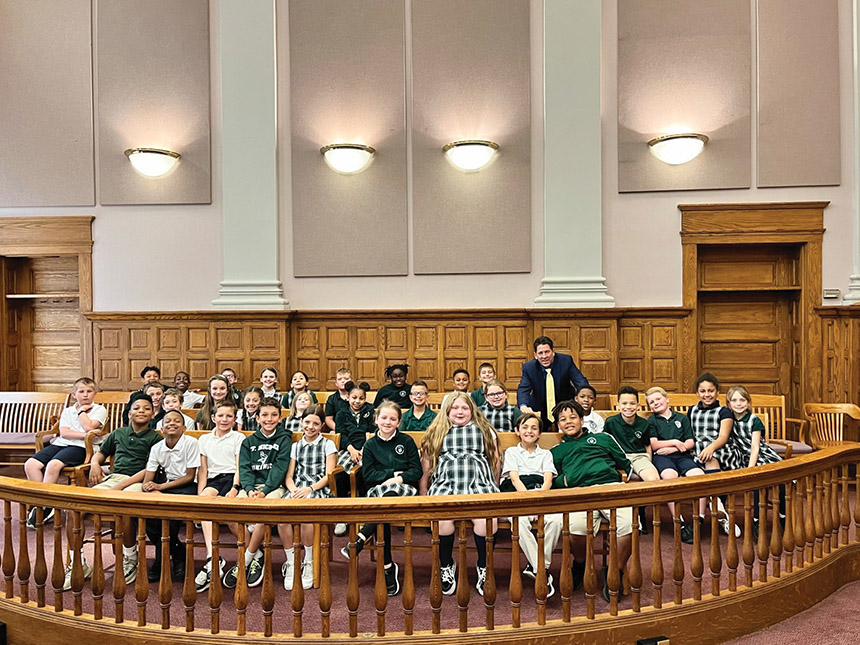
“And they can see,” said Claire Gatti, principal of St. Michael, “that there is something more going on in our world than what social media tells us.” At times, the school takes students out of the school to connect more deeply with their civics lessons. For example, Gatti said, the fifth graders visited the Stark County Courthouse. “They got to experience a mock trial. That’s really great for the kids. The kids say: ‘I’ll never forget that.’”
Other ways to connect with citizenship lie in observance of special days, Gatti said, such as their annual celebration of Veterans Day.
“Our students go over and above to honor these veterans,” sending letters and cards as well as inviting them to the school for a Veterans Day celebration. “It’s so important that the students understand the years of sacrifice that veterans have put in,” Gatti said.
Compton explained, “For 9/11, we did a virtual tour of the 9/11 Memorial & Museum,” which stands near the site of the 2001 terrorist attacks on the World Trade Center that took about 3,000 lives. As part of the virtual tour, they heard testimonies from family members of those killed. “They said that hearing these testimonies helped them to better appreciate that this happened to real people,” she said.
“One parent said that she was so grateful that Mrs. Compton brought it alive,” Gatti said.
Covering another aspect of citizenship, “We are very active in doing things in the community,” Gatti said, such as serving in the parish food pantry, making holiday placemats and greeting cards for residents of nursing homes and working on the parish Christmas giving trees.
Saint John School in Ashtabula, serving students in Pre-K through 12th grade, also combines conventional classroom instruction with more experiential learning, explains Tiffany Miller, who teaches various grades’ government classes—including advanced placement. “We do a lot of collaborative work.” For their mock elections, “we collaborated with the Ashtabula County Board of Elections to bring in real voting machines.” The result? “It lowered the barrier for many students who said that they wouldn’t be nervous now when they went to vote for real. They are looking forward to voting now,” Miller said.
Saint John students also had the opportunity to hear from Ohio Secretary of State Frank LaRose, when he visited the school, Miller said.
Miller, who serves as vice chair of the board of trustees for Geneva Township, also took students to a township meeting “so that they could watch government in action.” Her hope—depending on their ability to secure a grant—is to take students on a field trip to Columbus to the Ohio Supreme Court and its visitor education center.
Her goal is that students gain an understanding and see opportunities. “We encourage them to be involved and active. I’d like them to be confident in themselves, to have a sense that they matter, that they have a voice through their vote.” Saint John students also engage in service projects.
At St. Paul School in Salem, not only does it have social studies classes, but the school also has a civics club to offer additional opportunities to learn about citizenship.
Michael Godfrey, who teaches social studies and math at St. Paul School, said, “We teach them about leadership and government and equip the students with the tools for leadership and service. I always try to help them become engaged, to help the world and help others. Obviously, we want to make our students aware, because in a few years they will be involved.”

In addition to the classroom, many of the students participate in the civics club, sponsored by Major Emmy Prosko, who serves in the Army defense supply center in Columbus and is the mother of David Prosko, a sixth-grader at St. Paul.
David Fischer, principal at St. Paul, said, “It’s wonderful to know that we have parents who can volunteer in our schools and bring these unique opportunities to our students.”
The optional after-school club, Prosko said, is open to students in grades four through eight. “Over a third of the students eligible to participate are involved. That’s one of the really exciting parts.” The club meets twice monthly and offers a wealth of activities, including a visit from Salem Mayor Cyndi Baronzzi Dickey. The first half of the year, Prosko explained, focuses on developing “a kid-friendly understanding of government at each level and how citizens get to be involved,” as well as learning about great civic leaders of the past. In addition, Prosko said, “We’re hoping to do a field trip to the state capital, Columbus.
“The second half of the year, students will apply their understanding of civics and leadership to student-led group projects in the Salem community. At year’s end, students will present their projects at a local government meeting.
“Students at this age are ready to learn and see how they can participate,” Prosko said—“and even lead.”
“‘We the people’ means us. That idea should be introduced at the earliest level, so that students have a chance to understand not only the advantage of participating in a democracy but also the obligation. There is a moral responsibility to serve the community,” which is particularly fitting for a Catholic school, Prosko said. “Serving others is the ultimate calling in life. I’m very confident in the next generation of leaders.”
Jones also affirms that element of service in educating students for citizenship: “We are in this for the good of Youngstown, Canton, Warren, Salem, Ashtabula, Kent, Niles and all the places where our schools exist and where our students live.”