
Coming up in October is Respect Life Month. It is an annual reminder to reflect on the question, “How can we promote the culture of life?”
On social media, when discussing respect life issues, we see headlines touting the fact that someone “shut down” or “demolished” their opponent when defending life. While explosive confrontations are online gold, they are terrible at softening a hardened heart.
So, what works? We know that people’s attitudes and decisions can change. But in a climate that feels so hostile, how can we hope to make any difference? I try to start by removing the plank from my own eye. We can relate to others by sharing our own stories of conversion, whether big or small.
When I started my teaching career in GED test preparation, back when the test focused on personal essays, I was surprised by the responses to this practice question: “What is a belief that you have changed over time? Explain what led to the change.”
A common topic was their belief about human life.
Each story was different about what changed their mind. One of my adult learners wrote about getting pregnant and being amazed by the feeling of a person growing inside her. Another experienced grieving and realized how precious life is. Another lost his dad to a heart attack that occurred while shoveling snow and changed his habits to save his own life.
Every story described an increase in their belief that each human being is precious, with their own right to life. This change of heart led to action—sometimes personal, sometimes political. Their stories of conversion softened my heart as well.
The Catholic Church’s vision of what defines a human being does not fit with politics that rely on dehumanization. Viral slogans try to justify policies that treat precious human beings as monsters—a drain on society, or even deserving of death. Excuses for seeing someone as undeserving include migration, terminal illness, criminal conviction, religious identity or even political party.
We are all tempted to define or treat someone as inhuman—as undeserving of God’s love or our compassion. We all have stories of conversion and our own responses to the GED test question.
This is my story. I grew up a Unitarian Universalist. I was taught to value human rights, but to see a fetus as just a lump of cells. It wasn’t becoming Catholic that changed my mind. It was biology.
For a creative writing course in college, I interviewed a biology professor who was studying pregnancy. She explained that a woman’s body treats a fetus as a semi-foreign object. Her research lab studied how the immune system has to modify itself to both fight disease and allow pregnancy to continue. This was a shock to me.
“Does your research have political implications?” I asked.
“No,” came the curt reply. But this fact changed my beliefs forever: a mother’s body is biologically different from her unborn child.
I always supported each human’s right to life and dignity. Until that conversation, I did not believe a fetus was a human being until it was viable. Suddenly, my heart told me that that was wrong. I began to believe the unborn are people with their own right to life.
My interviewee didn’t even agree with me! My moment of conversion came when someone wasn’t even trying to change my mind. But I was open to learning something new, which allowed me to see human life in a different way.
Even among people who agree about valuing human life, there is reasonable debate about how that applies to personal decisions and public policy. When do we consider someone dead? When is medical intervention justified? When does it violate human dignity? Promoting a culture of life challenges us to soften our hearts when we consider these tough questions.
When we disagree with someone about respect life issues, do we still see them as human beings, loved by God? Do we see ourselves as forgiven sinners with our own stories of accepting God’s mercy? Do we acknowledge our shared values—even in conflict? Are we approaching our conversations with an open heart?
People’s attitudes and decisions can change.
Next month, for Respect Life Month, I ask that you join me in praying for conversion—starting with ourselves. No sin is too great for Christ’s Divine Mercy. It is our humility that promotes a culture that values all human life.
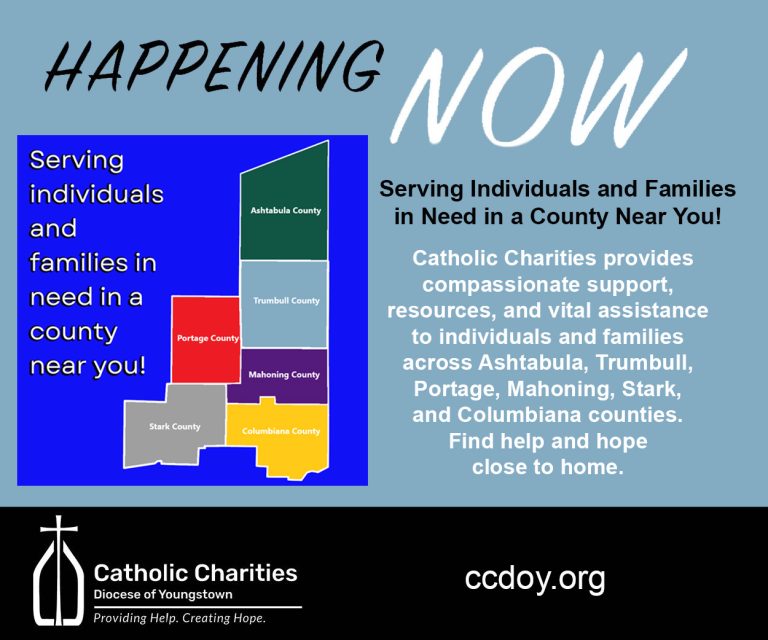
The United States Conference of Catholic Bishops, and Bishop Bonnar in particular, have asked all of us to explore practical ways to welcome children into our communities, regardless of their family’s circumstances. When we encounter someone who has difficulty with a pregnancy or parenting, let’s focus on our commitment to the program Walking with Moms in Need. Look up services in Catholic Charities’ Resource Guide at
CCDOY.org, or find other ways to respectfully encourage mothers to choose life.
If you are interested in the parish-based program Walking With Moms in Need—or other ways to respect life—please please visit the website: www.doy.org/respect-life/ or contact me at mfarrell@youngstowndiocese.org or 330-744-8451 x375. Learn more at DOY.org/walkingwithmomsneo/ and let’s all work together to promote a culture of life.