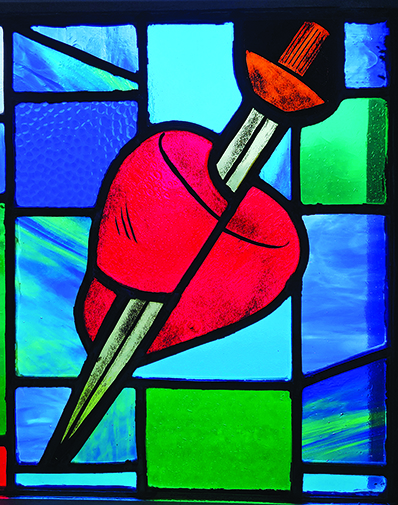
The Sacred Heart of Jesus is one of the most popular—and mysterious—devotions in the Christian faith. The historical development of this devotion traces the evolving path of Christology and our understanding of His divinity throughout the life of the Church. So, what is the Sacred Heart of Jesus, and why is it venerated?
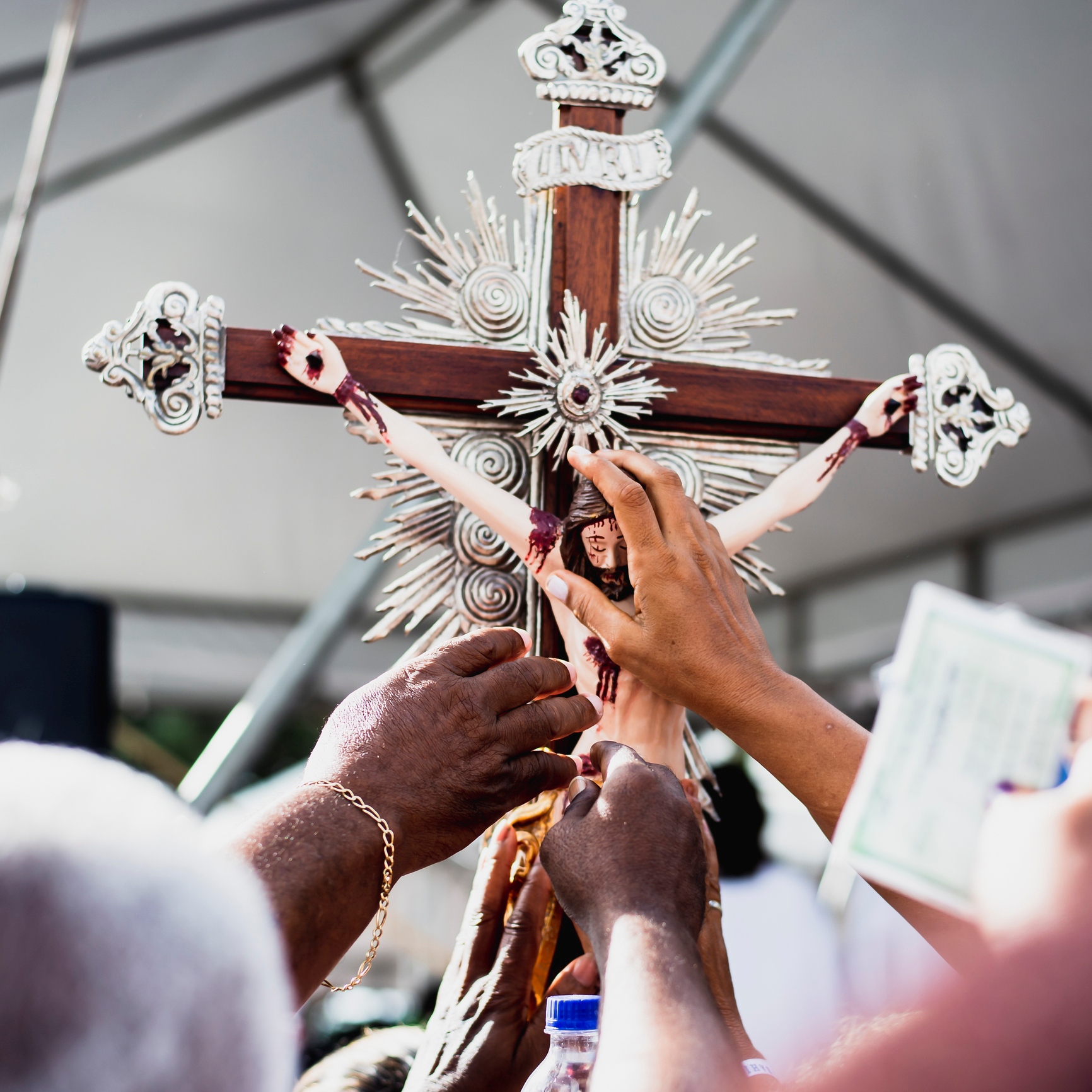
The idea of Jesus’ love for us is of course foundational to our faith. It is discussed most notably in the First Epistle of John, where it is said that “God is Love” (1 John 4:8). However, the earliest form of a particular devotion to the literal Heart of Jesus first began in the High Middle Ages, when it became increasingly popular to meditate on the Five Wounds of Jesus—especially the piercing of His side from which the blood and water flowed.
It was Saint Bernard of Clairvaux who connected Christ’s Heart and the piercing of His side, emphasizing this wound as the source of Jesus’ outpouring of divine love and mercy for us. In a sermon on the Song of Songs delivered sometime in the year 1130, Saint Bernard wrote: “The sword pierced His soul and came close to His Heart, so that He might be able to feel compassion for me in my weaknesses. Through these sacred wounds we can see the secret of His Heart, the great mystery of love, the sincerity of His mercy with which He visited us from on high. Where have your love, your mercy, your compassion shone out more luminously than in your wounds, sweet, gentle Lord of mercy?”
While Saint Bernard provides the earliest recorded basis for the veneration of the Sacred Heart, the devotion rose in prominence largely thanks to the works of several great women saints.
Saint Gertrude the Great, a Benedictine nun born in the 13th century, was an essential figure in the evolving Christology and theology surrounding the veneration of the Sacred Heart. A noted mystic, Saint Gertrude received visions regarding the Sacred Heart from the age of 25 until her death. The first vision came on the Feast of Saint John the Evangelist, which she describes in her influential work Herald of Divine Love. In the vision, she reported resting her head near the wound in Christ’s side and hearing the beating of His Heart. She asked Saint John why, if on the night of the Last Supper he too had heard these pulsations, he had not written of them—to which he replied that the revelation of the Sacred Heart had been reserved for future generations living in an age “grown cold,” who would need the image in order to rekindle the world’s love. Saint Gertrude and her writings would go on to influence other saints such as Saint Teresa Avila and Saint Francis de Sales.
Though not the first saint to bring awareness to the Sacred Heart, perhaps none were more significant in the devotion’s propagation and popularity than Saint Margaret Mary Alacoque. From 1673 to 1675, Saint Margaret Mary Alacoque—a French nun of the Order of the Visitation of Holy Mary—received several revelations on the Sacred Heart from the Lord. Similarly to Saint Gertrude, her first vision also came on the Feast of Saint John the Evangelist. In her vision, Jesus allowed Saint Margaret Mary to rest her head on His Heart and told her that He had chosen her to spread the devotion to His Sacred Heart. After this revelation, she saw the image of the Sacred Heart which we know today: the Heart, encircled by flames, crested with a cross, with the crown of thorns above.
On June 16, 1675, Saint Margaret Mary received what came to be known as the “great revelation,” wherein Jesus requested that Saint Margaret Mary institute a feast of “reparation” to His Sacred Heart to be celebrated eight days (an octave, as it is called in the Christian liturgical calendar) after the Feast of Corpus Christi. In the vision, Jesus said to Saint Margaret Mary: “Behold the Heart which has so loved men that it has spared nothing, even to exhausting and consuming itself, in order to testify its love; and in return, I receive from the greater part only ingratitude, by their irreverence and sacrilege, and by the coldness and contempt they have for me in this sacrament of love.”
It was also in this “great revelation” that Jesus made 12 promises to Saint Margaret Mary for those who practiced devotion to his Sacred Heart. He said: 1) I will give them all the graces necessary for their state of life. 2) I will give peace in their families. 3) I will console them in all their troubles. 4) I will be their refuge in life and especially in death. 5) I will abundantly bless all their undertakings. 6) Sinners shall find in My Heart the source and infinite ocean of mercy. 7) Tepid souls shall become fervent. 8) Fervent souls shall rise speedily to great perfection. 9) I will bless those places wherein the image of My Sacred Heart shall be exposed and venerated. 10) I will give to priests the power to touch the most hardened hearts. 11) Persons who propagate this devotion shall have their names eternally written in My Heart. 12) In the excess of the mercy of My Heart, I promise you that My all powerful love will grant to all those who will receive Communion on the first Friday, for nine consecutive months, the grace of final repentance: they will not die in My displeasure, nor without receiving the Sacraments; and My Heart will be their secure refuge in that last hour.
The final promise, which Saint Margaret Mary referred to as the “Great Promise,” is the source of the First Fridays devotion, which is still commonly practiced today. She said that Jesus requested devotees to spend an hour on Thursday night—from 11 p.m. to midnight—praying and meditating on His Agony in the Garden and that they receive Communion on the first Friday of nine consecutive months.
It was thanks to Saint Margaret Mary Alacoque’s friendship with her confessor, Saint Claude de La Colombiere, that the devotion began to spread. Saint Claude—convinced of the truthfulness of her revelations—asked that Saint Margaret Mary write an account of the apparitions, which he circulated throughout France and England. He consecrated himself to the Sacred Heart of Jesus on June 21, making him the first person to do so.
Due to the efforts of Saint Claude and the writings of Saint Margaret Mary, the devotion became popular in religious communities throughout Europe, and the Vatican gradually granted the feast to more groups during the 18th century. However, it was not until 1899 that Pope Leo XIII determined the validity of Saint Margaret Mary Alacoque’s visions and decreed that the entire human race should be consecrated to the Sacred Heart of Jesus. He raised the feast to a dignity of the first class. In his encyclical letter issuing the decree, he encouraged all the Catholic Bishops to promote the practice of the first Friday devotions and included the Prayer of Consecration to the Sacred Heart. After Vatican II’s liturgical changes, the Feast of the Sacred Heart was assigned as a solemnity.
Just as Christ was both fully human and fully divine, so too is the Sacred Heart both a symbolic and literal image of God’s love. Learn more about consecration to the Sacred Heart in the excerpt from Bishop Bonnar’s latest pastoral letter on page 14.
~By Collin Vogt