Running Off the Page of Scripture Into the Story of Our Lives
Inside the walls of Old Jerusalem at 4 a.m. on February 6, 2023, it was dark and chilly. The streets were empty except for a few young men walking to prayer. We followed the Via Dolorosa (The Way of Suffering), which is believed to be the path that Jesus walked as He carried His Cross on the way to Golgotha, where He was crucified. My group of pilgrims, which included clergy from across the United States, gathered in this early hour to pray the Stations of the Cross before the arrival of hectic crowds during daylight hours.
Almost all Catholic churches and chapels have Stations of the Cross images on their walls. Some have them outside on a path. The images are crafted of wood, clay, stone or mosaic tile, but the ones on the original path in Jerusalem are made of iron and are attached to the same stone walls—in the same narrow streets—in the same city of 2,000 years ago. The final Stations of the Cross are within the walls of the Church of the Holy Sepulchre, which houses the place of the Crucifixion, as well as Christ’s Tomb.
Our experience was life-changing, but, in reality, not many Christians are able to make a pilgrimage to Jerusalem. It was the same in the late Middle Ages, during the Turkish occupation of the Holy Land, when pilgrimages were forbidden. So, the practice of making replicas of these sacred sites for all Catholics to pray the devotions became popular all over the Christian world.
What prayers do we pray as we journey through each Station? The Stations are different from sacred liturgies, which follow prescribed formats. There are many ways to pray the Stations, but they are often rooted in Scripture, reflection and dialogue. For many years, my favorite version was from St. Alphonsus Liguori, which is a combination of reflection and dialogue. Another version that has become my favorite for personal prayer is Everyone’s Way of the Cross by Clarence Enzler. His reflective writings and dialogue are contemporary and relatable to most people.
Whether you use a booklet, or you just walk along and meditate on the event of each Station, you are still praying the Stations of the Cross and are still walking along with Jesus. So, let’s walk through them together now.
The First Station: Jesus is Condemned to Death
After the introduction of each Station, some versions have us pray:
We adore You, O Christ, and we praise You. Because, by Your Holy Cross You have redeemed the world.
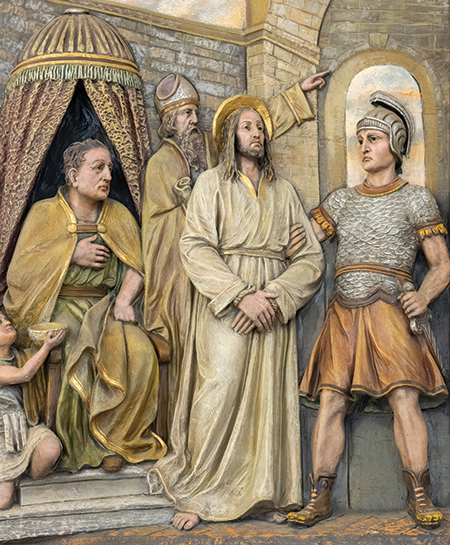
We repeat these words at each Station to remind us of His “why.” For instance, in the first Station we may ask, “Why did He allow Himself to be condemned to death? Why did He relinquish His divine control?” These questions come from our humanness, but He is always in control in His divinity. Authoritarian actors, like Pilate, were unwittingly players in our redemption. Instead of condemning Pilate, we should thank him. He prepared well for his role in the harsh Roman army. In response to him, Jesus teaches us that humility is a necessary component of love.
Have you ever been unjustly accused of something beyond your control? How hard is it for our prideful humanity to relinquish control—especially when we face injustice? To answer the question, “Why?” we need to ask, “Where is God in this situation?” and “By our humiliation, can we also help to redeem the world?” When we join our humiliation with the unjust condemnation of Jesus, how many souls can we help Him save?
The Second Station: Jesus Takes His Cross
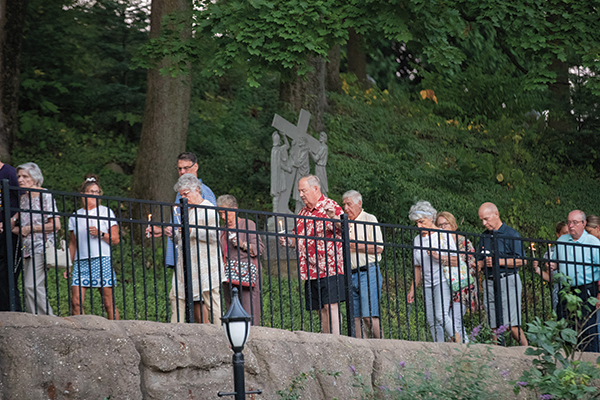
When I meditate on the Cross placed upon the shoulders of Jesus, I think about the imbalance of its weight, the splinters on His torn flesh, and I think about Jesus wondering how far He would need to drag the heavy tree.
It bothers me when I have a grain of sand in my sneaker, so I cannot imagine splinters in open wounds. I could not begin to imagine what His suffering was like—or the greater sufferings that others endure. Still, minor inconveniences get the best of me.
Clarence Enzler writes, “Remind me often that, in carrying my cross, I carry Yours with You. And though I bear a sliver only of Your Cross, You carry all of mine, except a sliver, in return. Jesus, please give me Your strength to help me carry the crosses in my life.”
The Third Station: Jesus Falls for the First Time
Most streets in Old Jerusalem are closer to the size of an alley. They are made of cobblestone with uneven footing. Add to this the spectacle of a prisoner carrying a cross, the noise, and the blood blinding His eyes. It is no wonder He lost His balance. But Jesus rises to journey on because He knows His ministry is not complete. He must go on to finish what He started.
Do you feel like this in your life? In your ministry? We become weighed down by the busyness of our lives and become frustrated with our limitations. Sometimes our fragile bodies give out, and we suffer a medical or emotional setback. How temping it is to quit, to say, “I cannot do this anymore.” But when we look beyond our limitations to see that there is still work to do, we can draw on His strength. Then we, too, can stand and continue.
The Fourth Station: Jesus Meets His Mother
For this Station, Jesus shares the scene with Mary. Put yourself into her story. What was she thinking about? Was she thinking this would be the last time she would share a moment with her Son? Had reality set in, or was she in denial? What sort of hole was being torn into her heart?
I have accompanied parents who have lost a child. We aren’t supposed to outlive our children, but that is not always the case. Sometimes these children are adults, but many times they are young or even unborn. How do we move forward? Only by the grace of God.
Mary knew this. Throughout our Christian story, Mary has been the model of perfect faith. With perfect faith comes perfect hope. With any tragedy, the only way forward is hope. Our faith communities help us answer the question, “Where is God in this?” Let us pray that all parents who have lost a child are surrounded by their faith communities and can find hope. Mary’s hope.
The Fifth Station: Simon Helps Jesus Carry His Cross
The guards did not think that Jesus would survive the rest of the journey to His crucifixion, so they forced a bystander, Simon of Cyrene, to help Jesus carry His Cross.
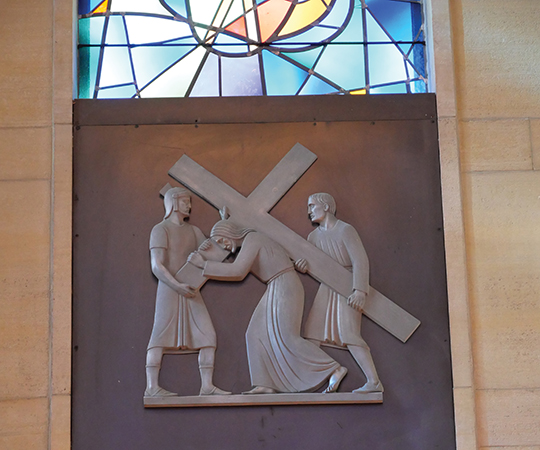
We cannot help but put ourselves in the place of Simon, looking into the eyes of Jesus from inches away. Just thinking about being there in Simon’s place is life changing. Think about Jesus allowing someone to help carry the weight of His Cross.
We do this each time we perform some act of Christian service. At my parish’s food and clothing ministry, when we debrief a night of service with our first-time workers, they usually tell us that they felt they received more than they gave. That is a sign of discipleship, and it is divinely intentional. God wants us to feel this because He wants us to serve again. Our society is so much richer and more beautiful when we serve each other. Is it part of God’s plan of redemption? You bet it is.
The Sixth Station: Veronica Wipes the Face of Jesus
A young woman, grief-stricken and sad, comforts Jesus by wiping His bloody face with her veil. This is a wonderfully beautiful scene. Everyone knows it, but it is not found in the Bible. It is a story of our Catholic tradition that very likely could have happened, as there was bound to be at least one sympathetic follower in the crowd. She is named Veronica from the Latin vera (true) and icon (image) because of the image of the face of Jesus left on her veil after wiping His face.
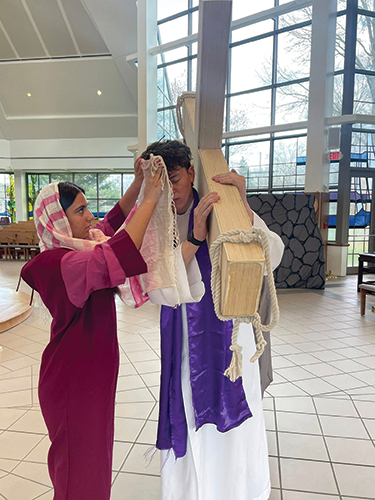
Compassion is another word derived from Latin, com (with) and passio (to suffer), so a definition of compassion is to “suffer with.” That is what Veronica was doing—suffering with Our Lord.
We do this when we acknowledge the suffering of another, and instead of turning away, we walk toward them to accompany them in their suffering. It could be a medical professional accompanying a patient. Or someone being present with another who is suffering so they do not suffer alone. Veronica teaches us that whenever we have compassion, we, too, are wiping the face of Jesus.
The Seventh Station: Jesus Falls for the Second Time
Jesus is fully divine, but He is also fully human. Every time He falls, the limits of His humanity are evident. Yet, He is helped up to his feet, and He continues on with His plan of redemption.
We have such a fragile humanity, but Jesus teaches us time and again that He is all about second chances. The fact that He became one of us to communicate His infinite mercy—sealing that with His suffering, dying and rising—is proof enough.
But there is one condition—we need to ask for it. By His dying, He freely gives us this gift of mercy. To open that gift of His mercy, we must confess our transgressions. When was the last time you went to confession? I am a sinner and a believer in frequent confessions. The grace received each time is life changing—even redeeming. For your freedom’s sake, go to confession.
The Eighth Station: Jesus Consoles the Women of Jerusalem
Word had gotten around that a man who committed no crime was being crucified. Sympathetic women gathered to see Him and wept. Jesus, being so intuitive about our human nature, says “Do not weep for me; weep instead for yourselves and for your children” (Luke 23:28).
Have you ever read a story or seen something in a movie that caused you to get emotional? Then you remembered that what you saw or read was all too close to something similar in your own life. That is called empathy—when we can feel the same pain or sadness of another. Here, Jesus doubles back the women’s empathy with His own. He saw how those souls were drifting away from their faith, just like He sees our grief when we do the same.
Jesus, help me turn my heart back to You, and then, let me be an offering for other souls to turn back toward You as well.
The Ninth Station: Jesus Falls for the Third Time

After this third fall, how difficult was it to rise and move on? I can only imagine that He may have felt that the pavement was His final resting place. I have never had clinical depression, but from what I have learned from those who have, this is exactly the way it feels. Dark, painful, desperate, hopeless.
On this third fall, let us remember those who suffer with depression and other mental illnesses. May they have the ability to ask for help. May God make available for them practitioners who can help them heal. May they be surrounded by their faith community so they never feel they are on their journey alone.
The Tenth Station: Jesus is Stripped of His Garments
A common fear is to be exposed for what you have done wrong. That is why the Seal of Confession is so important in the Church. The Church wants us to become free from whatever impedes our holiness—the reason Jesus gave us the Sacrament of Reconciliation. The Seal of Confession gives us the confidence that our sins will never be exposed. And, once forgiven, those sins are gone. We become as white as snow, just like on the day of our Baptism.
Fear of exposure comes from pride, which leads us to sin. At this Station is a man who has nothing to hide—no sin, no regrets, no pride. He has no fear of exposure, but He allows it, for our redemption. O Lord, as I mediate on this Station, make me humble like You.
The Eleventh Station: Jesus is Nailed to the Cross
This Station is very personal. While watching the soldier hammer nails through the flesh of Jesus, our empathy peaks. If it were anyone else, in any other situation, we may say, “Stop! Don’t do this for me!” But because we know the rest of the story, we allow the scene to move forward in our minds.
Here, Clarence Enzler’s writings ask, “My God, I look at You and think: Is my soul worth this much?” Father, You love me more than I love myself. Help me to love like You.
The Twelfth Station: Jesus Dies on the Cross
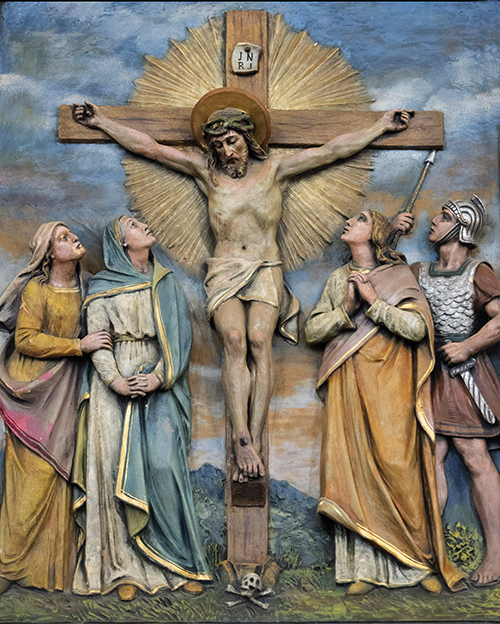
Traditionally, at this Station, we kneel and meditate silently for a few moments.
Have you ever heard of the saying, “They died well?” Is there such a thing? When we die in the merciful arms of our Father, as Jesus did, we die well. Before He took His last breath, Jesus said “Father, into Your hands I commend my Spirit.” Total faith. Total trust. That is dying well.
Some of us have accompanied loved ones when they leave this life for the next. It is never easy, but if the faith of our loved ones is aligned with Jesus in their final moments, we trust they are headed to where we all hope to go. Also, at that moment, we may sense the essence of divine beauty. Death does not always need to be scary.
What do we need to do to die well? Father, as I meditate on the death of Your Son, give me the faith of Jesus.
The Thirteenth Station: Jesus is Taken Down from the Cross
Jesus’ suffering is over, but not Mary’s. They lowered His body down from the Cross, into the arms of His grieving mother. Here, she experiences every mother’s nightmare—holding the lifeless body of her child.
The silence after one’s suffering is ended sometimes makes us feel guilty—especially if we prayed that God take them quickly. But grief always follows. Sometimes it is suffocating. Many times we want to rewind life. Sometimes we just want that person back.
Here is one more nugget of wisdom that Clarence Enzler gave us in his meditation: “And if by just one word I might restore their lives against Your will, I would stay silent.”
Our faith reminds us that we are just passing through this life. This is not our home. In the Rite of Christian Funerals, we commend our loved ones to God with the hope that He has prepared a place for them. We know this in our hearts, but we still grieve. Remember, grief is not lack of faith. It is the result of love.
The Fourteenth Station: Jesus is Placed in the Tomb
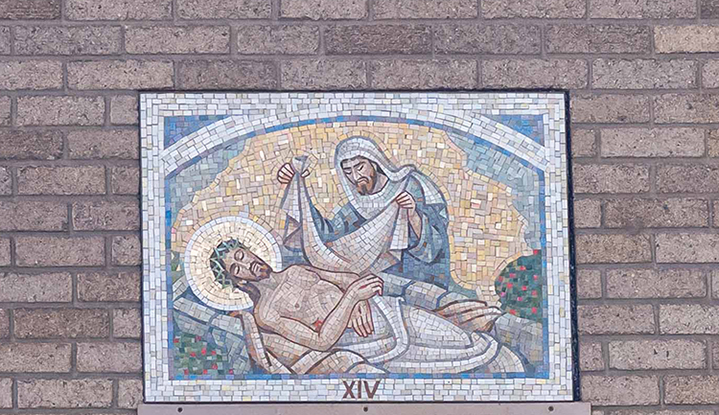
Joseph of Arimathea, a secret disciple, took the body of Jesus and placed Him in the tomb that he had made for himself. A large stone was placed to close its entrance. Then they departed. (Matthew 27:59-60)
I had the privilege of serving as deacon at Mass in the Church of the Holy Sepulchre. A little chapel sits just above the place where Jesus was laid in the tomb. The space inside is tiny. The inner chamber, where the altar is, can only fit a priest and a deacon. It was the most powerful place I experienced during my pilgrimage. The energy was palpable. Was it adrenaline? Maybe.
Meditating on this Station allows us to place ourselves at the tomb, as one of His disciples. They were in disbelief that their Christ was gone. But we, like most pilgrims, know the rest of the story. So when we visit the Holy Sepulchre, we also pray with anticipation for His return.
The reason we pray the Stations of the Cross is not for nostalgia—like going back home for the holidays and visiting the places where we grew up. The reason we pray it is to change. Before we change, we must become aware of our brokenness and then become aware that Jesus can heal that brokenness. Through any kind of prayer, we open that door for Him to do just that.
Hope in the divine makes us more alive and drives us to share our hope with others—in service to the poor, accompanying those who are sick or sharing our stories with those who are searching. This is our response to His incredibly loving act of mercy.
Through the Stations of the Cross, Scripture comes to life, like the words are running off the page of the Bible into the stories of our own lives. Afterward, we cannot help but change.