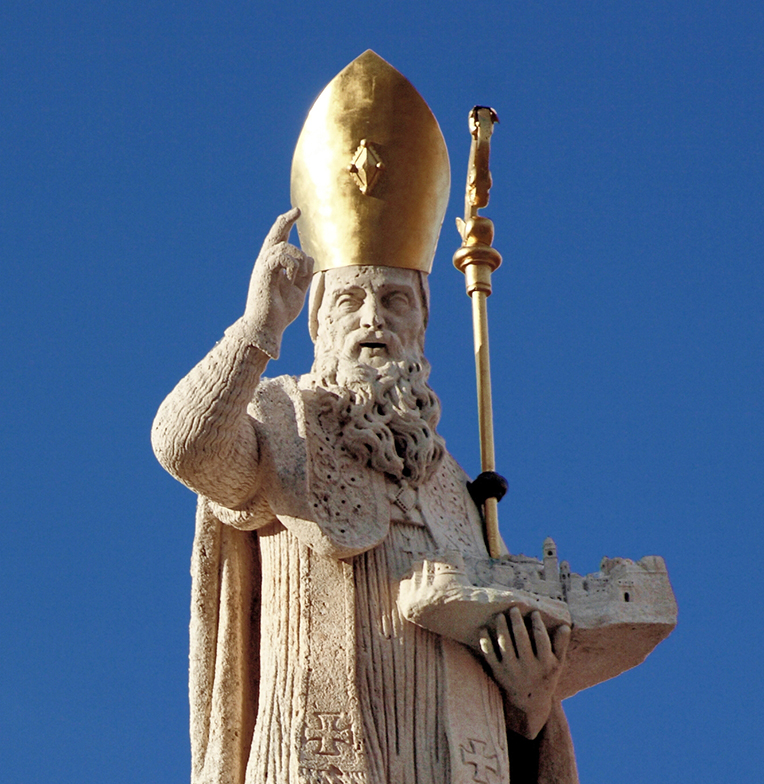
Many or most Catholics are familiar with the name Saint Blaise—a third-century physician, bishop and martyr—and the tradition of blessing throats on his feast day, but many do not know his story.
Saint Blaise lived in Lesser Armenia, in what is now Turkey. He is said to have been born to a wealthy family, becoming a physician noted for the treating of throat ailments. Saint Blaise was also known for healing animals. The first recorded accounts of Saint Blaise were found in the medical writings of Aëtius Amidenus, a fifth-century Byzantine Greek physician, who noted that Saint Blaise helped patients suffering from objects stuck in their throats. Over time, Saint Blaise became a “physician of souls,” retiring to a cave for prayer, where many came to him for healing miracles. According to legend, following the death of the bishop of Sebastea, Saint Blaise was made bishop by popular acclaim.
In 316 A.D., Agricola, the governor of Cappadocia and Lesser Armenia, persecuted Saint Blaise by the dictate of the Emperor Licinius. Much of what is known of Saint Blaise and his persecution and martyrdom come from writings 400 years after his death. One account states that while he was jailed by Agricola, a woman came to him with her son who was choking on a fish bone. Saint Blaise healed him immediately. Another account states that a poor woman visited him in prison with two fine wax candles, stating that a wolf had taken her pig. Saint Blaise ordered the wolf to return the pig unharmed to her owner. Still, the governor tried to make Saint Blaise renounce his faith—he had him beaten and his flesh subjected to iron combs. Eventually, the governor had Blaise beheaded.
Saint Blaise’s reputation grew over the following years. There was no known formal organization honoring him in the West until the eighth century, but his following grew through the Middle Ages. A 1625 “Book of Blessings” references an eighth-century practice of blessing throats, stemming from the stories of Saint Blaise—with candles often used in the blessing. Devotion to Saint Blaise has been found in Turkey, Italy, Germany, Croatia and Iceland—with churches and schools bearing his name. In the Youngstown Diocese, an Austintown parish bears his patronage. Saint Blaise is revered as the patron saint of infants, animals, builders, stonecutters, carvers, drapers, wool workers, the wool industry, veterinarians, physicians, healing, throats, the sick, and ear, nose and throat ailments.