In 1951, the Bishop James A. McFadden published The March of the Eucharist from Dungannon. Among its interesting sections is one simply called “The Diocese of Youngstown,” an account of the progress of the new diocese in the eight years since it had been established. What follows is an extract from the 1951 publication, and a brief update on the ensuing 74 years.
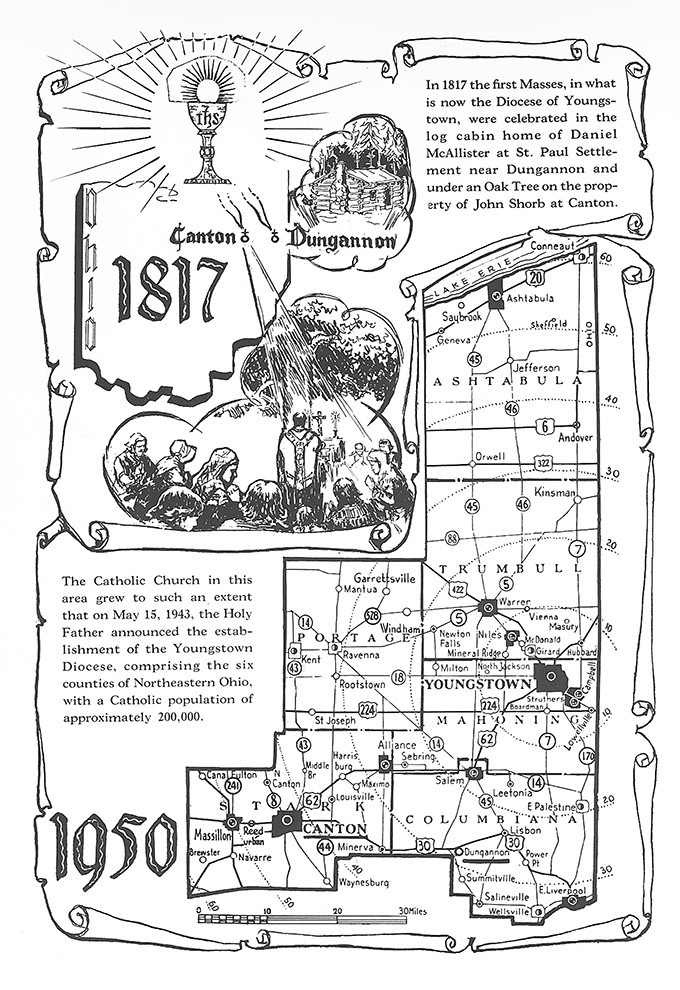
The Holy Years 1825 to 1950
beautiful characteristic in the lives of the Catholic pioneers in America was their ardent desire to promote the March of the Eucharist in this new wilderness country which was to become their future home. With the deep abiding faith of their ancestors, they were confident that Christ, the Light of the World, would guide them to the good lands in the new world where they could settle, build their homes and rear their families in the love and fear of God.
A group of these vigorous God-fearing pioneer men and women landed on our shores and, after many, many sacrifices, privations and dangers, found their way through the dense forests to Northeastern Ohio, now Columbiana and Stark Counties, in the Diocese of Youngstown. Here they knew they had found their promised land, and decided to call the new settlement Saint Paul, in honor of the great Apostle of the Gentiles.
Days of dark despair and bitter disappointment lay ahead. Disease, poverty and death stalked them in the woods of Ohio and almost destroyed the flock so full of zeal to perpetuate the faith. As God willed it, missionaries found their way to these pious, humble people and ministered to them, sometimes beneath the blue dome of heaven, sometimes beneath the shade of a spreading oak or elm, but more often in the log houses of these settlers, whose undying love for their Catholic faith was an inspiration to the priests who worked among them.
We owe a debt of gratitude to the untiring efforts of the pioneer priests who laid the firm foundation of Catholicity in Northeastern Ohio. As we review the story of the hardships and crosses that these courageous men endured to blaze the trail, build the roads, erect churches and bring civilization to the wilderness; we cannot but be grateful for the blessings we enjoy as the fruit of their sacrifices.
The early missionaries understood the importance of unity in faith and discipline in Catholic life, and that the center and fountainhead of unity was Rome, where Peter’s successor ruled the flock of Christ. With true Catholic fervor they sought to bring home the faithful of this territory the blessings and indulgences graciously granted by His Holiness Pope Leo XII. We learn from a letter dated June 1, 1827, that Fathers Young and Mullon had traveled to Canton to join Bishop Fenwick, who was there to visit Father Hill, then seriously ill. From the same source, we note that the Bishop eagerly awaited the arrival of these two priests to join him in the celebration of the year of Jubilee in Saint John Church. The record tells how the people, with great zeal and piety, attended services twice daily in fulfillment of the wish of the Holy Father. These two missionary priests continued on to Saint Paul Parish in Columbiana County, now Saint Philip Neri Parish of Dungannon. On the way and at the request of well-disposed citizens, Father Mullon preached to a numerous and respectful audience in the Courthouse at Lisbon, breaking down the prejudice against Catholics and winning much good will.
All praise to these apostles of the wilderness, who left behind so many landmarks of religion which stand today as testimony of their achievement for the greater honor and glory of God. May we not see in the blessed March of the Eucharist in Northeastern Ohio, beginning at Saint Paul in Columbiana County and Saint John in Canton, a symbol of the blessed march of the faithful to Rome from every part of the world in their Holy Year of Jubilee?
In Rome, the pilgrims visit the four great major basilicas, Saint Peter’s, Saint Paul’s, Saint John’s and Saint Mary Major. As they confess their sins, do their words of penance and offer their prayers of praise and love to our Eucharistic Lord, Christ is enthroned anew in loving human hearts.
Now that, according to custom, the Holy Father extends the privilege of the Holy Year to all Catholics throughout the world, the faithful of the Diocese of Youngstown might well consider the inclusion of these historic churches of the Diocese in their Holy Year visitation.
Certainly many Catholics will joyously respond to the suggestion that they make their pilgrimage in quest of the Jubilee indulgences, first to their own parish churches, then to Saint Philip Neri in Dungannon and Saint John the Baptist in Canton, where the faith was first sown in the wilderness of Northeastern Ohio. Then let them bring their pilgrimage to an end at Sancta Clara Monastery, the latest triumph in the March of the Eucharist, where Christ is enthroned for adoration as our Eucharistic King.
Excerpt from The March of the Eucharist from Dungannon, 1951
If the pious Bishop Fenwick, the Apostle of Ohio, could return to the scenes of his early labors, his heart would be gladdened by the sight of the progress from the fruits of his labors in the March of the Eucharist, for within the diocese are the locales of the first Catholic parishes in the State of Ohio which Father Fenwick attended in the days of the covered wagon.
The fifth diocese of Ohio, the Diocese of Youngstown, was canonically erected on June 4, 1943, the announcement of which was made by the Holy Father at that time [Pope Pius XII]. On July 22, 1943, at an impressive ceremony attended by bishops, priests, religious and dignitaries from various parts of the country, His Excellency, the Most Reverend James A. McFadden was installed in the Cathedral Church, St. Columba, as the first Ordinary of the Diocese of Youngstown.
The three decrees necessary for the launching of the new See were read by Right Reverend Monsignor Walter Martin, pastor of Our Mother of Sorrows Church in Ashtabula. One came from his Excellency, Archbishop Amleto Giovanni Cicognani, Apostolic Delegate to the United States, directing his Excellency, Archbishop John McNicholas, O.P., to erect the new See. A second came from the Metropolitan, establishing the diocese; and a third from Archbishop Cicognani, directing Bishop McFadden to leave his duties in Cleveland to take charge of the Youngstown diocese.
The Diocese of Youngstown covers an area of 3,404 square miles embracing six counties: Stark, Columbiana, Mahoning, Portage, Trumbull and Ashtabula. It stretches to the Ohio River at its most southerly point and is washed by the waters of Lake Erie on the North. Each one of the counties constitutes a deanery. It encloses within its boundaries great steel-producing and manufacturing centers as well as rich agricultural territory.
Although hampered by conditions arising from the global war then raging, Bishop McFadden established his Youngstown offices in 1943 and proceeded with the arduous work of organizing the diocese. Since then, the Diocese of Youngstown has progressed rapidly. The project of completing the great Cathedral Square at West Wood and Elm Streets was furthered with the organization of a building campaign by Bishop McFadden in 1947.
Among the many Catholic institutions in the diocese are one hundred ten churches and missions and fifty-four parochial schools.
A new chapel and other improvements have been made at the Father Kane Camp for young boys and girls at Lake Milton. A one-hundred-acre tract at Saybrook on Lake Erie has been acquired for future development of youth activities.
During the seven years of its life God has blessed the Diocese of Youngstown with vocations to the priesthood. Forty-nine young men have been ordained and one hundred and eight are studying for the diocese in minor and major seminaries. The number of vocations to the Sisterhoods also would indicate the growing soundness of Catholic life in the diocese as well as special divine blessing.
St. Paul Monastery, near Canfield, was established by the Society of St. Paul, having been invited by Bishop McFadden. At the invitation of Bishop McFadden, the teaching Sisters of the Third Order of St. Francis came to Glenmary, a ten-acre tract of land in Youngstown, and established a convent in a building on the site. The Wick Mansion, also in Youngstown, was purchased and converted into a Motherhouse for the Ursuline Sisters. Twelve Italian Oblate Sisters of the Sacred Heart were flown from Rome to establish a convent for charitable and apostolic work at McDonald.
The diocese provides religious education at Youngstown College, where instruction is given by Father Joseph Lucas, M.A., S.T.L. and Father Arthur DeCrane, Counsellor to Catholic students.
At Hiram College courses of religious instruction are given by Father John Lavelle.
In the Diocese of Youngstown there are three hospitals, St. Elizabeth Hospital, Youngstown, conducted by the Sisters of the Holy Humility of Mary, with Father William Martin as chaplain; St. Joseph Riverside Hospital, Warren, conducted by the same community of Sisters, with Father Wenceslaus Vukonic as chaplain; and Mercy Hospital with its annex, Little Flower Hospital for Children, Canton, conducted by the Sisters of Charity of St. Augustine, with Father Paul McNally as chaplain. There are two schools of nursing, that of St. Elizabeth Hospital in Youngstown and the other of Mercy Hospital, Canton.
St. Joseph Hospital in Warren has built a new wing and made other improvements. A building fund drive for Mercy Hospital, Canton, has been successfully completed. A new School of Nursing at St. Elizabeth’s Hospital, Youngstown, was built and a campaign for funds for extensive improvements and expansion is well under way.
The diocese also provides chaplains for the Molly Stark Tuberculosis Sanitarium, Louisville, the Mahoning County Infirmary and the Youngstown Receiving Hospital, and the Massillon State Hospital, where Father Austin Scully is resident chaplain.
An apartment building adjoining the Cathedral property was purchased by the diocese and converted into a Catholic Action Center. The Center, providing beautiful and well-equipped conference rooms in the See City, is in constant use by more than forty Catholic Action groups of the Youngstown area. The Center has a well-kept library and reading room and Catholic bookstore which are conducted by the Pious Daughters of St. Paul.
During World War II the “homelike atmosphere” of the Catholic Action Center provided recreation and relaxation for the many service men stationed at nearby posts. More recently Catholic Action Centers have been established in Canton and Massillon.
Seven social service bureaus, each staffed by an executive secretary and trained social workers, do the field work of the Catholic Charities of the Diocese of Youngstown.
Calvary Cemetery, Youngstown, with Msgr. Joseph Trainor, V.F., as director, and Calvary Cemetery, Massillon, with Father Ferdinand A. Hartmann as director, are diocesan cemeteries, and there are numerous parish cemeteries.
Because of the unprecedented growth of the diocese, the Holy Father, on September 8, 1949, appointed the Most Reverend Emmet Walsh, Bishop of the Diocese of Charleston, South Carolina, the first Coadjutor Bishop of Youngstown. On November 10, 1949, Bishop Walsh was solemnly installed at St. Columba Cathedral. Since his installation, Bishop Walsh has endeared himself to the Catholics and non-Catholics of the Diocese.
The short time in which the Diocese has functioned and the fact that the Catholic population of the area has increased to approximately 200,000 are good reasons to view the future with optimism. The Diocese of Youngstown is now well established and is developing a vigorous Catholic life in opposition to the evil forces which would destroy our country, founded upon belief in God and reverence for His law. Its Catholic life began at St. Paul Settlement near Dungannon in 1817 and has flowered in the establishment of Sancta Clara Monastery, Shrine of the Perpetual Adoration at Canton, dedicated to Christ the King in the March of the Eucharist.
The March of the Eucharist, 1951 to 2025
By Joan Lawson, diocesan Chancellor and Archivist
Since 1951, The March of the Eucharist has indeed progressed throughout the six counties of the Diocese of Youngstown, though certainly in ways that could not have been predicted by those who witnessed the new diocese being formed. Numbers of Catholics and parishes are fewer than in those booming post-World War II years, yet the more than 100,000 faithful parishioners of our diocese continue to live a vibrant Eucharistic life, praying, celebrating Sacraments and practicing works of mercy and charity in a spirit of joy, peace, courage, hope and love.
In 1951, it was noted that there were 110 churches and missions, and 54 elementary schools. Today, there are 91 church and mission buildings in 70 parishes, and 22 elementary schools. In 1951, there were 200,000 Catholics; today, we number approximately 117,000.
The original The March of the Eucharist book noted that Bishop McFadden had undertaken improvements to “Cathedral Square” beginning in 1947. The cathedral at that time was a large stone church built in the Gothic style, begun in 1893 and, because of economic downturns, not completed until 1903. Inside, the enormous Gothic arches were lined with 1500 light bulbs, the flawless Carrara marble altar was 18 feet wide, and the organ boasted 26 pipes. A local newspaper editorial noted at its dedication that it “compared favorably with St. Patrick’s Cathedral in New York.” It was the third church that St. Columba Parish had built since 1847 for its ever-growing membership. Parishioners and the community were proud when it became the cathedral at the naming of the new diocese in 1943, necessitating the remodeling of the sanctuary to accommodate the bishop’s chair (the cathedra) and large ceremonial functions. The Cleveland Plain Dealer described it as “one of Ohio’s most beautiful buildings.” When it was destroyed by fire due to a lightning strike on September 2, 1954, the loss weighed heavily. Bishop Emmet Walsh, who had become Bishop of Youngstown in 1952 upon Bishop McFadden’s death, wrote, “Every Catholic in the Diocese of Youngstown was stricken to the heart by the destruction of St. Columba Cathedral … It was our Mother Church, the core and center of our common Catholic life.”
In the face of catastrophe, yet in a spirit of hope, the diocesan response was: “What flames have destroyed, faith will rebuild.” As Bishop Walsh raised funds to build the new cathedral, he reminded the faithful people of the diocese about earlier generations who accomplished so much because of “their sturdy faith, their soaring love of God, their profoundly Christian willingness to sacrifice.” The people responded generously, and the splendid new cathedral was dedicated on Sunday, April 12, 1959. It has since served and inspired countless thousands with its shimmering sixty-foot-high glass-tile mosaic of Mary, Queen of Heaven among angels and saints; its richly colored soaring windows; its Sacred Heart Chapel; and its simple yet majestic aluminum and bronze Stations of the Cross.
At the same time Bishop Walsh raised money for the new cathedral, he asked for funds “to enable our children to see the panorama of their future lives in the glorious light of their faith and to inspire them with a holy enthusiasm to be great Catholic men and women.” You will have noted in the 1951 account above that there were three high schools in the diocese. Because of Bishop Walsh’s leadership, by 1964 there were the six that we still rely on today, along with our elementary schools, to provide students and families with an educational experience that nurtures faith, inspires learning, fosters service, and builds leadership for building the kingdom of God.
Bishop Walsh had qualified help to build up Catholic education from the man who, in 1960, had been appointed Auxiliary Bishop under him, Youngstown native James Malone. In 1952, then Father Malone became Superintendent of Schools for the diocese, and in 1956 Director of Christine Doctrine, meaning supervision of religious education in parishes. In 1957, he earned his Ph.D. from the Catholic University of America with his dissertation on parochial elementary schools. Upon Bishop Walsh’s death in 1968, Father Malone became Bishop of Youngstown. He continued his care for religious education in schools and parishes, especially in promoting the proper formation and training of lay teachers and catechists, in addition to the vowed religious sisters and brothers who modeled and taught faith.
In the generations that have followed Bishop Malone’s leadership, parish catechetical leaders and volunteers have devoted themselves to a lifelong process of formation in faith, hope and love that shapes the mind, touches the heart and leads adults, youth and children to embrace Christ. Whether preparing people for Sacraments, studying the Bible, or leading in Works of Mercy, parish faith formation teams have devoted themselves to our faith and our people.
Bishop Malone was our longest-serving bishop so far, with eight years as auxiliary and 27 as Bishop of Youngstown. From 1962 to 1965 he attended every session of the Second Vatican Council in Rome. He served as president of the National Council of Catholic Bishops from 1983 to 1986—the first bishop who was not an archbishop or cardinal to do so. He oversaw a diocesan synod from 1977 to 1978, strengthened ecumenism throughout the diocese and initiated long-range plans that included recognition of a pending priest shortage. He retired in 1995 and died in 2000.
Bishop Thomas Tobin was Auxiliary Bishop of the Diocese of Pittsburgh from 1992 to 1995 before becoming Bishop of Youngstown in 1995. He led the diocese through a major capital campaign, “Today’s Sacrifice, Tomorrow’s Church.” He wrote two pastoral letters: The Eucharist: To Be Loved, To Be Lived: A Pastoral Letter on the Centrality of the Eucharist (1998), and The Sacrament of Reconciliation: To Receive Mercy and Favor: A Pastoral Letter on the Ministry of Forgiveness in the Church (2000). He left Youngstown in 2005 to become Bishop of Providence, Rhode Island, from which he retired in 2023.
Bishop George Murry, S.J., was Auxiliary Bishop of Chicago, then Bishop of Saint Thomas, U.S. Virgin Islands, before becoming Bishop of Youngstown in 2007. He wrote the pastoral letter Who Is My Neighbor: A Pastoral Letter on the Occasion of National Poverty Awareness Month (2012). He led the diocese through a Pastoral Plan for Evangelization, Trusting in Christ: A Call to Discipleship, calling for the regionalization and collaboration of parishes, schools and resources. He died in June of 2020.
Father David Bonnar of the Diocese of Pittsburgh was ordained bishop and installed as the sixth Bishop of Youngstown on January 12, 2021, at St. Columba Cathedral. He has enlivened the diocese through participation in the world-wide synod and the national Eucharistic Revival, regularly visiting parishes and schools throughout the six counties to lead celebrations, collaborations, liturgy and devotions, including Holy Hours. He has written three pastoral letters: Testify to the Light: Confronting Darkness with the Light of Jesus Christ (2021), Practicing Faith, Hope, and Love: Living the Virtues Together in Tough Times (2023), and Take Heart! Do Not Lose Heart! Behold the Sacred Heart! (2025).
During periods when the seat of the Bishop was vacant, Monsignor Robert Siffrin has administered the diocese, keeping a steady course through times of waiting.
Bishop William Hughes served as Auxiliary Bishop of Youngstown from 1974 to 1979. From Youngstown, he was ordained a priest by Bishop McFadden in 1946. He earned a master’s degree in education from the University of Notre Dame and went on to become the founding principal of Cardinal Mooney High School, then the Superintendent of Catholic Schools and Vicar for Education. He left the Diocese of Youngstown when he was named Bishop of Covington (Kentucky). He retired in 1995 and died in 2013 at age 91.
Benedict Franzetta, from East Liverpool, was ordained a priest in 1950, and a Bishop in 1980. He served the diocese as pastor, Vice-Chancellor, Chancellor, Vicar for Finance and Diocesan Treasurer, Director of Cemeteries, Vicar General and Auxiliary Bishop. He was instrumental in shaping how diocesan offices worked. He retired in 1996 and died in 2006.
Bishop McFadden ordained the first two priests of the new diocese in December of 1943, Father Ralph Friedrich and Father John Vasko. Father Friedrich, who lived to be ninety-four, served in parishes, hospitals and missions, and was among four other Diocese of Youngstown priests—along with thousands of non-violent laity and other clergy—who walked from Selma to Montgomery, Alabama, under the leadership of Dr. Martin Luther King in support of civil rights. Father Vasko served in parishes including St. Stephen of Hungary, Youngstown, from which he helped to resettle about 100 displaced persons from Hungary after World War II. He died at age 50 in 1968.
Bishop David J. Bonnar most recently ordained to the priesthood Father Travis Seagraves. He is serving as Parochial Vicar for Divine Mercy Parish, Massillon, and SS. Philip and James Parish, Canal Fulton. Between Fathers Friedrich and Vasko in 1943 and Father Seagraves in 2025 has been a long succession of faithful diocesan priests dedicated to their ministry and the people they serve.
The Diocese of Youngstown started a new chapter in its history in 1977 when permanent deacons became part of pastoral ministry. Men who are discerned for the ministry of Word, Liturgy and Charity, undertake intensive training before ordination. For close to fifty years, our permanent deacons have been ordained to be a sacramental sign of service to the Church and the world, in their outreach to the poor and the marginalized, and in their fostering of the Eucharistic communion of the Church. Our deacons live a life of service in the self-giving love of Christ.
The 1951 account above of Bishop McFadden’s invitations to the Society of Saint Paul, the teaching Sisters of the Third Order of Saint Francis and the Oblate Sisters of the Sacred Heart to minister in our diocese hints at the great importance of religious communities in our Eucharistic life together. Other religious orders have served faithfully through many generations, including the Benedictines, Claretians, Dominicans, Franciscans, Vincentians, Priestly Fraternity of Saint Peter, Adorers of the Blood of Christ, Brothers of Christian Instruction, Congregation of the Divine Spirit, Daughters of Charity, Missionaries of the Sacred Heart, Parish Visitors of Mary Immaculate, Poor Clare Nuns of Perpetual Adoration, Servants of the Holy Paraclete, Sisters of Charity of Saint Augustine, Sisters of Divine Providence, Sisters of the Holy Family of Nazareth, Sisters of the Holy Ghost, Sisters of the Humility of Mary, Sisters of Saint Joseph, Sisters of Saint Joseph of Saint Mark, Sisters of Notre Dame, Society of the Precious Blood and the Ursuline Sisters of Youngstown. Joining these countless faithful men and women in the March of the Eucharist in our diocese will be the Rogationist Fathers of the Heart of Jesus, invited by Bishop Bonnar this year to minister among us in Canton. This religious congregation of priests and brothers—in addition to the vows of poverty, chastity, and obedience—take as a fourth vow the pledge to pray for vocations.
The 1951 March of the Eucharist spoke of the Catholic Action Center near the cathedral and of the seven social service bureaus doing the work of the Gospel in the world. Catholic Charities was established by Bishop McFadden soon after the formation of the diocese to coordinate the social service efforts already present in five of the six counties. The Catholic Service League of Ashtabula County was added to complete the diocesan presence in each of the counties. Early priorities for Catholic Charities included child welfare, emergency services and family services. In 1999, the Diocese of Youngstown Catholic Charities Corporation (DOYCCC) was formed to strengthen the Catholic identity, structure and mission of the social service and housing organizations operating under the auspices of the Catholic Church. Today, the DOYCCC includes three affiliate social service agencies: Catholic Charities of Ashtabula County; Catholic Charities Serving Portage and Stark Counties; and Catholic Charities Regional Agency, serving Columbiana, Mahoning and Trumbull Counties. Each of these agencies collaborate to extend the love and compassion of Jesus Christ to those who are poor, vulnerable and without hope. Through essential assistance and other services, Catholic Charities affirms human dignity, meets basic human needs, strengthens families, builds communities and empowers others to transform their lives. Through the tireless efforts of Catholic Charities staff and volunteers, and the unending generosity of the people of our diocese who support them, the Eucharist is made tangible in the world.
Caring for the sick has always been part of the Christian life, and three hospitals noted in the 1951 The March of the Eucharist still undertake that work of mercy today, though organized differently. Mercy Medical Center in Canton is now a member of the Cleveland Clinic Health System, sponsored by the Sisters of Charity of Saint Augustine. Mercy Health operates those hospitals founded by the Sisters of the Humility of Mary, St. Elizabeth in Youngstown and St. Joseph in Warren, and has added the St. Elizabeth facility in Boardman. Our hospitals partner with schools of nursing at local universities to meet the growing demand for quality, compassionate health care professionals.
Burying the dead—another work of mercy—is a vital part of ministry in the diocese. In 1951, there were two diocesan cemeteries: Calvary in Youngstown and Calvary in Massillon. Today, besides those two venerable graveyards, the diocese also provides sacred and dignified burial at All Souls Cemetery in Cortland and Resurrection Cemetery in Austintown—all four operated by Catholic Funeral and Cemetery Services. In addition, our parishes provide perpetual care at thirty-one separate cemeteries, giving comfort to those who mourn.
Eucharist is God’s gift to us. We have celebrated this mystery of Christ’s death and resurrection for 2000 years, and while the mystery remains eternal, the way we celebrate it takes place in specific times and places. The language, clothing, postures and rhythms have changed from generation to generation, from 1817 when our first parishes formed, to 1943 when our diocese was established, to 1951 when we first published the March of the Eucharist, until now as we pause, reflect and update our understanding of our needs, accomplishments and responsibilities. What remains constant throughout is our love of Christ and our desire as a Eucharistic community to proclaim the joy of the Gospel, and to grow together in faith, hope and love.