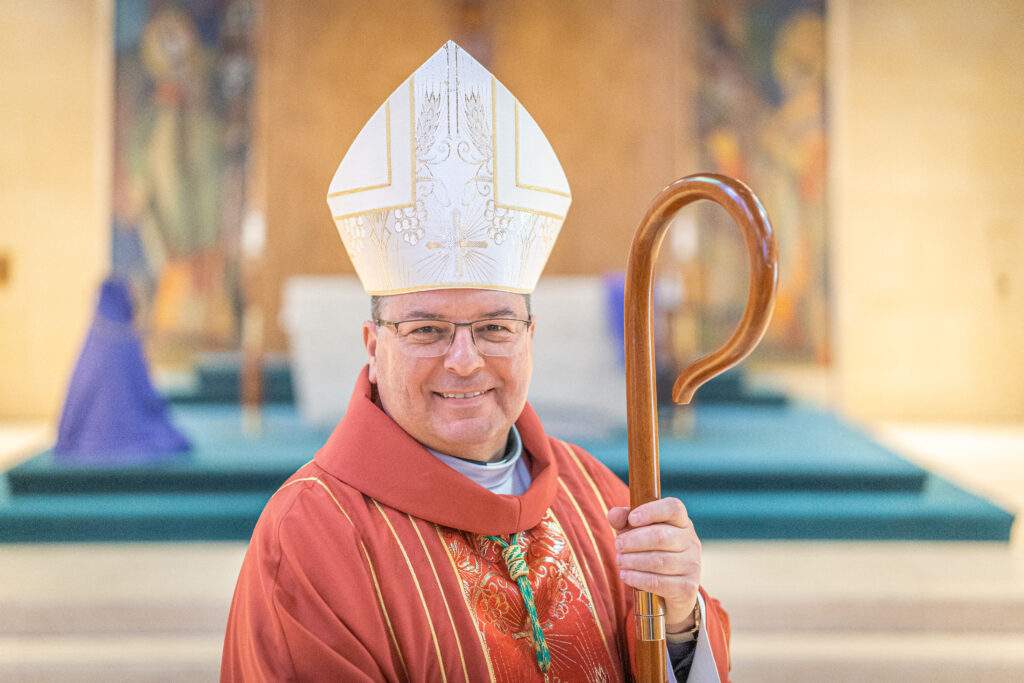
When I was a pastor, I remember welcoming a young seminarian to the parish for a summer assignment. It happened that he had a deep devotion to Saint Michael the Archangel. He even brought a statue of this great protector and placed it on the dresser in his room. One day he came to me with great concern because the statue was not in its ordinary place. He wondered how it could have moved. When I told him the housekeeper cleaned his room that day and probably failed to move it back to its original place after dusting, we each had a hearty laugh. But the takeaway for me was that this young man frequently looked at this saintly image and valued it immensely.
Since becoming bishop nearly four years ago, I am much more attuned to the saints, and have encountered them in various ways.
The first was the day of my episcopal ordination when, as I lay prostrate on the sanctuary floor, the Litany of Saints was sung. With the mentioning of every name, I begged for help and grace as I began this journey into the unknown. Every ordination that I have celebrated as bishop has deepened this relationship with the saints because the Litany of Saints is sung and prayed as part of the ritual. In a span of nearly 35 days this summer, I celebrated three final professions of vows for three women religious. The Litany of Saints is also part of this ritual.
I hear the echo of this same Litany during the celebration of the Sacrament of Confirmation. As the candidates present themselves to me, along with their sponsors, I say their confirmation name and ask God to seal them with the gift of the Holy Spirit. From person to person, and parish to parish, the mentioning of these names representing holy men and women canonized by Holy Mother Church is like a beautiful prayer seeking their inspiration and intercession—not just on the candidate, but for the Church as well.
Recently, I had to give a saintly name to my new chapel in my home. I chose Saint John Vianney, the patron saint of parish priests. And thanks to the kindness of the late Father Stephen Popovich’s family, his altar and ambo are in my private chapel, and our diocesan archivist, Joan Lawson, was able to secure a relic of Saint John Vianney, which was placed in the altar.
Throughout the liturgical year, we celebrate the lives of various saints by telling their stories once again and seeking their intercession. At every Holy Mass, as part of the conclusion of the Preface preceding the Holy, Holy, Holy, the celebrant calls upon the saints to join us in giving praise to God. Heaven and earth are filled with the glory of God.
Another way people become more familiar with saints is through pilgrimages. It was my honor to encounter the patronal saint of our diocese, Saint Columba, during a pilgrimage a year ago to his shrine on the Island of Iona, in Scotland.
As bishop, I also encounter the saints anew during the merger process, as each parish submits potential names for their newly merged community that signifies their new identity, while the churches involved retain their saintly name. In fact, every church and religious community I visit in the diocese has some connection to a saint—and so do many parishioners who bear saints’ names.
And finally, I am now part of an effort begun by my predecessor to pray for the beatification of one of our own, Rhoda Wise, servant of God. I pray to her every day seeking an increase of vocations for our diocese. But I also pray that we might all answer the call to sainthood by embracing holiness.
Pope Francis once said, “To be saints is not a privilege for a few, but a vocation for everyone.” As we stand on the threshold of the Solemnity of All Saints next month, let us be grateful for these holy men and women and seek to grow in our appreciation and relationship with them. I encourage you to adopt a saint as your special patron. Place an image of them nearby, and pray to them especially as we all aspire to become saints with the help of God’s grace.
Saints of God, pray for us!
Cuando era un párroco, recuerdo haberle dado la bienvenida a un joven seminarista en la parroquia para una asignación de verano. Sucedió que él tenía una profunda devoción a San Miguel Arcángel. Incluso trajo una estatua de este gran protector y la colocó sobre la cómoda de su habitación. Un día vino a verme muy preocupado porque la estatua no estaba en su lugar de costumbre. Se preguntó cómo podría haberse movido. Cuando le dije que la señora de la limpieza había limpiado su habitación ese día y que probablemente no la había vuelto a colocar en su lugar original después de quitarle el polvo, todos nos reímos mucho. Pero la conclusión para mí fue que este joven miraba con frecuencia esta santa imagen y la valoraba inmensamente.
Desde que me convertí en obispo hace casi cuatro años, me he sintonizado mucho más con los santos, encontrándolos de diversas maneras.
La primera fue el día de mi ordenación episcopal cuando, mientras yacía postrado en el suelo del santuario, se cantó la Letanía de los Santos. Al mencionar cada nombre, rogué por ayuda y gracia al comenzar este viaje hacia lo desconocido. Cada ordenación que he celebrado como obispo ha profundizado esta relación con los santos porque la Letanía de los Santos se canta y reza como parte del ritual. En un lapso de casi 35 días este verano, celebré tres profesiones finales de votos para tres religiosas. La Letanía de los Santos también forma parte de este ritual.
Escucho el eco de esta misma Letanía durante la celebración del Sacramento de la Confirmación. Cuando los candidatos se presentan ante mí junto a su padrino, digo su nombre de confirmación y le pido a Dios que los selle con el don del Espíritu Santo. De persona en persona, y de parroquia en parroquia, la mención de estos nombres que representan a hombres y mujeres santos canonizados por la Santa Madre Iglesia es como una hermosa oración buscando su inspiración e intercesión, no solo por el candidato, sino también por la Iglesia.
Recientemente, tuve que darle un nombre santo a mi nueva capilla en mi hogar. Escogí a San Juan Vianney, el santo patrón de los párrocos. Y gracias a la amabilidad de la familia del fallecido Padre Stephen Popovich, su altar y su ambón se encuentran en mi capilla privada. Nuestra archivista diocesana, Joan Lawson, pudo conseguir entonces una reliquia de San Juan Vianney, que se encuentra en el altar.
A lo largo del año litúrgico, celebramos la vida de varios santos contando su historia una vez más y buscando su intercesión. En cada Santa Misa, como parte de la conclusión del Prefacio que precede al Santo, Santo, Santo, el celebrante llama a los santos a unirse a nosotros para alabar a Dios. El cielo y la tierra están llenos de la gloria de Dios.
Otra manera en que la gente se familiariza más con los santos es a través de las peregrinaciones. Fue un honor para mí encontrarme con el santo patrón de nuestra diócesis, San Columba, durante una peregrinación a su santuario en la isla de Iona, en Escocia, hace un año.
Como obispo, también me encontré nuevamente con los santos durante el proceso de unificación, cuando cada parroquia presenta posibles nombres para su comunidad recién unificada que significan su nueva identidad, mientras que las iglesias involucradas conservan su nombre santo. De hecho, cada iglesia y comunidad religiosa que visito en la diócesis tiene alguna conexión con un santo, al igual que muchos feligreses que llevan nombres de santos.
Y finalmente, ahora soy parte de un esfuerzo iniciado por mi predecesor para orar por la beatificación de una de las nuestras, Rhoda Wise, sierva de Dios. A ella le rezo todos los días buscando un aumento de vocaciones para nuestra diócesis. Pero también oro para que todos podamos responder al llamado a la santidad abrazando lo sagrado.
El Papa Francisco una vez dijo, “Ser santos no es un privilegio de pocos, sino una vocación de todos.” Al acercarnos al umbral de la Solemnidad de Todos los Santos el próximo mes, estemos agradecidos por estos santos hombres y mujeres y busquemos crecer en nuestro aprecio y relación con ellos. Los animo a adoptar a un santo como su patrón especial. Coloquen una imagen de ellos cerca y órenles, especialmente porque todos aspiramos a convertirnos en santos con la ayuda de la gracia de Dios.
¡Santos de Dios, oren por nosotros!