Cemeteries as we know them today are a more recent phenomenon than may be expected. While nearly all civilizations throughout history have practiced some sort of burial ritual, much of the time bodies were inhumated—placed directly in the ground or only covered with a shroud—in mass burial sites, catacombs or ossuaries. The earliest known communal grave site is in the Taforalt cave in Morocco, where at least 34 paleolithic individuals were buried approximately 15,000 years ago.
In seventh-century Europe, the growth of Christianity precipitated a change in funeral customs, with the dead being placed to rest in church graveyards. Early Christian burial practices were rooted in Jewish-culture burial rites, which consisted of washing the body, wrapping it in linen and placing it in a tomb. Over the centuries, this evolved into burying the dead in consecrated Church graveyards.
Churchyard burials persisted until the early 19th century. Due to the population growth of cities during the Industrial Revolution and the huge number of burials often due to continued outbreaks of infectious diseases, new cemeteries were built in larger areas away from population centers. Thus, the rural cemetery—a large plot of land designed for burials on the outskirts of a city—was born.
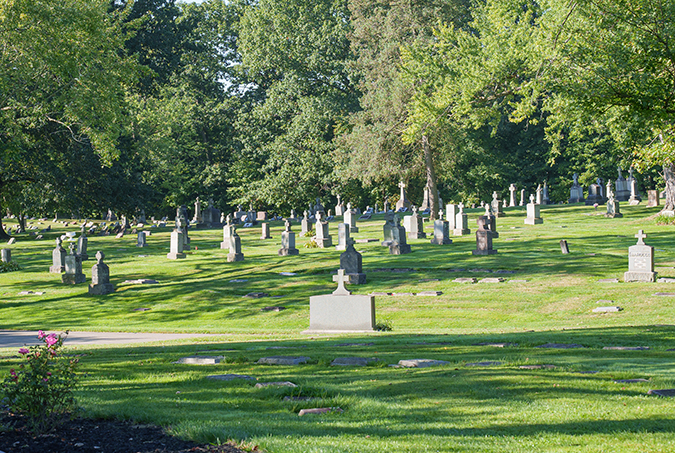
The construction of the first rural cemetery in the United States—Mount Auburn Cemetery in Massachusetts—in 1831, led to a proliferation of dozens of other similarly constructed cemeteries across both the United States and Europe. People began burying loved ones at these elaborate, well-maintained sites, rather than on small, family plots on private land. Before public parks became commonplace in the United States, these rural cemeteries were popular sites for public gatherings and recreation.
The same shift occurred in Western Europe with the opening of the Père Lachaise Cemetery in Paris. Rural cemeteries featured added roads and paths, plantings of hundreds of both native and exotic plants, and the retention of natural features such as ponds, hills and old-growth forests, in addition to the obelisks, mausoleums and sculptures of the gravesites.
Despite their immediate popularity for recreation, rural cemeteries gave way to public urban parks in the 1860s, though these new spaces were certainly inspired by the cemeteries.
Due to the incredibly high death toll of the Civil War and the need to preserve bodies until they could be moved to their places of rest, embalming became a commonplace burial practice, giving birth to the modern funeral industry. This decreased the need for the rural cemetery, as they were no longer necessary to control the negative impact of untreated decomposing bodies in urban centers.
However, the legacy of the rural cemetery is still seen in our Catholic cemeteries today. Due to their myriad benefits, bishops began establishing official diocesan cemeteries in the mid-19th century to serve groupings of regional parishes. In the early 20th century, diocesan cemeteries began guaranteeing perpetual care of the land and gravesites, while the Catholic Cemetery Conference—founded in 1949 after the end of World War II—worked to standardize diocesan cemetery practices throughout the country, with an emphasis on handling the deceased with respect and creating settings that were not only visually pleasant, but spiritually significant. According to the Catholic Cemetery Conference (CCC), their guiding principle is that “burial of the dead is one of the Corporal Works of Mercy.”
In the past, even our public rural cemeteries recognized the significance of caring for the earthly remains of the deceased and the protection of gravesites, as they are a place to acknowledge our spiritual reality. Today, our Catholic cemeteries maintain the practice of honoring our dead and creating consecrated resting places, which recognize the journey of the soul into Heaven.