Christian Horror Movies: Are They A Thing?
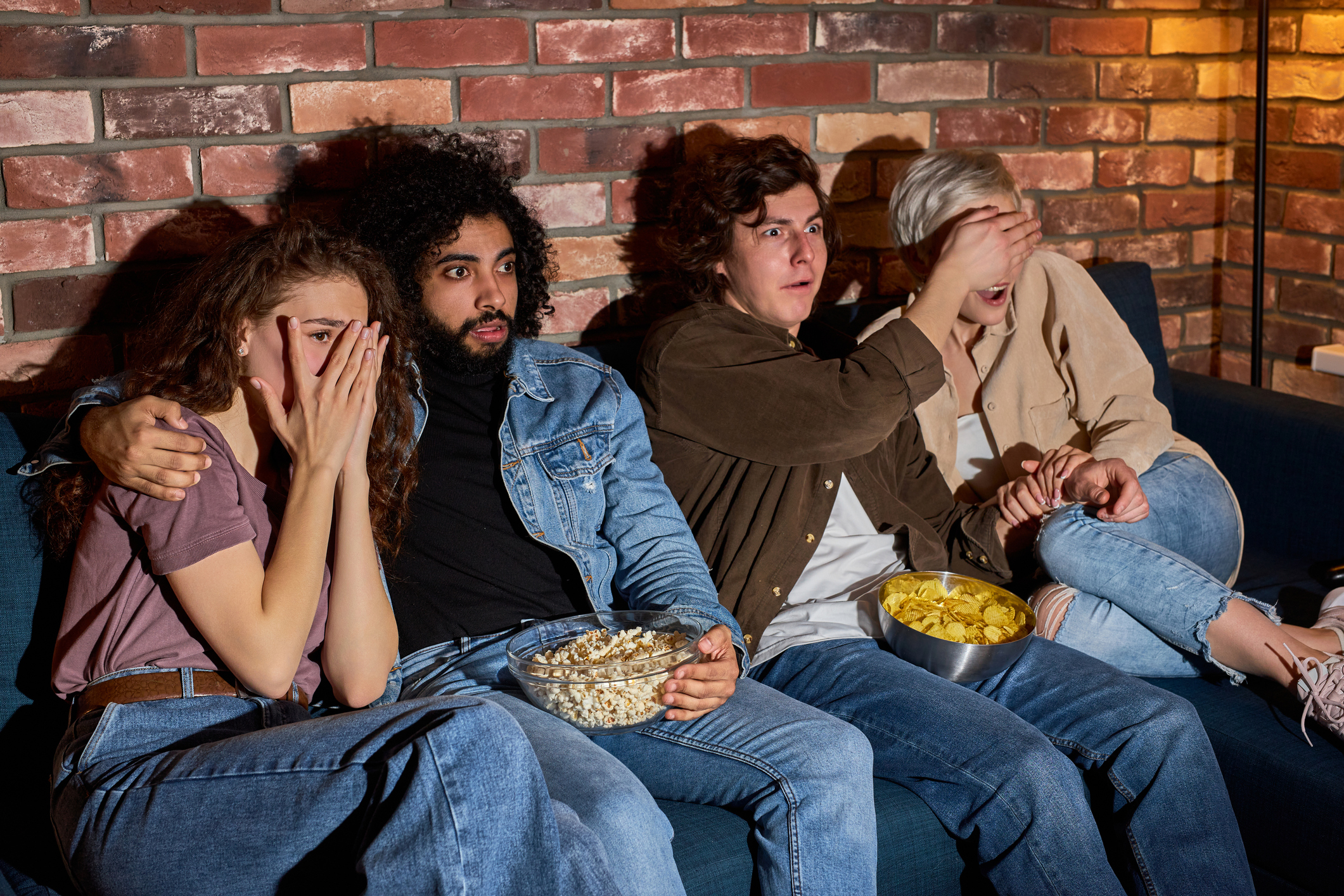
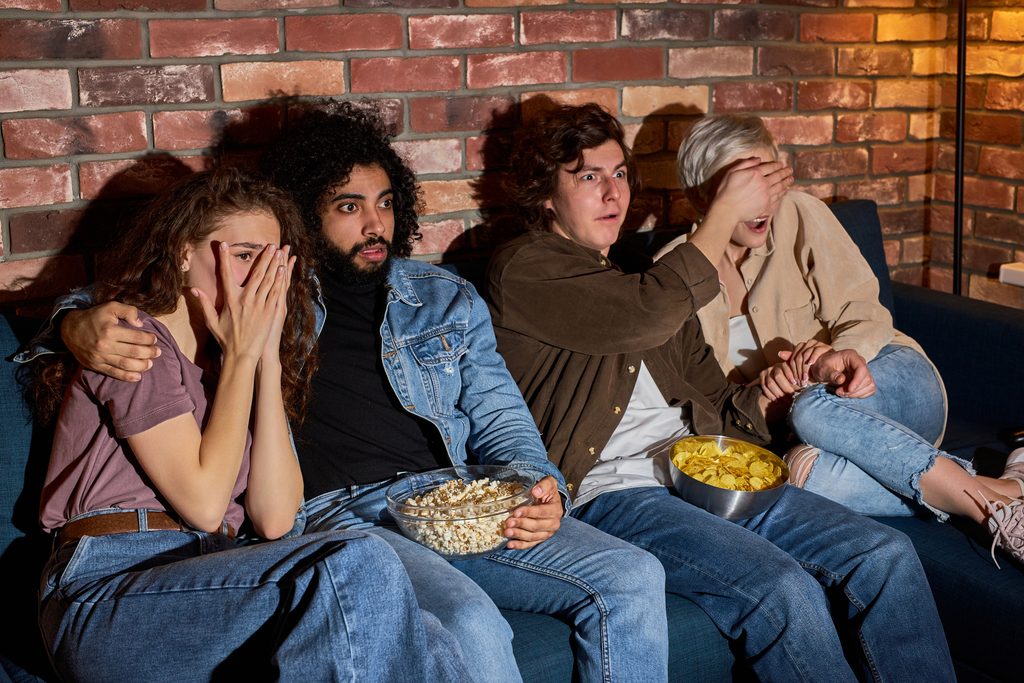
Horror films—you either love them or hate them. Right? Whenever I try to entice my wife to watch a scary movie, it usually means using up all my “I-pick-the-movie-tonight” chips for the whole month, unless it’s some kind of “slash-horror” film, like an action/horror, horror/comedy, or a crime thriller/horror (Silence of the Lambs, anyone?)
Why do some of us enjoy horror movies while others steer clear? For me, the best thing about fall is the opportunity to turn the lights down, grab a cup of tea, and indulge in some spooky entertainment. But then again, I also like sad movies. My wife, on the other hand, only wants to watch things that make her feel good. That’s understandable.
But why doesn’t she understand that being scared and sad do feel good? Alas, it’s just one of those things.
The fascination with the macabre may sound like something to be avoided, until you remember that many of our Protestant relatives levy that accusation against all Catholics; for example, with our preference for a crucifix rather than a simple cross, our veneration of saintly relics, and the use of bones in certain crypts, ossuaries and churches around the world.
While some may see the attraction as a temptation towards the occult, allow me to present a counterargument: horror films are in fact the one film genre capable of dealing with the entire range of human experiences—therefore, they are the truest representation of Christianity in film.
At the end of the day, we are engaged in a spiritual conflict between the forces of light and darkness. Can any other genre paint that as plainly as horror? And if no other genre can portray darkness so truthfully, can any other portray the light better?
The Difference Between Horror Movies and Christian Horror Movies
I’m not saying that every horror film is Christian at its core. What I’m saying is that the best horror movies are ones which depict the struggle against good and evil most honestly. And any honest discussion of good versus evil must essentially be Christian. Fear, dread, and evil are facts of life—the meaning we glean from these encounters and how we overcome them should be represented in art. These are what I refer to as “Christian horror movies.”
An important note: there is a difference in depicting evil honestly and glorifying it. There are films out there with the express intention of representing darkness as alluring, and we would do well to avoid them. However, I would also say that they do not follow my rule above, which is that films of this nature do not depict good and evil honestly.
For example, C.S. Lewis’ masterpiece of spiritual literature The Screwtape Letters consists entirely of two demonic tempters exchanging letters on how to better undermine humanity. Yet it is very often one of the first books a Christian reader will recommend to you—the content alone is not what makes a work of art either sinful or virtuous. What matters is what the artist is saying about these events.
As in Screwtape Letters, Lewis’ engagement with darkness serves to better prepare us for the spiritual adversity we will face in our lives, and reminds us that God is ultimately stronger than those who seek our ruin. We should be scared of the darkness—because in truth the darkness wants us to convince ourselves there’s nothing to be afraid of.
In order to be worthy of my recommendation as a Christian horror movie, a film must 1) treat its subject matter seriously; 2) must serve some instructive purpose; 3) must demonstrate that God is more powerful than the devil; 4) must leave the viewer feeling uplifted.
So, if you want to enjoy the Halloween festivities with some spooky movies, here are some thought-provoking recommendations that I feel still accentuate Christian themes and glorify God.
The Exorcism of Emily Rose, Scott Derrickson, 2005
Rating: PG-13 (intense and frightening sequences, disturbing images)
This film’s PG-13 rating had me turning it on at the technically permissible but personally not recommended age of—you guessed it, thirteen. It scared me so much that I turned it off, only for me to discover that I loved it years later when I was feeling more courageous.
Part courtroom drama and part exorcism picture, The Exorcism of Emily Rose (based on the real story of Anneliese Michel) adds to the familiar equation the question of what it means to be faithful in a secular age. The best thing about this film is its sincerity. All too often, filmmakers smirk at people of faith by depicting us as ignorant—but that’s not so in this film. Both the titular character and her parish priest, played by Jennifer Carpenter and Tom Wilkinson, respectively, are represented as pious, devout, and intelligent.
When Wilkinson’s Father Moore is prosecuted for his role in Emily’s exorcism and its consequences, the film demonstrates the devil’s desire to obfuscate the truth—a reality that corresponds to a sentiment from The Screwtape Letters, in which the tempters of Hell describe the need not to argue against the Gospel openly, but merely to distract their victims from ever considering it. It’s an important reminder for us to bring the light of the Gospel wherever there is darkness—no matter if a secular society will judge us for it.
Perhaps the best point of discussion as a piece of Catholic art comes from the ending, so quick spoiler warning…
3…
2…
1…
Okay, if you’re still hear I’ll assume you’re fine with me discussing the ending.
When the jury finds Father Moore guilty of Emily Rose’s death, but recommends a sentence of time served, his lawyer considers this a victory. But Father Moore is disappointed. For him, failing to sufficiently convince the world of the reality of Emily’s possession is a failure, his own freedom being a secondary, even trivial concern.
However, despite feeling that the trial was ultimately a failure, the end credits reveal that, in the real story upon which the movie is based, Anneliese Michel’s gravesite became a place of pilgrimage for many Catholics and others who were inspired by her resilience and unwavering faith.
Father Moore’s self-sacrificing mentality, Emily’s persevering faith, and the ultimate impact of Anneliese’s legacy entrench this film as an excellent example of what I consider a Christian horror movie.
The scares are genuinely frightening, so I would say this is on the more mature side of a PG-13 flick, but there’s a level of restraint when compared to something like The Exorcist (which is still a masterpiece, in my opinion) which wants to revolt the viewer. Whether that is a valid goal is up for debate, but is just as concerned with drama as it is with scares, so there’s plenty here to dig in to.
Signs, M. Night Shyamalan, 2002
Rating: PG-13 (occasional profanity, suspense, violence)
This may be the most polarizing movie on this list. I, however, absolutely love this movie and will defend it until my last breath.
Yes, it’s full of many of the Shyamalan-isms that make some of his other films unbearable (The Happening, The Last Airbender, etc), like occasionally bizarre dialogue and some stiff performances. Mel Gibson, though, turns in an impeccable performance as Graham Hess, a former Episcopal pastor whose wife was recently killed in a freak accident.
Hess is a mess, for lack of a better word. Angry at God for the apparent injustice of his wife’s death, he has turned away from preaching—though many of his former flock still call him ‘Father’, to his frustration. Thrust into the role of single parent, Hess is out of his depth, trying to take care of his young children with only his little brother—played by a thrilling Joaquin Phoenix—to help. As if the burden of grief and single parenthood was not enough, it just so happens that aliens decide to invade the planet at the same time, using mysterious crop circles on Hess’ farm to coordinate their movements. Could they be any more inconsiderate?
Although some Christian reviewers have criticized the depiction of Hess’ crumbling faith, I think they’re failing to take his arc into consideration as a whole. Yes, at periods of extreme duress, Hess angrily rejects God and prayer. However, do we not all fall into this trap? The fact that members of his former congregation keep calling him Father, with one even asking for a confession, shows us that God is still reaching out to him, tugging at him to return to the right path. Hess’ repudiations don’t sound like those of an atheist; they sound like those of a child whose parent took away his favorite toy.
To the child, it seems unfair. But when tragedy strikes in our own lives, we must ask ourselves—do we trust in God? The answer should of course be yes…but have you never missed the mark?
In one of the film’s most powerful scenes, Hess even lashes out in anger at God. But you don’t talk to that which you do not believe in, no?
By the end of the film, Hess has learned from his mistake. Even though he was a pastor, he still had much to learn about God’s Grace, His constant presence, and His unceasing calls to put our faith in Him. In the final shot, we see Hess back in the collar, with, we can assume, a stronger faith that no longer wavers based on how things are going in his personal life, but with a more profound trust that everything is as God wills it.
It’s a reminder that being a Christian requires that we deliberately place ourselves in a specific mindset—being a person who chooses to believe in providence rather than hardening our hearts and seeing both our good and bad fortune as mere “chance.”
Is it a dramatic representation? Yes, but that’s what makes it engaging and fun to think about. Signs is not just a lesson about having faith. It is a story about choosing to see God’s work in everything that happens to us—even the tragedies we can’t understand.
An interesting side note: a popular internet theory posits that the invaders are not really aliens, but demons. I’d recommend watching a video on this interpretation afterward—it may provide some fruitful material for conversations with teens.
The Nightmare Before Christmas, Henry Selick, 1993
Rating: PG (some scary images and mild thematic/fantasy elements)
This animated film is undeniably an all-time classic. Directed by Henry Selick, the painstaking claymation is jaw-droppingly gorgeous and full of visual gags that will have you and your kids laughing, while the songs are fun and memorable (though not as revolutionary as the visuals). My wife and I put it on for some innocent, spook-themed fun.
The story has a good heart that I believe is appropriate for elementary-aged kids, though if yours are sensitive to somewhat frightening images then steer clear. My two-year-old, on the other hand, is a certified Halloween diva apparently—she loves carrying around the little skeleton dog that my wife placed on our mailbox, delightedly asking me to make him chase after her. To each their own!
However, the problem with many Halloween-themed movies aimed at young kids is that by attempting to make the source material more appropriate, they often make ghosts, zombies, vampires and the like seem harmless and even approachable. Films that show them accurately as evil tend to be more mature and frightening. Although this does, in my opinion, make them more rooted in Christianity, I would not recommend movies such as Coraline, ParaNorman, and Corpse Bride, which, while popular, verge on glorifying the occult.
In The Nightmare Before Christmas, though, I feel there’s significant meat on the bone for fruitful spiritual conversations for you and your kids while remaining clear that this is clearly a realm of fantasy.
Jack Skellington, the Pumpkin King of Halloween Town, is responsible for running the spooky denizens’ annual Halloween celebrations. Unfortunately for him, his heart is no longer in it. He’s tired of only thinking about frights and yearns for something more warm, pleasant, and loving. When he accidentally wanders into Christmas Town, he is astounded by what he finds, leaping into song over the falling snow, the cozy fireplaces, the joyful decorations, and, of course, the presents.
He hatches a plan to “take over” Christmas this year and tries to get his whole town to join in planning the festivities. Unfortunately, his eagerness doesn’t translate to effective planning, and his designs go hilariously awry. He instructs some young accomplices to abduct “Sandy Claws” so that he can fill the jolly figure’s place in Christmas Town, but Jack’s vision for the holiday terrifies the locals—so much so that they shoot his sleigh sleigh (pulled by skeletal reindeer) out of the sky.
It is at this moment, when Jack’s plans have ended disastrously, that he realizes the vanity of his own ambition and embarks on a new mission to right his wrongs. Taken allegorically, Jack confronts his “sin” and seeks reconciliation with himself and in the world.
Moreover, what Jack learns from the experience is to not covet what others have—he acted pridefully, trying to take “Sandy Claws’” place for his own benefit, but realizes that not only has he let down the people who were depending on him, but ruined Christmas for everyone else too. It’s an important lesson on embracing God’s plan for our life instead of serving our own egos—instead of following our own impulses, we must ask for God’s guidance.
There are more subtle allusions to Christianity as well. Jack, as we are also so eager to do, initially becomes obsessed with the materialistic trappings of Christmas. But as he grows, he realizes that the “spirit” of Christmas is “invisible, but everywhere”, and that just because he can’t see something doesn’t mean he can’t believe in it.
Again, although The Nightmare Before Christmas is age-appropriate, its Christian symbolism is less overt and more sub-textual—but I still firmly believe it’s a Christian story at heart, as all good stories are.
The Lion, The Witch, and The Wardrobe, Andrew Adamson, 2005
Rating: PG (battle sequences and frightening moments)
While not necessarily a Halloween-themed film, Andrew Adamson’s 2005 adaptation of C.S. Lewis’ classic fantasy novel is full of monsters, the titular witch, and heaps of Christian symbolism. It certainly portrays evil as a very real force that must be confronted, just like some of the more mature films I recommended above, without being too frightening.
As you are probably aware, the story centers around the four Pevensie children who discover the magical realm of Narnia after passing through a wardrobe in the house they’re occupying for the summer.
Their arrival in Narnia breaks a long-standing stalemate for the land, a world trapped in an eternal winter “with no Christmas” thanks to the evil White Witch, Jadis. Taken as a metaphor for Christianity, Narnia is “dead in sin”, awaiting a Christ-like spiritual rebirth.
Jadis, who wants the Pevensie children for herself, tempts Edmund Pevensie with Turkish delight and separates him from his siblings. Edmund learns too late, however, that Jadis’ promises of power and luxury were contingent upon him betraying the other Pevensie children, and, in failing to do so, he is locked away.
The other Pevensie children make their way to Aslan, the leader of the resistance and Narnia’s true king. Together, they rescue Edmund, and when Jadis comes to parlay with Aslan, claiming that Edmund forfeited his life by signing a contract with her, Aslan sacrifices his own life instead. The witch is all too eager to accept, not realizing that there is a “deeper magic” which brings Aslan back to life and breaks the witch’s hold on Narnia and frees all the creatures she had imprisoned.
It’s a fun and well-made film based on a masterpiece of fiction from renowned Christian author C.S. Lewis—what is there not to love? The genre of fantasy epic proves fertile ground for Christian allegory, while the imaginative creatures and epic battles will be sure to hold your kids’ attention.
A Final Word on Christian Horror Movies
As I mentioned at the beginning, my love of (good) horror movies is because I feel that they are, ironically, the most real. Unlike any other genre, they cut to the core of the human experience and, for me, the Christian experience. No other genre presents the spiritual dimension of our reality so plainly, with stakes so high.
That said, if any of these films feel like too much for you or your family, then I hope you don’t feel pressured by me to indulge in something you wouldn’t enjoy. This is just meant to be a bit of festive fun that still represents our faith authentically.
Whether you watch or not, I wish you a happy Halloween and All Souls’ Day!
Find more news, events, and insights at The Catholic Echo.