The recent schism of the Society of Saint Pius X reminds us that obedience is only valuable when it costs something.
A Family Reunion
There’s one story I tell that I know might get me in trouble, depending on my audience. I understand why—it touches on some very sensitive topics, things considered virtues in our current age: agency, freedom, reproductive healthcare, and, most of all, license. The reaction can be downright vitriolic at times.
It most recently came up at a family reunion. I was speaking with my cousin, whom I love dearly but hadn’t seen in over ten years. It was her first time meeting my 21-month-old daughter—a princess, if ever there was one, as likely to show you favor as she is to give you the cold shoulder—and, as she bounced giggling between relatives, our conversation naturally turned towards whether my wife and I would have any more kids.
Natural Desires
I told her the truth: we are open to having more kids, but we simply don’t know if it’s possible. My wife and I had dealt with infertility before we had our daughter, and were told we had only around a one per cent chance of conceiving naturally.
At the time we were struggling to conceive, we were seeing an incredibly successful fertility doctor. He told us that we were looking at maybe an 18-month window, and advised that we immediately begin the process of in vitro fertilization.
Faced with dire circumstances and an intense desire for a child, my wife and I decided that we would go along with the treatment only if we only created as many embryos as we would be willing to implant. We thought that would balance respect for human life with our natural desire to have a child.
I knew that the Church was opposed to IVF, but what my wife and I desired was so natural and pure… I couldn’t see how it could be wrong.
Still, I wasn’t fully comfortable with it. I prayed to God and asked for His will to be done, whatever it was, and I told my wife that I wasn’t ready to give up trying naturally.
God heard my prayer.
When God Answered My Prayer
On the day we were set to begin the IVF process, we found out my wife was pregnant. This revelation came about two weeks after my prayer, a fact that still—and probably always will—gives me goosebumps.
I’m sure it doesn’t technically qualify as a miracle, but it was to us. God knew our desire and intervened in the most perfect way possible: revealing His love for us, showing us the value of prayer, reminding us of what comes from trusting Him, and protecting us from committing a sin.
Almost three years later, I now properly understand why the Church opposes IVF for multiple reasons: the destruction or freezing of embryos, the separation of conception from the marital act, and the commodification of human life (CCC 2373-2379).
But perhaps most central to all these teachings is that, by engaging in IVF, we are placing our will above God’s. The fact that it’s in service of a noble calling makes it all the more dangerous; the temptation feels righteous.
Having been on this journey, we are unwilling to go against God’s will—even though we want more children. And that’s what I told my cousin.
I know that’s easier for me to say now that I have a child, and I completely sympathize with anyone dealing with infertility. Looking back, I wish I’d had the maturity in my faith to fully trust Him.
My cousin is a very compassionate person, and I’m happy to say that her response was not vitriolic. She disagreed though, saying that we had to “make up our own minds” about IVF, and that, while she believes in a “creator”, she could never follow a formal religious moral law.
She couldn’t be a “follower”, she said.
Oh, but she is. And so are we all.
The Obedience of Faith
There is no such thing as an areligious human being. You either follow God, or you follow a composite religion in which you have made yourself god.
I didn’t think of that at the time, of course, and even if I had, I’m not sure I would have said it. As I mentioned, I hadn’t seen my cousin in over a decade and she’s important to me, so I didn’t want the conversation to get heated.
Still, I wanted to say something truthful about faith that would, with the Holy Spirit’s help, turn her towards God.
And so, I said “obedience is a good thing.”
The word “obedience” could not be any less appealing to a modern, secular person. It’s antithetical to our culture’s prime virtue: what Saint John Paul II recognized as not authentic freedom, but mere license.
If you want to submit to your faith, you are certainly free to do so, secularists believe, even if it would make you a backwards, incomprehensible luddite in their eyes. But what is utterly unacceptable is to give off even the faintest whiff that you have a problem with what anyone else is doing. Faith certainly shouldn’t come between anyone and their desires, after all.
But what value is a faith without sacrifice? If one’s “faith” allows them to do everything they desire, then it’s truly little more than a bedtime story meant to ward off our fear of death.
If pride is the original and greatest sin—as CS Lewis puts it, the “anti-God state of mind”—then obedience is the enactment of humility.
A Lesson from SSPX
In the weeks after this conversation, I knew I wanted to explore the idea of obedience more deeply. When news broke about the consecration and subsequent excommunication of the four “bishops” put forth by the Society of St. Pius X (SSPX), I realized that, while these events may seem unrelated at first, they revolve around the same principle: setting aside our own desires in deference to God’s will.
SSPX was founded after the Second Vatican Council by Archbishop Marcel Lefebvre to preserve older liturgical traditions. He and the four bishops he originally ordained were excommunicated, although that was rescinded in 2009 by Pope Benedict XVI, leaving them as “canonically irregular.”
Despite Rome’s repeated efforts at reconciliation, the society has remained in a tense standoff with the Papacy; a tension which, earlier this month, culminated in a new schism when SSPX superior Fr. Davide Pagliarani consecrated four bishops against the explicit direction of Pope Leo XIV, incurring automatic excommunication.
SSPX believes that it alone is upholding the true Catholic tradition. Yet apparently upholding that tradition does not extend as far as remaining obedient to the very Church whose traditions they claim to preserve.
Many within SSPX believe Vatican II weakened the Church and accelerated secularization. But truthfully, the cultural upheavals of the twentieth century were already transforming Western society as early as the 1940s—this video from Trent Horn for Catholic Answers goes into great depth on that front. So, while it may be tempting to blame Vatican II for the rise of secularism, the council was really the Church’s response to that upheaval rather than its cause.
When we see Vatican II not as a senseless demolition of tradition, but as a—possibly flawed—attempt to address ongoing societal trends, it becomes harder to justify rejecting its principles.
We Owe Obedience to Christ
The reason Catholics submit to the authority of Rome is not because we think our leaders have perfect judgment, but because we believe God has providentially guided the Church founded by Jesus Christ through the Holy Spirit, preserved through apostolic succession. Christian faith, as defined by the Catechism, is an ‘obedience of faith’ (CCC 143). Ultimately, we believe that Jesus has ordained this faith and leads it through the Holy Spirit, and it is to Jesus that our obedience is directed.
I don’t want it to sound like I’m not sympathetic towards SSPX practitioners, because I am. They deeply resonate with a certain type of liturgy, one that they should be allowed to practice, and I don’t agree with the Vatican’s current stance on the growth of the Latin Mass.
I myself am not enthusiastic about Masses featuring a rock band setup, with guitars or an electronic drum-set (shudder) making an audial appearance. In my opinion, I prefer an organ, a choir, and, God willing, some incense. It calms me, centers me, and puts my mind into a reflective, spiritual state.
However, if a contemporary Mass is the only one available, I will suck it up and go.
At the end of the day, I’m not there to satisfy my own preferences but to worship God. And I worship God through obedience to His will—which includes recognizing the authority of the Church. Even when our leaders make imperfect decisions, we can at least be sure that we are fostering our spiritual life by practicing the virtue of humility.
Why Authority Matters
Failing to be obedient to Rome, therefore, is to fall into pride.
It is to create a composite religion, where we choose to follow some of the Church’s ordinances, but draw the line when it costs us something too dear. It comes with the additional problem of questioning why I should be obedient to any bishop who himself cannot be obedient to the Pope. To quote the Catechism again, the Pope is ‘the perpetual and visible source and foundation of the unity both of the bishops and of the whole company of the faithful…the college or body of bishops has no authority unless united with the Roman Pontiff, Peter’s successor, as its head (CCC 882-883).’
Why does this matter? Well, why should I surrender the opportunity to have more children through IVF if my bishop cannot submit to the existence of the ordinary Mass?
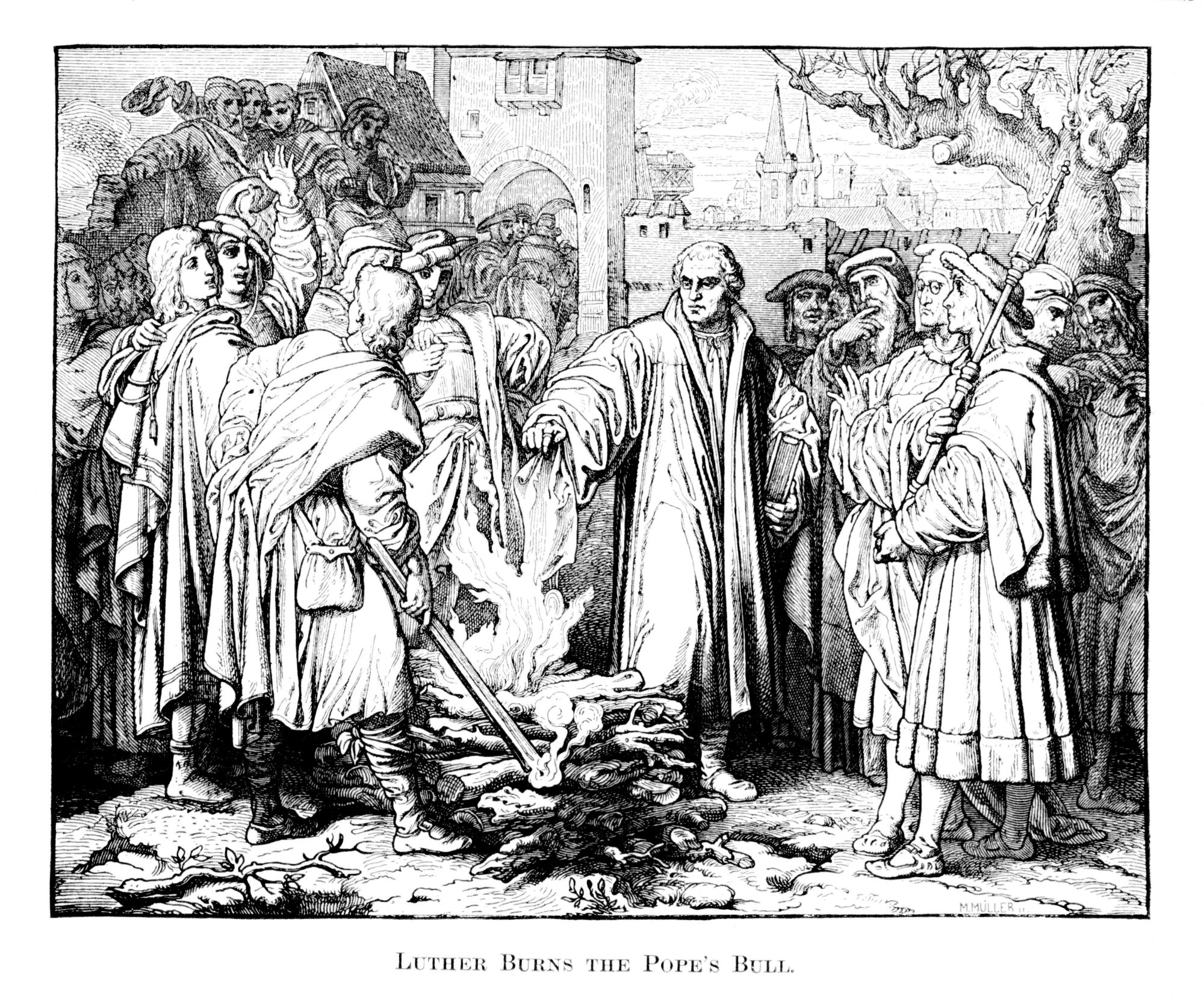
This very question is why there are now seemingly countless Protestant denominations. I doubt the continuous fracturing was Martin Luther’s intent when he nailed his Ninety-five Theses to the door. Unfortunately, once you’ve determined that your obedience is contingent upon your agreement with authority, there’s no end to the separations. Every individual becomes their own church.
As I was attempting to explain to my cousin, I can’t go along with that.
I know I’m certainly not trustworthy enough to establish my own church—me, with all my flaws, pride, and sinfulness. If I merely followed my own conscience, I’d probably end up with an individual religion based entirely on giving myself whatever I want. Especially if I thought those desires were noble, like using IVF to have more children.
Christ’s Example of Obedience
While there may be many Vatican II-era changes that rub you the wrong way, Church history is measured in centuries. We are rarely in a position to judge the ultimate outcomes of ecclesial reforms within our lifetimes.
Therefore, our duty is to practice the virtue of obedience, remain in communion with Rome, and trust in God’s divine plan. The Church has endured for 2,000 years through the sublimation of many human wills to God’s will.
Change is scary, but sometimes warranted. Time will tell regarding Vatican II.
Obedience, on the other hand, is an absolute. As Jesus says in Matthew 5:46-48: “If you love those who love you, what reward will you get? Are not even the tax collectors doing that? And if you greet only your own people, what are you doing more than others? Do not even pagans do that? Be perfect, therefore, as your heavenly Father is perfect.”
The same can be said of obedience. What value is obedience if it is given only when we are comfortable with its demands?
Jesus was obedient to God and entered into His Passion willingly—not because He had no fear, but because He loved us. As St. Paul wrote: “He humbled himself, becoming obedient to the point of death, even death on a cross (Philippians 2:8).”
Perhaps it would be a good exercise for all of us to see our obedience to God’s will as an act of love, whether that is accepting the Church’s teaching on IVF or remaining in communion with Rome even when we disagree. These are small ways in which we can imitate Christ’s humility—which was enacted through His obedience.
When Honoring Tradition Becomes Division
I’m sure SSPX believes their desires are just. My fear, though, is that by schisming over liturgical preferences, SSPX has scandalized the entire Catholic community, causing their brothers and sisters in Christ to question themselves and each other.
Is the family you know who prefers a more traditional liturgy secretly schismatic? Am I the wrong sort of Catholic because I don’t like the traditional Mass?
SSPX is doing exactly what they don’t want done to them—they are saying that there’s one true liturgy, and it’s their own. You cannot beg for tolerance with one hand and with the other cut divisions in the Church between the “true” adherents and everyone else.
If you think I’m being hyperbolic, I’m not. According to SSPX’s website, they claim: “The correct definition of evil—lack of a due good—clearly shows that the New Mass is evil in and of itself regardless of the circumstances. It is not evil by positive profession of heresy. It is evil by lacking what Catholic dogma should profess: the True Sacrifice, the Real Presence, the ministerial priesthood.”
That is a fairly extreme statement. They’re not simply saying they are committed to celebrating a traditional Latin Mass—they are calling into question the validity of the ordinary Mass.
This also goes against Church teachings that the sacraments are “guaranteed” by Christ. It is not a spell that is somehow invalidated if, for example, the priest accidentally misspeaks while performing the sacrament. Nor does it depend on the righteousness of either the minister or the recipient. According to the Catechism, “From the moment that a sacrament is celebrated in accordance with the intention of the Church, the power of Christ and his Spirit acts in and through it, independently of the personal holiness of the minister,” (CCC 1128).
A Prayer for Unity
The path to reconciliation is not clear. For those who have attended SSPX services in the past and do not want to be in schism with the Church, the procedure is fairly simple: all you must do is “approach ‘a priest in full communion, with the decision not to attend the Priestly Fraternity of Saint Pius X in the future.’” But for the entire SSPX community, it’s hard to see how the group can come back into communion with the Church without a definitive dissolution.
My hope is that adherents to SSPX are brought back into full communion with the Church, and that the Vatican works to find an outcome that restores unity while allowing those who enjoy a traditional liturgy to do so. Perhaps all we as ordinary Catholics can do is to ask ourselves, whenever we feel inclined towards disobedience, whether pride is preying on us.
In the aftermath of these events, let us pray for the future of the Church, for those on both sides of this rift, and for the entire human race to embrace Jesus Christ as their Lord and Savior.
Find more news, events, and insights at The Catholic Echo.